
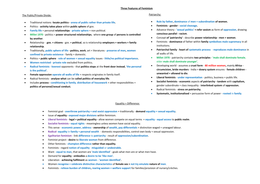
Three Features of Feminism
The Public/Private Divide: Patriarchy:
Traditional notions -locate politics - arena of public rather than private life. Rule by father, dominance of men + subordination of women.
Politics - activity takes place within public sphere of gov. Feminists - gender - social cleavage.
Family life + personal relationships - private sphere + non political. Advance theory - 'sexual politics' + refer sexism as form of oppression, drawing
Millet 1970 - politics = power structured relationships, where one group of persons is controlled conscious parallel - racism.
by another. Concept of 'patriarchy' - describe power relationship - men + women.
Relationship - gov. + citizens - gov. = political, so is relationship employers + workers + family Feminists - dominance of father within family symbolises male supremacy in all
relationship. institutions.
Traditionally, public sphere of life - politics, work, art + literatures - preserve of men, women Patriarchal family - heart of systematic process - reproduces male dominance in
confined to private existence - family + domestic. all walks of life.
Politics = public sphere - role of women + sexual equality issues - little/no political importance. Millet 1970 - patriarchy contains two principles - 'male shall dominate female,
Women restricted - private role excluded from politics. elder male shall dominate younger'.
Radical feminists - keenest opponents - that politics stops at the front door instead, 'the personal Developing world - assumes a cruel form - 80 million women, mainly Africa -
is the political'. circumcision, bride murders - India + dowry system ensures - female children -
Female oppression operate all walks of life + respects originates in family itself. unwanted + allowed to die.
Radical feminists - analyse what can be called politics of everyday life. Liberal feminists - under representation - politics, business + public life.
Includes process - conditioning in family, distribution of housework + other responsibilities + Socialist feminists - economic aspects of patriarchy - tandem with capitalism,
politics of personal/sexual conduct. gender subordinate + class inequality - interlinked system of oppression.
Radical feminists - stress on patriarchy.
Systematic, institutionalised + persuasive form of power - rooted in family.
Equality + Difference:
Feminist goal - overthrow patriarchy + end sexist oppression + traditionally - demand equality + sexual equality.
Issue of equality - exposed major divisions within feminism.
Liberal feminists - legal + political equality - allow women compete on equal terms + equality - equal access to public realm.
Socialist feminists - equal rights - meaningless unless women have social equality.
This sense - economic power, address - ownership of wealth, pay differentials + distinction waged + unwaged labour.
Radical- equality in family + personal wealth - domestic responsibilities, control own body + sexual oppression.
Egalitarian feminism - link difference to patriarchy - result of oppression/subordination.
Feminist project - desire to liberate women from difference.
Other feminists - champion difference rather than equality.
Feminists - regard notion of equality - misguided or undesirable.
Want - equal to man, that women are 'male identified' - goals what men are or what men have.
Demand for equality - embodies a desire to be 'like men'.
Liberation - achieving fulfilment as women - 'women identified'.
Women recognise + celebrate distinctive characteristics of female sex + not try emulate nature of men.
Feminists - relieve burden of children, rearing women + welfare support for families/provision of nursery/crèches.
The Public/Private Divide: Patriarchy:
Traditional notions -locate politics - arena of public rather than private life. Rule by father, dominance of men + subordination of women.
Politics - activity takes place within public sphere of gov. Feminists - gender - social cleavage.
Family life + personal relationships - private sphere + non political. Advance theory - 'sexual politics' + refer sexism as form of oppression, drawing
Millet 1970 - politics = power structured relationships, where one group of persons is controlled conscious parallel - racism.
by another. Concept of 'patriarchy' - describe power relationship - men + women.
Relationship - gov. + citizens - gov. = political, so is relationship employers + workers + family Feminists - dominance of father within family symbolises male supremacy in all
relationship. institutions.
Traditionally, public sphere of life - politics, work, art + literatures - preserve of men, women Patriarchal family - heart of systematic process - reproduces male dominance in
confined to private existence - family + domestic. all walks of life.
Politics = public sphere - role of women + sexual equality issues - little/no political importance. Millet 1970 - patriarchy contains two principles - 'male shall dominate female,
Women restricted - private role excluded from politics. elder male shall dominate younger'.
Radical feminists - keenest opponents - that politics stops at the front door instead, 'the personal Developing world - assumes a cruel form - 80 million women, mainly Africa -
is the political'. circumcision, bride murders - India + dowry system ensures - female children -
Female oppression operate all walks of life + respects originates in family itself. unwanted + allowed to die.
Radical feminists - analyse what can be called politics of everyday life. Liberal feminists - under representation - politics, business + public life.
Includes process - conditioning in family, distribution of housework + other responsibilities + Socialist feminists - economic aspects of patriarchy - tandem with capitalism,
politics of personal/sexual conduct. gender subordinate + class inequality - interlinked system of oppression.
Radical feminists - stress on patriarchy.
Systematic, institutionalised + persuasive form of power - rooted in family.
Equality + Difference:
Feminist goal - overthrow patriarchy + end sexist oppression + traditionally - demand equality + sexual equality.
Issue of equality - exposed major divisions within feminism.
Liberal feminists - legal + political equality - allow women compete on equal terms + equality - equal access to public realm.
Socialist feminists - equal rights - meaningless unless women have social equality.
This sense - economic power, address - ownership of wealth, pay differentials + distinction waged + unwaged labour.
Radical- equality in family + personal wealth - domestic responsibilities, control own body + sexual oppression.
Egalitarian feminism - link difference to patriarchy - result of oppression/subordination.
Feminist project - desire to liberate women from difference.
Other feminists - champion difference rather than equality.
Feminists - regard notion of equality - misguided or undesirable.
Want - equal to man, that women are 'male identified' - goals what men are or what men have.
Demand for equality - embodies a desire to be 'like men'.
Liberation - achieving fulfilment as women - 'women identified'.
Women recognise + celebrate distinctive characteristics of female sex + not try emulate nature of men.
Feminists - relieve burden of children, rearing women + welfare support for families/provision of nursery/crèches.


