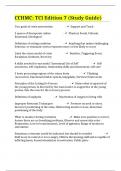
CCHMC: TCI Edition 7 (Study Guide)
Two goals of crisis intervention - ✔️ Support and Teach
5 spaces of therapeutic milieu - ✔️ Physical, Social, Cultural,
Emotional, Ideological
Definition of setting condition - ✔️ Anything that makes challenging
behavior, or traumatic stress responses more or less likely to occur
Label the stress model of crisis - ✔️ Baseline, Triggering Event,
Escalation, Outburst, Recovery
4 skills needed for successful "Intentional Use of Self" - ✔️ Self-
awareness, self-regulation, relationship skills and attunement, self-care
3 basic processing regions of the triune brain - ✔️ Thinking
(neocortex), Emotional (limbic system/amygdala), Survival (brain stem)
Principles of the Letting Go Process - ✔️ States what is expected of
the young person, Is directed by the team leader, Is supportive of the young
person, Sets the tone for the recovery process
Definition of asphyxia - ✔️ Deprivation of oxygen to living cells
Improper Restraint Techniques - ✔️ Pressure on neck or chest,
Incorrect positioning of the arms, Obstructing mouth or nose, Abnormal
positioning of the body
What to monitor during restraints - ✔️ Make sure position is correct,
Assure there are no breathing problems, Observe and assess skin color
Respiration, Level of consciousness, Level of agitation, Range of motion in
extremities
Situations a restraint would be indicated, but should be avoided - ✔️
Staff is not in control or is too angry, Child is threatening staff and is capable of
inflicting harm, Sexual stimulation is motivation, Public place
Two goals of crisis intervention - ✔️ Support and Teach
5 spaces of therapeutic milieu - ✔️ Physical, Social, Cultural,
Emotional, Ideological
Definition of setting condition - ✔️ Anything that makes challenging
behavior, or traumatic stress responses more or less likely to occur
Label the stress model of crisis - ✔️ Baseline, Triggering Event,
Escalation, Outburst, Recovery
4 skills needed for successful "Intentional Use of Self" - ✔️ Self-
awareness, self-regulation, relationship skills and attunement, self-care
3 basic processing regions of the triune brain - ✔️ Thinking
(neocortex), Emotional (limbic system/amygdala), Survival (brain stem)
Principles of the Letting Go Process - ✔️ States what is expected of
the young person, Is directed by the team leader, Is supportive of the young
person, Sets the tone for the recovery process
Definition of asphyxia - ✔️ Deprivation of oxygen to living cells
Improper Restraint Techniques - ✔️ Pressure on neck or chest,
Incorrect positioning of the arms, Obstructing mouth or nose, Abnormal
positioning of the body
What to monitor during restraints - ✔️ Make sure position is correct,
Assure there are no breathing problems, Observe and assess skin color
Respiration, Level of consciousness, Level of agitation, Range of motion in
extremities
Situations a restraint would be indicated, but should be avoided - ✔️
Staff is not in control or is too angry, Child is threatening staff and is capable of
inflicting harm, Sexual stimulation is motivation, Public place