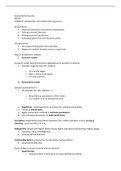
APES: organic molecules
Macromolecules
Carbohydrates Used for energy and structural support
1) Monosaccharides: glucose, fructose,
galactose, ribose, deoxyribose
2) Disaccharides: sucrose (glucose +
fructose), maltose (glucose + glucose),
lactose (glucose + galactose)
3) Polysaccharides: starch (plants, stores
energy), glycogen (animals, stores
energy), cellulose (indigestible, made in
plants, structural support)
Lipids Insoluble in water
1) triglycerides (energy storage molecules in
adipose tissue) -> composed of glycerol and
three fatty acids which can be saturated (in
fats) single bonds and unsaturated (in oils)
double bonds
2) phospholipids (cell membrane structure) ->
glycerol and two fatty acids + phosphate group.
Phosphate + glycerol = hydrophilic
2 fatty acids = hydrophobic
3) steroids (carbon-based ring structures) e.g.,
cholesterol, oestrogen, testosterone
Proteins Made up of long chains (polymers) of amino
acids: 20 types- amino acid end, carboxyl end, R
group.
Amino acids joined by peptide bonds produced
by dehydration synthesis.
Primary: amino acid sequence stabilised by
peptide bonds.
Secondary: alpha helix, beta pleated sheets
stabilised by hydrogen bonds.
Tertiary: 3-D, stabilised by disulphide and
hydrogen bonds, creates polar and non-polar
areas in molecule.
Quaternary: two or more polypeptide chains
associated.
Enzymes are proteins which facilitate
biochemical reactions and function as biological
catalysts. Affected by pH, temperature, ion
concentration and inhibitor presence.
Nucleic acids Stores genetic information.
Made up of long chains of nucleotides.
DNA contains instructions for producing RNA.
RNA contains instructions for processing
proteins.
DNA: A-T
C-G
RNA: A,G,C,U
Macromolecules
Carbohydrates Used for energy and structural support
1) Monosaccharides: glucose, fructose,
galactose, ribose, deoxyribose
2) Disaccharides: sucrose (glucose +
fructose), maltose (glucose + glucose),
lactose (glucose + galactose)
3) Polysaccharides: starch (plants, stores
energy), glycogen (animals, stores
energy), cellulose (indigestible, made in
plants, structural support)
Lipids Insoluble in water
1) triglycerides (energy storage molecules in
adipose tissue) -> composed of glycerol and
three fatty acids which can be saturated (in
fats) single bonds and unsaturated (in oils)
double bonds
2) phospholipids (cell membrane structure) ->
glycerol and two fatty acids + phosphate group.
Phosphate + glycerol = hydrophilic
2 fatty acids = hydrophobic
3) steroids (carbon-based ring structures) e.g.,
cholesterol, oestrogen, testosterone
Proteins Made up of long chains (polymers) of amino
acids: 20 types- amino acid end, carboxyl end, R
group.
Amino acids joined by peptide bonds produced
by dehydration synthesis.
Primary: amino acid sequence stabilised by
peptide bonds.
Secondary: alpha helix, beta pleated sheets
stabilised by hydrogen bonds.
Tertiary: 3-D, stabilised by disulphide and
hydrogen bonds, creates polar and non-polar
areas in molecule.
Quaternary: two or more polypeptide chains
associated.
Enzymes are proteins which facilitate
biochemical reactions and function as biological
catalysts. Affected by pH, temperature, ion
concentration and inhibitor presence.
Nucleic acids Stores genetic information.
Made up of long chains of nucleotides.
DNA contains instructions for producing RNA.
RNA contains instructions for processing
proteins.
DNA: A-T
C-G
RNA: A,G,C,U