Foundations of Reading - 090 Exam Questions With Solutions
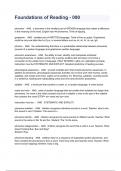
Foundations of Reading - 090 Exam Questions With Solutions phoneme - ANS a phoneme is the smallest part of SPOKEN language that makes a difference in the meaning of the word. English has 44 phonemes. Think of tapping. grapheme - ANS smallest part of WRITTEN language. Think of line on graph. Graphemes could be only one letter like b,d,f,p,s; or several letters such as ch, sh, th, ck, ea, igh. phonics - ANS the understanding that there is a predictable relationship between phonemes (sounds of a spoken language) and graphemes (written language). phonemic awareness - ANS the ability to hear, identify, and manipulate individual sounds-phonemes- in spoken words. this is purely auditory skill and does not involve a connection to the written form of language. ONLY SPOKEN. Lights on= alphabetic principle. Instruction must be SYSTEMATIC AND EXPLICIT. Greatest predictors of reading success. phonological awareness - ANS a broad umbrella term that include phonemic awareness. In addition to phonemes, phonological awareness activities can involve work with rhymes, words, syllables, and onsets and rimes. Lights out its auditory. Ex. Rhyming, syllables, counting words in a sentence, hearing and manipulating onset and rime and phonemic awareness. syllable - ANS a word part that contains a vowel, or, in spoken language, a vowel sound. onset and rime - ANS parts of spoken language that are smaller than syllables but larger than phonemes. An onset is the initial constant sound of a syllable; a rime is the part of the syllable that contains the vowel STOP= st= onset and op= rime. Instruction must be.. - ANS SYSTEMATIC AND EXPLICIT. phoneme isolation - ANS children recognize individual sounds in a word. Teacher: what is the first sound in van? Children: The sound is v. phoneme identity - ANS children recognize the same sounds in different words. Teacher: What sound is the same in fall, fix and fun. Student: The f is the same. phoneme categorization - ANS children recognize the word that is odd in a set. Teacher: What doesn't belong Bus, Bun and Rug? Student: Rug. phoneme blending - ANS children listen to a sequence of separately spoken phonemes, and then combine the phonemes to form a word. Then they write and read the word. Teacher: What word is b/i/g? (tapping) Children: b/i/g/ is big. phoneme segmenation - ANS Teacher: How many sounds are in grab? Children (tapping): g r a b. Four sounds. Teacher: Now let's write the sounds in grab: g r a b Teacher: writes grab on the board. Now we're going to read the word grab. phoneme addition - ANS Children make a new word by adding a phoneme to an existing word. Write park, now change park to spark. phoneme substitution - ANS children substitute one phoneme for another to make a new word. the word is bug. change bug to bun. alphabetic principle - ANS understanding that there are systematic and predictable relationships between written letters and spoken sounds. A apple a. book handling skills - ANS illustrates a children's knowledge of how books "work". How to hold the book, tracking print from left to right, front and back cover, title page, dedication page etc. environmental print - ANS print found authentically in our environment, (street signs, store labels, and food labels). Ex: Target, exit, cheerios and McDonalds. emergent literacy - ANS print carries meaning. Student knows that squiggly lines mean "cursive" like their moms and dads do. Random letters put together that don't make words. cueing systems -
Written for
- Institution
- 090 OAE Foundations of Reading
- Course
- 090 OAE Foundations of Reading
Document information
- Uploaded on
- July 22, 2023
- Number of pages
- 12
- Written in
- 2022/2023
- Type
- Exam (elaborations)
- Contains
- Questions & answers
Subjects
-
foundations of reading 090

Also available in package deal