2.2
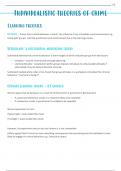
Individualistic theories of crime
Learning theories
Definition = theory that criminal behaviour is learnt, the influence of our immediate social environment e.g.
family peer groups, role that punishment and reinforcement has in the learning process
Sutherland’s differential association theory
Sutherland believed that criminal behaviour is learnt largely in family and peer groups from two factors
- Imitation – acquire criminal skills through observing
- Learned attitudes – socialisation within groups exposes individuals to unfavourable attitudes if
internalized, they are likely to become criminals
Sutherland studied white collar crime, found that group attitudes in a workplace normalized the criminal
behaviour, “everyone’s doing it”
Operant learning theory – B.F skinner
Skinner argues that all behaviour is a result of reinforcement or punishment, Behaviourism
- If a particular behaviour results in a reward its likely to be repeated
- If a behaviour results in punishment its unlikely to be repeated
Skinner experiment on rats:
If green light + lever pulled then food
If red light + leaver pulled then shock
However, the experiment was on rats not humans it is not comparable
Jeffery argued that If crime has more rewarding consequences than punishing ones the individual is more
likely to engage in criminal behaviour e.g., financial or status
Individualistic theories of crime
Learning theories
Definition = theory that criminal behaviour is learnt, the influence of our immediate social environment e.g.
family peer groups, role that punishment and reinforcement has in the learning process
Sutherland’s differential association theory
Sutherland believed that criminal behaviour is learnt largely in family and peer groups from two factors
- Imitation – acquire criminal skills through observing
- Learned attitudes – socialisation within groups exposes individuals to unfavourable attitudes if
internalized, they are likely to become criminals
Sutherland studied white collar crime, found that group attitudes in a workplace normalized the criminal
behaviour, “everyone’s doing it”
Operant learning theory – B.F skinner
Skinner argues that all behaviour is a result of reinforcement or punishment, Behaviourism
- If a particular behaviour results in a reward its likely to be repeated
- If a behaviour results in punishment its unlikely to be repeated
Skinner experiment on rats:
If green light + lever pulled then food
If red light + leaver pulled then shock
However, the experiment was on rats not humans it is not comparable
Jeffery argued that If crime has more rewarding consequences than punishing ones the individual is more
likely to engage in criminal behaviour e.g., financial or status