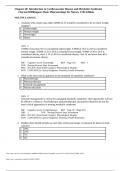
Chapter 20: Introduction to Cardiovascular Disease and Metabolic Syndrome Clayton/Willihnganz: Basic Pharmacology for Nurses, 17th Edition
1. A patient with a body mass index (BMI) of 25 would be considered to be in which weight category? a. Underweight b. Normal weight c. Overweight d. Obese ANS: C A BMI of less than 18.5 is considered underweight. A BMI of 18.5 to 24.9 is considered normal weight. A BMI of 25 to 29.9 is considered overweight. A BMI of 30 to 34.9 is considered obesity, class I; 35 to 39.9 is considered obesity, class II; and more than 40 is considered extreme obesity. DIF: Cognitive Level: Knowledge REF: Page 319 OBJ: 1 TOP: Nursing Process Step: Assessment MSC: NCLEX Client Needs Category: Physiological Integrity NOT: CONCEPT(S): Clinical Judgment; Nutrition; Health Promotion 2. What is the most critical approach to the treatment of metabolic syndrome? a. Psychotherapy b. Pharmacotherapy c. Lifestyle management d. Patient education ANS: C Lifestyle management is critical for managing metabolic syndrome; other approaches will not be effective without it. Psychotherapy, pharmacotherapy, and patient education are not the most critical approaches to treating metabolic syndrome. DIF: Cognitive Level: Comprehension REF: Page 317 | Page 320 OBJ: 2 TOP: Nursing Process Step: Assessment MSC: NCLEX Cl
Written for
- Institution
-
South Texas College
- Course
-
RNSG MISC
Document information
- Uploaded on
- July 21, 2023
- Number of pages
- 6
- Written in
- 2022/2023
- Type
- Exam (elaborations)
- Contains
- Questions & answers
Subjects
- rnsg misc
-
chapter 20 introduction to cardiovascular disease

Also available in package deal