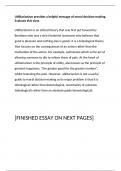
Utilitarianism provides a helpful message of moral decision-making.
Evaluate this view.
Utilitarianism is an ethical theory that was first put forward by
Bentham who was a strict hedonist (someone who believes that
good is pleasure and nothing else is good). It is a teleological theory
that focuses on the consequences of an action rather than the
motivation of the action. For example, euthanasia which is the act of
allowing someone to die to relieve them of pain. At the heart of
utilitarianism is the principle of utility, also known as the principle of
greatest happiness, “the greater good for the greater number”,
whilst lessening the pain. However, utilitarianism is not a useful
guide to moral decision-making as its major problem is that it is
teleological rather than deontological, uncertainty of outcome
(teleological) rather than an absolute guide (deontological).
[FINISHED ESSAY ON NEXT PAGES]
Evaluate this view.
Utilitarianism is an ethical theory that was first put forward by
Bentham who was a strict hedonist (someone who believes that
good is pleasure and nothing else is good). It is a teleological theory
that focuses on the consequences of an action rather than the
motivation of the action. For example, euthanasia which is the act of
allowing someone to die to relieve them of pain. At the heart of
utilitarianism is the principle of utility, also known as the principle of
greatest happiness, “the greater good for the greater number”,
whilst lessening the pain. However, utilitarianism is not a useful
guide to moral decision-making as its major problem is that it is
teleological rather than deontological, uncertainty of outcome
(teleological) rather than an absolute guide (deontological).
[FINISHED ESSAY ON NEXT PAGES]