Evolutionary Analysis Ch10 questions with correct answers
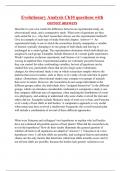
Describe in your own words the difference between an experimental study, an observational study, and a comparative study. What sorts of questions are they each suited for (i.e., why don't researchers always use the experimental method)? Give an example of each type of study from this chapter. Answer An experimental study is one in which the researchers directly manipulate a variable of interest, typically changing it in one group of individuals and leaving it unchanged in a control group. The experimenters determine which individuals are assigned to each group. Examples include Hansen et al.'s nectar guide experiment, Weeks' oxpecker-exclusion experiment, and Greene et al.'s experiment on wing-waving in tephritid flies. Experimental studies are extremely powerful because they can control for other confounding variables, but not all questions can be studied this way, particularly those that involve large-scale evolutionary changes.An observational study is one in which researchers simply observe the patterns that occur in nature, such as Huey et al.'s study of rock selection in garter snakes. (Sometimes, observational studies may compare two groups of animals that occur in nature. However, the researchers do not assign individuals to the different groups; rather, the individuals have "assigned themselves" to the different groups, which can introduce considerable confounds.)A comparative study is one that compares different taxa of organisms, often studying the distribution of a trait on a phylogeny, and seeking to understand why some clades evolved the trait and others did not. Examples include Hosken's study of testis size in bats, and Futuyma et al.'s study of host shifts in leaf beetles. A comparative approach is very useful when many taxa have evolved a similar trait.Frequently, the overall research plan will include a combination of several of these different approaches. What were Futuyma and colleagues' two hypotheses to explain why leaf beetles have not colonized all possible species of host plants? What did the researchers do to test the hypotheses? How do their results illuminate the general question of whether all traits in all organisms are adaptive? Answer Futuyma et al.'s two hypotheses were: 1) all host shifts are possible, and ecological factors and random chance are the only factors that determine which host shifts actually occur; and 2) not all host shifts are possible, because the beetles lack genetic variation to eat certain species of host plants. Futuyma et al
Connected book
Written for
- Institution
- Evolutionary Analysis
- Course
- Evolutionary Analysis
Document information
- Uploaded on
- July 18, 2023
- Number of pages
- 10
- Written in
- 2022/2023
- Type
- Exam (elaborations)
- Contains
- Questions & answers
Subjects
-
evolutionary analysis ch10 questions with correct

Also available in package deal