Psyc 140 Module 5 Problem Set.pdf
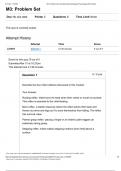
Psyc 140 Module 5 Problem S M5: Problem Set Due No due date Points 5 Questions 9 Time Limit None This quiz is currently locked. Attempt History Attempt Time Score LATEST Attempt 1 5,225 minutes 5 out of 5 Score for this quiz: 5 out of 5 Submitted Apr 14 at 10:23pm This attempt took 5,225 minutes. Q 0 / 0 pts uestion 1 Your Answer: Compare and contrast physical growth in early and middle childhood. Physical growth in early and middle childhood follows 2 growth patterns; cephalocaudal and proximodistal. The cephalocaudal pattern shows growth began with the head in early childhood and in middle childhood the head circumference becomes more proportional with total body height. The proximodistal pattern shows growth began in the trunk and spread to the limbs, in middle childhood, making fine motor skills easier. This study source was downloaded by from CourseH on :24:05 GMT -05:00 6/11/22, 1:18 PM M5: Problem Set: Developmental (Lifespan) Psychology-2021-Bosch In the cephalocaudal pattern of growth, we see development beginning with the head in infancy and early childhood. By middle childhood, major growth can be seen in additional areas; namely, height and weight. The child becomes more proportional in terms of head to full body ratio. In the proximodistal pattern of growth, gross motor skill development occurs in early childhood, while fine motor skills are more readily gained in middle childhood. Ques 0 / 0 pts tion 2 Your Answer: Self-reflection: What are your views of why ADHD diagnoses and rates of childhood obesity have increased? What are the solutions? I think the rates of ADHD diagnoses and childhood obesity have increased because of a variety of factors. For ADHD, nutrition, teratogens, and genetics play major roles in the increasing rates. In the present day there are more man made/synthetic/unnatural things that people consume, whether that by food/drink or drugs. These things could be consumed by the mother and/or father and passed to the child via teratogen which in turn could lead to a later diagnosis of ADHD. The child them-self could also consume something that could contribute to a diagnosis of ADHD. Overtime, this could also turn into a genetic issue. A solution would be to stop consuming said things. I believe the increased rates of obesity can be attributed to socioeconomic status. Right now there are a lot of people who lack education and/or money. Parents may not have the knowledge to pick healthy foods for their children. They also may not be able to afford it. Sadly, fast food is cheaper than healthy food right now so it is hard to come up with a solution to this problem. Answers will vary. This study source was downloaded by from CourseH on :24:05 GMT -05:00 6/11/22, 1:18 PM M5: Problem Set: Developmental (Lifespan) Psychology-2021-Bosch Ques 0 / 0 pts tion 3 Your Answer: What is the recommended treatment for ADHD? Recommended treatment for ADHD is medication (stimulant or nonstimulant) and behavioral therapy. Medication + Behavioral therapy. Ques 0 / 0 pts tion 4 Your Answer: According to Piaget, what cognitive gains are made during the Concrete Operational Stage? The cognitive gains made during the concrete operational stage are conservation, classification, and seriation. Conservation, seriation, and logical thinking. Ques 0 / 0 pts tion 5 Describe the four peer statuses and potential outcomes in adolescence and adulthood pertaining to each. This study source was downloaded by from CourseH on :24:05 GMT -05:00 6/11/22, 1:18 PM M5: Problem Set: Developmental (Lifespan) Psychology-2021-Bosch Your Answer: Popular children are favored by their peers. There are two types; antisocial and prosocial. Antisocial children often use gossip and humiliation to cement their popularity. Prosocial children are very social with out being relational aggressive. In adolescence and adulthood they have quality social skills, are good listeners and communicators. Rejected children are disliked by their peers. In adolescence and adulthood they often lack social skills, use drugs, have aggression, and are shy. Neglected children are ignored by their peers, but not necessarily seen as negative or positive. They have average social skills as adolescents and adults. Controversial children can be viewed as positive or negative by their peers. They have mixed outcomes as adolescents and adults. Popular children tend to be well-liked by their peers and are often socially skilled. These skills often continue into adulthood. Rejected children are actively disliked and some may engage in behaviors that encourage this dislike. Rejected children are at risk for a variety of problems in the future, such as drug use, aggression, and delinquency. Neglected children are largely ignored by their peers, but they may in fact be socially skilled. They seem to have similar outcomes as average children. Controversial children receive both positive and negative votes, and outcomes for these children tend to be mixed (some positive, some negative, depending on the child). Ques 0 / 0 pts tion 6 Your Answer: What are some immediate consequences of divorce? This study source was downloaded by from CourseH on :24:05 GMT -05:00 6/11/22, 1:18 PM M5: Problem Set: Developmental (Lifespan) Psychology-2021-Bosch Immediate consequences in divorce are drop in income, increases in family conflict, and changes in parenting styles. Sharp drop in income (particularly in mother-headed households), increase in family conflict, and changes in parenting styles, among other consequences. Ques 0 / 0 pts tion 7 Your Answer: How does a child’s response to divorce vary according to age and gender? Young children often do not understand why a divorce took place and blame themselves for it. They regress to babyish behaviors. Older children might understand the reason behind a divorce, but act out. They may run away, engage in early sexual activity, and have poor school performance. Girls are more likely to internalize their feelings, which results in crying and pulling away from others. Boys tend to act out and become rebellious. Younger children may blame themselves for the divorce or act immaturely, while older children may act out in different ways, either through externalizing problems (rebellion, school problems, etc.) or internalizing problems (depression, anxiety, etc.). Girls are particularly likely to act out when a parent remarries, while boys are at risk for externalizing problems if they are raised in a mother-headed household.
Written for
- Institution
- Abnormal psychology 470
- Course
- Abnormal psychology 470
Document information
- Uploaded on
- July 14, 2023
- Number of pages
- 7
- Written in
- 2022/2023
- Type
- Exam (elaborations)
- Contains
- Questions & answers
Subjects
-
psyc 140 module 5 problem setpdf
-
ompare and contrast physical growth in early and m
-
r self reflection what are your views of why adh