Brain Story Certification | 38 Questions and Answers with complete solution
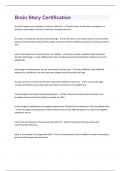
the brain begins as an embryonic structure called the - neural tube, shortly after conception it is formed in neurulation, all areas of the brain develop from here the brain is considered mature around what age - 25, the brain is not mature until our mid-twenties because the prefrontal cortex (which enables executive function abilities) continues to develop until this time what is the sequence in which we learn our abilities - sensory, motor, emotional skills, executive function skills (begin in early childhood but their sensitive period of development continues into early adulthood) what stages of development are the most plastic and the least - early childhood, late childhood, adolescence, adulthood, the brain becomes progressively less plastic with age the age at which a human has the most connections between neurons is - 3, as the brain ages, unused connections are pruned away and active connections are strengthened how do experiences shape the developing brain - they influence which neural connections are strengthened or pruned, they help us practice our skills at what stage of development do negative experiences influence the architecture of the developing brain - at any stage of development, which neural circuits will be affected depends on when the negative experience occurs most traits and diseases in humans are derived from - the interaction between genes and environmental influences what is an example of an epigenetic effect - an environmental factor modifies the area surrounding a gene such that expression decreasesis manual dexterity related to the quality of parental care a child receives - no which gene has been shown to be epigenetically modified by the quality of maternal care in rat offsrping - the glucocorticoid receptor gene which is methylated in response to maternal care what happens to the tress response system when the glucocorticoid receptor gene is epigenetically modified such that it is less active and produced fewer receptors - the stress response increases what pre-existing conditions are associated with epigenetic modification of the glucocorticoid receptor gene in victims of suicide - childhood maltreatment which aspect of development is NOT affected by social interactions - cognitive, social, emotional, language, physical and behavioral development are all affected by social interactions human infants need to be taught how to react to social causes by - nothing- infants have an innate response to social cues what is meant by a "serve and return" interaction - it is the interaction between a child and adult where various activities and communication pass back and forth
Written for
- Institution
- Brain Story Certification
- Course
- Brain Story Certification
Document information
- Uploaded on
- July 10, 2023
- Number of pages
- 4
- Written in
- 2022/2023
- Type
- Exam (elaborations)
- Contains
- Questions & answers
Subjects

Also available in package deal