UNE medical biochemistry Unit 1 Test with Verified Solutions
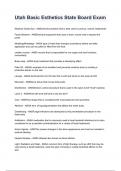
UNE medical biochemistry Unit 1 Test with Verified Solutions Changes in the physiological variables listed below can alter the affinity of hemoglobin for oxygen. Which of the following will lower the affinity of hemoglobin for oxygen? a) decrease in protons b) increase in 2,3 bisphosphoglycerate (BPG) c) increase in pH d) decrease in CO2 Increase in 2,3 bisphosphoglycerate (BPG) Domains are common structural elements that retain a particular function within the protein. Which of the following is an example of a protein domain? a) a prosthetic group such as heme b) irregular coils and loops c) an arrangement of β-strands connected by α- helixes d) a single α- helix An arrangement of β-strands connected by α-helixes A 22-year-old female is diagnosed with acute pancreatitis. Elevation of which of the following serum enzymes would be consistent with this diagnosis? a) lactate dehydrogenase b) amylase c) troponin d) creatine kinase amylase Movement of ammonia from an amino acid to an alpha-keto acid involves a family of enzymes best categorized as: a) transferases b) ligases c) lyases d) isomerases transferases Which of the following proteins is likely to have quaternary structure? a) a protein that contains both α-helix and β-sheet secondary structures b) a multimeric protein that contains multiple peptide chains c) a small protein consisting of a single amino acid chain d) a large transmemberane protein with seven alpha helical domains a multimeric protein that contains multiple peptide chains Cleavage of fructose 1, 6 bisphosphate to dihydroxyacetone and glyceraldehyde 3-phosphate is achieved by what class of enzymes? a) ligase b) lyase c) transferase d) hydrolase Lyase Which of the following best describes the structure of heme? a) a planar porphyrin ring that binds iron b) a nicotinamide structure that is readily oxidized c) an n-linked glycosylation d) a negatively charged phosphate group a planar porphyrin ring that binds iron Prosthetic groups are complex nonprotein molecules that participate in catalysis by providing functional groups that form a covalent intermediate between the enzyme and the substrate. Which of the following is an example of a coenzyme or cofactor that participates in a covalent catalysis reaction? a) ATP b) OH- c) NADH d) pyridoxal phosphate pyridoxal phsophate Which of the following best describes tertiary structure? a) interactions between differing subunits of a protein b) interactions between α-helixes and β-pleated sheets to form a domain c) interactions between amino acids 4 residues away from each other d) interactions between single amino acids adjacent to one another interactions between α-helixes and β-pleated sheets to form a domain Hemoglobin bound to heme is termed a holoprotein. The heme is required for oxygen binding and is defined as which of the following? a) apoprotein b) holoprotein c) heteroprotein d) prosthetic group prosthetic group Children with cystinosis have growth delay and renal issues to to accumulation of cysteine in cellular lysosomes. The defect involves a specific lysosomal membrane receptor that facilitates cysteine removal from the cell. An effective therapy involves administration of a drug with a similar structure to cysteine. This therapy reflects the general principle that competitive inhibitors typically resemble the structure of which of the following? a) substrates or ligands that bind the active site b) enzyme or receptor protein c) enzyme reaction products d) the cofactor substrates or ligands that bind the active site A new enzyme is discovered that increases in activity when it is phosphorylated on an exposed tyrosine. Phosphorylation of this amino acid is classified as which of the following? a) feedback inhibition b) transcriptional activation c) covalent modification d) increased protein ubiquitination covalent modification Which of the following is an example of enzyme regulation through covalent modification? a) binding of GTP to a monomeric G-protein b) phosphorylation of muscle glycogen c) digestion of misfolded proteins by lysosomes d) cleavage of chymotrypsinogen to chymotrypsin phosphorylation of muscle glycogen phosphorylase Under low energy conditions, AMP will bind to phosphofructokinase I and glycogen phosphorylase. This is an example of which of the follow types of enzyme regulation? a) competitive inhibition b) covalent modification c) allosteric inhibition d) allosteric activation allosteric activation The following represents a series of reactions. As levels of B increase, this will decrease the conversion of S3 to B. Which of the following best describes this type of regulation in a biosynthetic pathway? a) feedback inhibition b) feedforward activation c) covalent regulation d) inducible regulation feedback inhibition The association of DNA and histones can be modified by histone acetylation. A decrease in histone acetylation will have which of the following impacts on the assocation of DNA and histones? a) increase DNA:histone association b) decrease DNA:histone association c) have no effect Increase DNA:histone association If a mutation is made within the active site of an enzyme resulting in a decrease of it's Km value, which of the following will be true with respect to enzyme kinetics? a) the Vmax of the reaction will increase b) the enzyme will require a higher substrate concentration to achieve 1/2 Vmax c) the concentration of substrate needed to reach 1/2 Vmax will not change d) the enzyme will require a lower substrate concentration to reach 1/2 Vmax The enzyme will require a lower substrate concentration to reach 1/2 Vmax An example of enzyme activation by cleavage is best illustrated by which of the following? a) activation of chymotrypsinogen to chymotrypsin b) phosphorylation of muscle glycogen phosphorylase c) cortisol binding an intracellular receptor d) activation of adenylyl cyclase to generate cAMP activation of chymotrypsinogen to chymotrypsin As electrons flow through complexes in the inner mitochondrial membrane, protons are pumped from the matrix to the intermembrane space. Which of the following statements is most reflective of the pH in the intermembrane space? a) the pH in the matrix and the intermembrane space are the same b) the pH is higher in the matrix c) the pH is lower in the matrix the pH is higher in the matrix In the malate/aspartate shuttle, glutamate is converted to _________ in the mitochondria while aspartate is converted to ___________ in the cytosol. a-ketoglutarate; oxaloacetate Which of the following components of the electron transport chain is not bound to the mitochondrial membrane? Co Q A 19-year-old male is being evaluated for muscle weakness. A muscle biopsy revealed normal states of succinate oxidation but very low rates of pyruvate oxidation. Further testing determined normal levels of enzymatic activity in both malate dehydrogenase and pyruvate dehydrogenase. Based on this data, the patient may have a mutation in a gene encoding for which mitochondrial protein? a) complex I b) complex II c) complex III d) complex IV e) complex V Complex I (NADH Q-oxidoreductase) Succinate is a substrate for which complex in the electron transport chain? a) complex I b) complex II c) complex IV d) complex V Complex II (succinate-Q reductase) The malate-aspartate shuttle is used to move reducing equivalents of cytosolic NADH into the mitochondria where it can be oxidized. Which of the following compounds is used to move the reducing equivalents from cytosolic NADH into the mitochondria? a) aspartate b) malate c) glutamate d) oxaloacetate Malate Which of the following would be consistent with an exergonic reaction? a) ΔG would be negative b) ΔS would be negative c) ΔS would be positive d) ΔG would be positive ΔG would be negative Dinitrophenol is an uncoupler of the electron transport chain. The addition of dinitrophenol will have which of the following impacts? a) decrease the pH of the intermembrane space b) increase oxygen consumption c) increase ATP production d) decrease oxidation of NADH increase oxygen consumption ATP is a high energy molecule that is often hydrolyzed during reactions. The energy within ATP is stored primarily in which of the following components of the molecule? a) in the adenine base b) in the high energy phosphate bonds c) in the D-ribose group in the high energy phosphate bonds Which of the following describes the malate-aspartate shuttle system? a) carries NADH from the cytoplasm directly into the mitochondria b) generates 2.5 molecules of APT in mitochondria per each NADH from glycolysis c) moves NADH from the mitochondria into the cytoplasm d) relies on malade dehydrogenase in the inner mitochondrial membrane e) requires reduction of pyruvate to lactate for oxidizing NADH generates 2.5 molecules of ATP in mitochondria for each NADH from glycolysis
Written for
- Institution
- UNE medical biochemistry
- Course
- UNE medical biochemistry
Document information
- Uploaded on
- July 10, 2023
- Number of pages
- 12
- Written in
- 2022/2023
- Type
- Exam (elaborations)
- Contains
- Questions & answers
Subjects
-
une medical biochemistry unit 1 test with verified
-
changes in the physiological variables listed belo

Also available in package deal