REVISION
Term 2
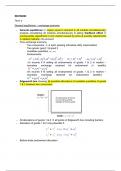
General equilibrium – exchange economy
- General equilibrium (= supply equal to demand in all markets simultaneously)
analysis considering all markets simultaneously & taking feedback effect (=
price/quantity adjustment in one market caused by price & quantity adjustments
in related markets) into account
- Pure exchange economy
Two consumers: A , B each seeking individual utility maximization
Two goods: good 1 & good 2
Available quantities: 1, 2
Endowments:
A 's income if A selling all endowments of goods 1 & 2 in market –
monetary exchange received for endowment (= wealth):
B's income if B selling all endowments of goods 1 & 2 in market –
monetary exchange received for endowment (wealth):
- Edgeworth box showing all possible allocations of available quantities of goods
1 & 2 between two consumers
- All allocations of goods 1 & 2 all points in Edgeworth box including borders
- Allocation of goods 1 & 2 only plausible if:
- Before-trade endowment allocation
,- Preferences of consumers sloping downwards indifference curves
o Note: direction of improvement of consumer A’s welfare (see red arrow) ;
direction of improvement of consumer B’s welfare (see green arrow)
- Pareto-improving allocation = allocation of endowment improving welfare of at
least one consumer without reducing welfare of other consumer(s)
- Consumers able refusing trade if in best interest only possible outcomes from
exchange = Pareto-improving allocations
- Point of Pareto optimal/efficient allocation when indifference curves of
consumers A & B tangential impossibility of improving at least one
consumer’s welfare without making other consumer(s) worse off
, - Contract curve (black line) = set of all Pareto optimal/efficient allocations = set
of points where traders' indifference curves tangential
Finding slope of contract curve & point of Pareto efficiency – solving three
equations
A B
MRS = MRS
x 1A + x B1 =ω1A +ω1B
x 2A + x B2 =ω2A +ω2B
- Trade in perfectly competitive market consumers guided by own preferences
& constraints of market
Given endowments & prices p ₁ and p ₂ consumers A & B solving own utility
maximisation problem subject to respective budget constraints (write “A solves”
& “B solves”)
Equilibrium: total demand = total resources available
Supply fixed
Consumer’s budget constraint: consumer’s total expenditure = consumer’s
endowment’s total monetary value
Term 2
General equilibrium – exchange economy
- General equilibrium (= supply equal to demand in all markets simultaneously)
analysis considering all markets simultaneously & taking feedback effect (=
price/quantity adjustment in one market caused by price & quantity adjustments
in related markets) into account
- Pure exchange economy
Two consumers: A , B each seeking individual utility maximization
Two goods: good 1 & good 2
Available quantities: 1, 2
Endowments:
A 's income if A selling all endowments of goods 1 & 2 in market –
monetary exchange received for endowment (= wealth):
B's income if B selling all endowments of goods 1 & 2 in market –
monetary exchange received for endowment (wealth):
- Edgeworth box showing all possible allocations of available quantities of goods
1 & 2 between two consumers
- All allocations of goods 1 & 2 all points in Edgeworth box including borders
- Allocation of goods 1 & 2 only plausible if:
- Before-trade endowment allocation
,- Preferences of consumers sloping downwards indifference curves
o Note: direction of improvement of consumer A’s welfare (see red arrow) ;
direction of improvement of consumer B’s welfare (see green arrow)
- Pareto-improving allocation = allocation of endowment improving welfare of at
least one consumer without reducing welfare of other consumer(s)
- Consumers able refusing trade if in best interest only possible outcomes from
exchange = Pareto-improving allocations
- Point of Pareto optimal/efficient allocation when indifference curves of
consumers A & B tangential impossibility of improving at least one
consumer’s welfare without making other consumer(s) worse off
, - Contract curve (black line) = set of all Pareto optimal/efficient allocations = set
of points where traders' indifference curves tangential
Finding slope of contract curve & point of Pareto efficiency – solving three
equations
A B
MRS = MRS
x 1A + x B1 =ω1A +ω1B
x 2A + x B2 =ω2A +ω2B
- Trade in perfectly competitive market consumers guided by own preferences
& constraints of market
Given endowments & prices p ₁ and p ₂ consumers A & B solving own utility
maximisation problem subject to respective budget constraints (write “A solves”
& “B solves”)
Equilibrium: total demand = total resources available
Supply fixed
Consumer’s budget constraint: consumer’s total expenditure = consumer’s
endowment’s total monetary value