

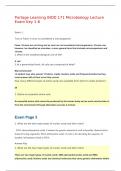
How many different types of amino acids are available from which to make proteins?
20
2. Define an essential amino acid.
An essential amino acid cannot be produced by the human body and as such must be take in from the environment through alternative sources (i.e) food.Portage Learning BIOD 171 Microbiology Lecture Exam Key 1-6
Exam 1.
True or False: A virus is considered a microorganism.
False. Viruses are not living and as such are not considered microorganisms. Viruses can, however, be classified as microbes, a more general term that includes microorganisms and viruses.
2.What is the smallest biological unit of life?
A cell.
3.At a generalized level, all cells are comprised of what?
Macromolecules*
*A student may also answer: Proteins, Lipids, Nucleic acids and Polysaccharides but they must answer with all four to be fully correct.
Exam Page 3
1. What are the two major types of nucleic acids and their roles?
DNA (deoxyribonucleic acid): Contains the genetic material as well as heredity characteristics found in living organisms. RNA (ribonucleic acid): its role is for decoding the sequence of heredity information found in DNA
Answer Key
1. What are the two major types of nucleic acids and their roles?
There are two major types of nucleic acids: DNA (deoxyribonucleic acid) and RNA (ribonucleic acid). Nucleic acids are chemical molecules that carry genetic information within Exam Page 4
Answer Key
Exam Page 5
Answer Key
Exam Page 6
Answer Key
1. True of False: Eukaryotic cells do not have a nucleus1. Complete the following RNA strand and indicate how many bonds are formed for each complementary pair:
3’ GGUCAUCG 5’
5’ CCAGC 3’
3’ GGUCAUCG 5’
5’ CCAGUAGC 3’
There are 2 bonds formed between A and U, and 3 bonds between G and C.
1.The plasma membrane (select all that are true):
A.Only restricts movement of materials into the cell
B.Is often a bilayer comprised of lipids
C.Cannot prevent essential nutrients from escaping
D.Contains hydrophobic tails pointing inward
B and D
2. Carbon, Hydrogen and Oxygen atoms come together to form what primary macromolecule? Give an example.
Polysaccharides. Glucose, sucrose and cellulose are all acceptable answers.the cell. DNA contains a vast amount of hereditary information and is responsible for the inheritable characteristics of living organisms. RNA is responsible for deciphering the hereditary information in DNA and using it to synthesize proteins. Exam Page 7
Answer Key
Exam Page 8
Answer Key1.Which of the following microorganisms are considered to be Eukarya? Select all that apply.
A.Animalia
B.Plantae
C.Fungi
D.Protista
A,B,C,D
2.True of False: All multicellular microorganisms classified as Animalia are heterotropic.
True
3.Microorganisms classified as Plantae obtain most of their energy by converting
energy into energy.False. Eukaryotic cells do have a nucleus (prokaryotic cells do not).
2.True or False: Prokaryotic cells can be subdivided into Bacteria and Archaea.
True
3.Describe the 4 basic bacterial morphologies.
Coccus (round/spherical), bacillus (rod), vibrio (curved rod) or spirillum (spiral/corkscrew).
4.True or False: Archaea, a eukaryotic class of microorganisms, are capable of surviving harsh environments.
False. Archaea are prokaryotic bacteria capable of surviving harsh environments. Exam Page 9
Answer Key
Exam Page 10
Answer Key1.Cell walls are found in which of the following (select all that apply):
A.Plants
B.Fungi
C.Bacteria
D.Mammalian cells
E.Algae
A, B, C, E
2.The function of the ribosome is (select all that apply):
A.Lipid synthesis
B.Protein synthesis
C.To produce energy (ATP)
D.Protein modification and distribution
E.Waste disposal via hydrolytic enzymes
B. Ribosomes are located in the cytoplasm of prokaryotic cells and in the ER of eukaryotic cells.1.A defining characteristic of fungi is the presence of chitin in the cell walls. Which of following also contain chitin? Select all that apply.
A.Mushrooms
B.Bacteria
C.Yeast
D.Molds
A, C and D all contain chitin.
2. True or False: A defining characteristic of Protista is the inability of colonies to form tissue layers.
20
2. Define an essential amino acid.
An essential amino acid cannot be produced by the human body and as such must be take in from the environment through alternative sources (i.e) food.Portage Learning BIOD 171 Microbiology Lecture Exam Key 1-6
Exam 1.
True or False: A virus is considered a microorganism.
False. Viruses are not living and as such are not considered microorganisms. Viruses can, however, be classified as microbes, a more general term that includes microorganisms and viruses.
2.What is the smallest biological unit of life?
A cell.
3.At a generalized level, all cells are comprised of what?
Macromolecules*
*A student may also answer: Proteins, Lipids, Nucleic acids and Polysaccharides but they must answer with all four to be fully correct.
Exam Page 3
1. What are the two major types of nucleic acids and their roles?
DNA (deoxyribonucleic acid): Contains the genetic material as well as heredity characteristics found in living organisms. RNA (ribonucleic acid): its role is for decoding the sequence of heredity information found in DNA
Answer Key
1. What are the two major types of nucleic acids and their roles?
There are two major types of nucleic acids: DNA (deoxyribonucleic acid) and RNA (ribonucleic acid). Nucleic acids are chemical molecules that carry genetic information within Exam Page 4
Answer Key
Exam Page 5
Answer Key
Exam Page 6
Answer Key
1. True of False: Eukaryotic cells do not have a nucleus1. Complete the following RNA strand and indicate how many bonds are formed for each complementary pair:
3’ GGUCAUCG 5’
5’ CCAGC 3’
3’ GGUCAUCG 5’
5’ CCAGUAGC 3’
There are 2 bonds formed between A and U, and 3 bonds between G and C.
1.The plasma membrane (select all that are true):
A.Only restricts movement of materials into the cell
B.Is often a bilayer comprised of lipids
C.Cannot prevent essential nutrients from escaping
D.Contains hydrophobic tails pointing inward
B and D
2. Carbon, Hydrogen and Oxygen atoms come together to form what primary macromolecule? Give an example.
Polysaccharides. Glucose, sucrose and cellulose are all acceptable answers.the cell. DNA contains a vast amount of hereditary information and is responsible for the inheritable characteristics of living organisms. RNA is responsible for deciphering the hereditary information in DNA and using it to synthesize proteins. Exam Page 7
Answer Key
Exam Page 8
Answer Key1.Which of the following microorganisms are considered to be Eukarya? Select all that apply.
A.Animalia
B.Plantae
C.Fungi
D.Protista
A,B,C,D
2.True of False: All multicellular microorganisms classified as Animalia are heterotropic.
True
3.Microorganisms classified as Plantae obtain most of their energy by converting
energy into energy.False. Eukaryotic cells do have a nucleus (prokaryotic cells do not).
2.True or False: Prokaryotic cells can be subdivided into Bacteria and Archaea.
True
3.Describe the 4 basic bacterial morphologies.
Coccus (round/spherical), bacillus (rod), vibrio (curved rod) or spirillum (spiral/corkscrew).
4.True or False: Archaea, a eukaryotic class of microorganisms, are capable of surviving harsh environments.
False. Archaea are prokaryotic bacteria capable of surviving harsh environments. Exam Page 9
Answer Key
Exam Page 10
Answer Key1.Cell walls are found in which of the following (select all that apply):
A.Plants
B.Fungi
C.Bacteria
D.Mammalian cells
E.Algae
A, B, C, E
2.The function of the ribosome is (select all that apply):
A.Lipid synthesis
B.Protein synthesis
C.To produce energy (ATP)
D.Protein modification and distribution
E.Waste disposal via hydrolytic enzymes
B. Ribosomes are located in the cytoplasm of prokaryotic cells and in the ER of eukaryotic cells.1.A defining characteristic of fungi is the presence of chitin in the cell walls. Which of following also contain chitin? Select all that apply.
A.Mushrooms
B.Bacteria
C.Yeast
D.Molds
A, C and D all contain chitin.
2. True or False: A defining characteristic of Protista is the inability of colonies to form tissue layers.


