Explain the level of output and the price at which a monopoly will produce
A monopoly can be defined as a company which has a significant market share in a market where
there is an absence of competition. Thus, the monopoly firm enjoys market power and is a ‘price
maker’ – it has some influence over the level of output and price. However, whilst monopolies
certainly have the power to influence price and output levels, it is important to remember that they
are still constrained to a certain extent by the consumers’ price elasticity of demand. If, for example,
a monopoly charged astronomical prices for its good, simply no one would purchase it. Nevertheless,
monopolists still enjoy a level of influence in the market.
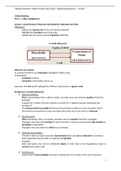
Fig 1
To explain the level of output and price at which a monopoly is likely to produce requires us to make
the important assumption that firms are profit maximising. Thus, monopolies should produce up to
the point where marginal revenue (MR) equals marginal cost (MC), labelled as Q1 on Fig 1. This level
of output can be sold at a price of P1 as the average revenue curve (AR) can be taken as the firm’s
demand curve assuming it is a pure monopoly. This is a good example of the limitations on a
monopoly’s price-setting power; whilst they are still likely to make supernormal profits, a monopoly
firm still has to take heed of its demand curve and if it wants to profit-maximise, it cannot set the
price at any random level.
Fig 2
Any changes in demand are likely to cause a change in the level of output and the price at which a
monopoly will produce. Assuming that the monopoly’s costs have remained the same, an increase
inthe demand for their good will shift the AR and MR curve right, as can be seen in Fig 2. This will
result in a new profit maximising position (where MR=MC) and the quantity will increase from Q1 to
Q2, and the price from P1 to P2 and the monopoly’s level of supernormal profits will increase. Of
course, the opposite can occur. If the demand curve contracts, the monopoly will produce less
quantity and at a lower price, and monopoly profits will fall. In fact, monopolies are not guaranteed
profits, and if there is a sharp contraction of demand to the point where costs exceed revenue, then
even a monopoly can lose money.
Overall, the main determinant of the output level and the price at which a monopoly will produce is
the AR and MR curves – essentially the demand curve. Although monopolies enjoy a certain freedom
in price-setting, they are still constrained by their demand curve. If they wish to maximise profits
then they must produce output at the point where MR=MC, and the price is set by the AR curve at
this output level.
Using appropriate diagrams, explain whether a monopoly is likely to be more or less efficient than
a firm in perfect competition
A monopoly can be defined as a company which has a significant market share in a market where
there is an absence of competition. Thus, the monopoly firm enjoys market power and is a ‘price
maker’ – it has some influence over the level of output and price. However, whilst monopolies
certainly have the power to influence price and output levels, it is important to remember that they
are still constrained to a certain extent by the consumers’ price elasticity of demand. If, for example,
a monopoly charged astronomical prices for its good, simply no one would purchase it. Nevertheless,
monopolists still enjoy a level of influence in the market.
Fig 1
To explain the level of output and price at which a monopoly is likely to produce requires us to make
the important assumption that firms are profit maximising. Thus, monopolies should produce up to
the point where marginal revenue (MR) equals marginal cost (MC), labelled as Q1 on Fig 1. This level
of output can be sold at a price of P1 as the average revenue curve (AR) can be taken as the firm’s
demand curve assuming it is a pure monopoly. This is a good example of the limitations on a
monopoly’s price-setting power; whilst they are still likely to make supernormal profits, a monopoly
firm still has to take heed of its demand curve and if it wants to profit-maximise, it cannot set the
price at any random level.
Fig 2
Any changes in demand are likely to cause a change in the level of output and the price at which a
monopoly will produce. Assuming that the monopoly’s costs have remained the same, an increase
inthe demand for their good will shift the AR and MR curve right, as can be seen in Fig 2. This will
result in a new profit maximising position (where MR=MC) and the quantity will increase from Q1 to
Q2, and the price from P1 to P2 and the monopoly’s level of supernormal profits will increase. Of
course, the opposite can occur. If the demand curve contracts, the monopoly will produce less
quantity and at a lower price, and monopoly profits will fall. In fact, monopolies are not guaranteed
profits, and if there is a sharp contraction of demand to the point where costs exceed revenue, then
even a monopoly can lose money.
Overall, the main determinant of the output level and the price at which a monopoly will produce is
the AR and MR curves – essentially the demand curve. Although monopolies enjoy a certain freedom
in price-setting, they are still constrained by their demand curve. If they wish to maximise profits
then they must produce output at the point where MR=MC, and the price is set by the AR curve at
this output level.
Using appropriate diagrams, explain whether a monopoly is likely to be more or less efficient than
a firm in perfect competition