June 2009 AQA Econ 1 - Context 2
Plastic Bags and Household Waste Data Response
Define the term ‘negative externality’ (Extract E, line 1).
a) A negative externality is when the production and/or consumption of a good imposes
external costs on third parties outside of the market, for which the market does not
make appropriate compensation for.
Compare two changes shown in Extract D in UK waste production and recycling over
the period 1996 to 2006.
b) One significant change shown in Extract D in UK waste production and recycling over
the period 1996 to 2006 is that the total quantity of waste produced increased every year
between 1996 and 2003, from 450kg per person per year in 1996, to 520kg per person per
year in 2003.
In comparison, the total quantity of recycled waste increased every year from 1996 to
2006 from 30kg per person per year in 1996 to 150kg per person per year in 2006.
With the help of a demand and supply diagram, explain how a tax on the plastic bags
distributed by shops and supermarkets might affect the use of plastic bags.
c) An indirect tax is a charge levied by the government on a good and the burden of the
tax can fall either on the producer or the consumer, depending on the price elasticity of
demand and supply for the product.
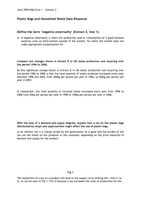
Fig 1
The imposition of a tax on a product will lead to the supply curve shifting left, from S1 to
S2, as can be seen in Fig 1. This is because a tax increases the costs of production for the
Plastic Bags and Household Waste Data Response
Define the term ‘negative externality’ (Extract E, line 1).
a) A negative externality is when the production and/or consumption of a good imposes
external costs on third parties outside of the market, for which the market does not
make appropriate compensation for.
Compare two changes shown in Extract D in UK waste production and recycling over
the period 1996 to 2006.
b) One significant change shown in Extract D in UK waste production and recycling over
the period 1996 to 2006 is that the total quantity of waste produced increased every year
between 1996 and 2003, from 450kg per person per year in 1996, to 520kg per person per
year in 2003.
In comparison, the total quantity of recycled waste increased every year from 1996 to
2006 from 30kg per person per year in 1996 to 150kg per person per year in 2006.
With the help of a demand and supply diagram, explain how a tax on the plastic bags
distributed by shops and supermarkets might affect the use of plastic bags.
c) An indirect tax is a charge levied by the government on a good and the burden of the
tax can fall either on the producer or the consumer, depending on the price elasticity of
demand and supply for the product.
Fig 1
The imposition of a tax on a product will lead to the supply curve shifting left, from S1 to
S2, as can be seen in Fig 1. This is because a tax increases the costs of production for the