Micro notes
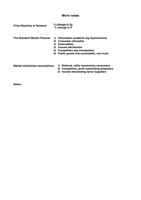
Price Elasticity of Demand: % change in QD
% change in P
The Standard Market Failures: 1) Information problems (eg asymmetries)
2) Consumer rationality
3) Externalities
4) Income distribution
5) Competition (eg monopolies)
6) Public goods (non-excludable, non-rival)
Market mechanism assumptions: 1) Rational, utility maximising consumers
2) Competitive, profit maximising producers
3) Income maximising factor suppliers
Notes:
,Factors of production:
Land: includes everything on Earth’s surface eg trees, seas, minerals
Labour: division increases productivity, perfection through repetition
Capital: buildings, machinery, financial capital
Enterprise: managing inputs, directors?
PPF:
If on PPF: economy at full capacity, resources used to 100% maximum efficiency, full employment
PPF expands if economy expands
If below PPF: not 100% efficient, unemployment, resources ‘wasted’
Disadvantages of free market economy:
Inequality - health/education (merit goods) unaffordable to some
Demerit goods over-consumed
Public goods wouldn’t be provided at all
Disadvantages of command economy:
Less efficient use of resources
Less choice, innovation and competition
Opens up to government failure
Positive statements:
Concerns what is/was/will be
No indication of approval/disapproval
Factual statements - can be incorrect
eg: Unemployment in the UK is higher than in China
Normative statements:
Expresses an opinion - whether it is desirable or not, therefore not testable
Key words: should/would
eg: high income earners should be taxed more
Causes of supply curve shift:
Change in technology
Tax/subsidy
Change in production costs e.g. rent/wages/raw materials
Number of suppliers in the market
Consumer & producer surplus:
Producer: the difference between what producers are willing and able to supply and what they
actually supply at
Consumer: the difference between what consumers are willing and able to pay at and what they
actually pay at the market equilibrium
, Causes of demand curve shift:
Price of other goods/services (substitues/complements)
Consumer incomes
Consumer tastes
Population
Advertising
Functions of price:
Rationing: stops/allows consumers to buy goods
Signalling: signals quality/rarity to consumers and what to produce to producers
Incentive: high prices incentivise producers to enter market
Inter-relationships between markets:
Complement: increase in demand of A = increase demand of B
Substitute: in competitive demand, increase demand of A = decrease demand of B
Derived: A = bread, B = flour : increase demand of A = increase demand of B (needed to make A)
Composite: A = cheese, B = yoghurt, both need milk: increase in demand of A = fall in supply of B
Joint: A = wool, B = lamb, both from lambs: fall in supply of A = fall in supply of B
XPED:
Complement: negative (price of A decreases, QD of B increases)
Substitute: positive (price of B increases, QD of B increases)
Incidence of tax/subsidy:
Why use buffer stock scheme:
Unplanned changes in supply and inelasticity of both supply (can’t hold stocks and grow more
quickly) and demand (food is a necessity) = volatile agricultural prices
Price Elasticity of Demand: % change in QD
% change in P
The Standard Market Failures: 1) Information problems (eg asymmetries)
2) Consumer rationality
3) Externalities
4) Income distribution
5) Competition (eg monopolies)
6) Public goods (non-excludable, non-rival)
Market mechanism assumptions: 1) Rational, utility maximising consumers
2) Competitive, profit maximising producers
3) Income maximising factor suppliers
Notes:
,Factors of production:
Land: includes everything on Earth’s surface eg trees, seas, minerals
Labour: division increases productivity, perfection through repetition
Capital: buildings, machinery, financial capital
Enterprise: managing inputs, directors?
PPF:
If on PPF: economy at full capacity, resources used to 100% maximum efficiency, full employment
PPF expands if economy expands
If below PPF: not 100% efficient, unemployment, resources ‘wasted’
Disadvantages of free market economy:
Inequality - health/education (merit goods) unaffordable to some
Demerit goods over-consumed
Public goods wouldn’t be provided at all
Disadvantages of command economy:
Less efficient use of resources
Less choice, innovation and competition
Opens up to government failure
Positive statements:
Concerns what is/was/will be
No indication of approval/disapproval
Factual statements - can be incorrect
eg: Unemployment in the UK is higher than in China
Normative statements:
Expresses an opinion - whether it is desirable or not, therefore not testable
Key words: should/would
eg: high income earners should be taxed more
Causes of supply curve shift:
Change in technology
Tax/subsidy
Change in production costs e.g. rent/wages/raw materials
Number of suppliers in the market
Consumer & producer surplus:
Producer: the difference between what producers are willing and able to supply and what they
actually supply at
Consumer: the difference between what consumers are willing and able to pay at and what they
actually pay at the market equilibrium
, Causes of demand curve shift:
Price of other goods/services (substitues/complements)
Consumer incomes
Consumer tastes
Population
Advertising
Functions of price:
Rationing: stops/allows consumers to buy goods
Signalling: signals quality/rarity to consumers and what to produce to producers
Incentive: high prices incentivise producers to enter market
Inter-relationships between markets:
Complement: increase in demand of A = increase demand of B
Substitute: in competitive demand, increase demand of A = decrease demand of B
Derived: A = bread, B = flour : increase demand of A = increase demand of B (needed to make A)
Composite: A = cheese, B = yoghurt, both need milk: increase in demand of A = fall in supply of B
Joint: A = wool, B = lamb, both from lambs: fall in supply of A = fall in supply of B
XPED:
Complement: negative (price of A decreases, QD of B increases)
Substitute: positive (price of B increases, QD of B increases)
Incidence of tax/subsidy:
Why use buffer stock scheme:
Unplanned changes in supply and inelasticity of both supply (can’t hold stocks and grow more
quickly) and demand (food is a necessity) = volatile agricultural prices