June 2012 Econ1 AQA Context 2
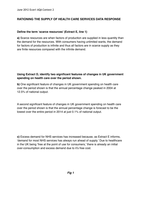
RATIONING THE SUPPLY OF HEALTH CARE SERVICES DATA RESPONSE
Define the term ‘scarce resources’ (Extract E, line 1)
a) Scarce resources are when factors of production are supplied in less quantity than
the demand for the resources. With consumers having unlimited wants, the demand
for factors of production is infinite and thus all factors are in scarce supply as they
are finite resources compared with the infinite demand.
Using Extract D, identify two significant features of changes in UK government
spending on health care over the period shown.
b) One significant feature of changes in UK government spending on health care
over the period shown is that the annual percentage change peaked in 2004 at
12.5% of national output.
A second significant feature of changes in UK government spending on health care
over the period shown is that the annual percentage change is forecast to be the
lowest over the entire period in 2014 at just 0.1% of national output.
c) Excess demand for NHS services has increased because, as Extract E informs,
‘demand for most NHS services has always run ahead of supply.’ Due to healthcare
in the UK being ‘free at the point of use for consumers,’ there is already an initial
over-consumption and excess demand due to it’s free cost.
Fig 1
RATIONING THE SUPPLY OF HEALTH CARE SERVICES DATA RESPONSE
Define the term ‘scarce resources’ (Extract E, line 1)
a) Scarce resources are when factors of production are supplied in less quantity than
the demand for the resources. With consumers having unlimited wants, the demand
for factors of production is infinite and thus all factors are in scarce supply as they
are finite resources compared with the infinite demand.
Using Extract D, identify two significant features of changes in UK government
spending on health care over the period shown.
b) One significant feature of changes in UK government spending on health care
over the period shown is that the annual percentage change peaked in 2004 at
12.5% of national output.
A second significant feature of changes in UK government spending on health care
over the period shown is that the annual percentage change is forecast to be the
lowest over the entire period in 2014 at just 0.1% of national output.
c) Excess demand for NHS services has increased because, as Extract E informs,
‘demand for most NHS services has always run ahead of supply.’ Due to healthcare
in the UK being ‘free at the point of use for consumers,’ there is already an initial
over-consumption and excess demand due to it’s free cost.
Fig 1