Water Treatment Questions and Answers 2023
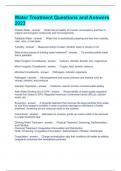
Water Treatment Questions and Answers 2023 Potable Water Water that is healthy for human consumption, and free of organic and inorganic compounds and microorganisms Palatable Water Water that is aesthetically pleasing and free from turbidity, color, odor, or bad taste Turbidity Measures clarity of water; whether water is cloudy or not What is the purpose of drinking water treatment? To provide potable water that is palatable Major Inorganic Constituents Calcium, chloride, fluoride, iron, magnesium Minor Inorganic Constituents Copper, lead, arsenic, mercury Microbial Constituents Pathogens, indicator organisms Pathogens Microorganisms that cause sickness and disease such as viruses, bacteria, and protozoa Indicator Organisms Coliforms, used to monitor microbial water activity Safe Water Drinking Act of 1974 Responsibility of water quality regulation moved from states to EPA. Regulated maximum contaminant levels (MCLs), calcium levels, etc. Screening A physical treatment that removes the large particles from water, by size from largest to smallest in order to prevent damage to mechanics in further treatment. Screening occurs using bar racks or bar screens. Comminutor Alternative to screens; grinds up coarse solids to be removed in a later treatment step Drinking Water Treatment Physical Treatment: Screening, Sedimentation, and Filtration Chemical Treatment: Coagulation-Flocculation and Disinfection Order: Screening, Coagulation-Flocculation, Sedimentation, Filtration, Disinfection Coagulation Charge neutralization step that conditions all matter by adding coagulants (chemical that destabilizes particles) Flocculation Small suspended particles stick together from the coagulant to form larger particles known as floc Sedimentation Process in which majority of the particles will settle by gravity within a reasonable time and be removed Filtration Water passes through filtration medium, removes small particles, pathogens, and flocs Granular Media Filtration Can operate at high or low hydraulic loading rate, water is driven by gravity flow through a bed of granular material, and particles are collected within the bed Membrane Filtration Water is pumped under pressure into a housing containing a semipermeable membrane, where some water filters through that membrane. Filters from largest to smallest, and processes increase in pressure. Microfiltration Membrane filtration: Filters particles, sediment, algae, protozoa, bacteria Ultrafiltration Membrane filtration: Filters small colloids and viruses Nanofiltration Reverse osmosis: Filters dissolved organic matter Reverse Osmosis Filters ionic species Primary Disinfection Inactivations of microorganisms in the water Secondary Disinfection maintaining a disinfectant residual in treated water distribution system
Written for
- Institution
- Water treatment
- Course
- Water treatment
Document information
- Uploaded on
- July 5, 2023
- Number of pages
- 3
- Written in
- 2022/2023
- Type
- Exam (elaborations)
- Contains
- Questions & answers
Subjects
- coagu
-
water treatment questions and answers 2023
-
potable water water that is healthy for human cons
-
safe water drinking act of 1974 responsibility of
-
screening a physical treatment that removes the la

Also available in package deal