QASP-S Exam Study Guide using Competency Guide Questions and Answers 2023
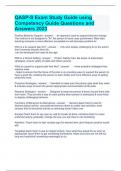
QASP-S Exam Study Guide using Competency Guide Questions and Answers 2023 Positive Behavior Support an approach used to support behavior change. The method is not designed to "fix" the person & never uses punishment. Main idea: teaching someone a more effective/ acceptable bx will decrease problem bx. Who is a bx support plan for? indv who display challenging bx to the extent that it severely impacts their life. -can be developed and used at any age. PBS in a School Setting Proact, Safety Care, Be aware of antecedant strategies, ensure safety of kiddo and others around. What is a good bx support plan look like? - more proactive strategies than reactive ones - helps to ensure that the focus of the plan is on providing ways to support the person to have a good life, enabling the person to learn better and more effective ways of getting what they need. Proactive Strategies Intended to make sure the person gets what they need & includes ways to teach the person appropriate communication & life skills. Reactive Strategies Designed to keep the person & those around them safe from harm. They provide a way to react quickly when person is distressed & more likely to display challenging behavior. Functions of Behaviors & Alternatives Sensory:teach them to ask for desired object/ activity, use preferred sensory items to create new activities, have sensory time & structured activity so stimming doesn't take over Escape:Teach them to say yes/ no, ask for break/ all done, introduce them to a less preferred activity gradually, change the way you ask them to do something Attention: Teach them to tap/ vocalize sign for desired item; give frequent positive social attn Tangibles:teach them to ask for object/ activity, Give what they asked for as soon as appropriate, teach them to get something themselves, Make sure they are not left too long w/o food/drink/ something meaningful to do. What is Discrete Trial Training? a Method of teaching in simplified & structured steps. A skill is broken down into steps & built up one step at a time. Each attempt is a "trial". 5 steps of DTT 1.Antecedent-sets up the response (SD, environment) 2.Prompt 3.Response 4. Consequence for Correct Response/ Incorrect response 5. Inter-trial interval Pros of DTT Scripted to ensure all trials are consistent, can increase motivation & learning, numerous learning opportunities, can be easily individualized, clear beginning & end to each trial, can minimize failures Cons of DTT Difficult to generalize, boring, lacks naturalistic reinforcement, difficulty fading reinforcement Purpose of Person Centered Planning ongoing problem solving process used to help ppl w disabilities plan for the future: -To look at the ind a different way -To assist the focus person in gaining control of their own life -To increase opportunities for participation in the community -To recognize individual desires, interests & dreams -Through team effort, develop a plan to turn dreams into reality. Who is involved in Person Centered Planning? The focus person & whoever they would like. Works best when there is an unbiased facilitator & a person to record what is shared. Family members, professionals, friends, etc may be invited. Steps of Person Centered Planning: Profiling 1. Develop a history for focus person. (Background, critical events, medical issues, major developments, important relationships) 2. Description of quality of life for FP. (Comm participation, comm presence, choices/rights, respect & competence) 3. Personal preferences of FP. (Preferred activities, things they do not like) Person Centered Planning Meeting 1. Review the profile. Make comments & observations 2. Review trends/ongoing events in the environment. 3. Share visions for the future to increase opportunities. 4. ID obstacles & opportunities, things that could make vision a reality 5. ID strategies: action steps for implementation 6. Getting started: ID action steps that can be done in a short time. 7. ID the need for service delivery to be more responsive to ind needs. Who was Hans Asperger? 20th century, Austrian Pediatrician who published a profile in 1944 of four boys with a specific pattern of bx: "autisitic psychopathy". Characteristics of Aspergers (1944) "lack of empathy, little ability to form friendships, one-sided conversations, intense absorption in a special interest & clumsy movements." The term "Asperger Syndrome" was coined by: Lorna Wing, a British Researcher in 1981 in her research to counter Kanner's findings on Autism. Basic principles of Bx by Skinner (& others) Reinforcement -Prompting -Fading -Shaping -Schedules of Rx (Principles are the pure science, not the applied science.) -Principles used to describe how bx is lawful, observable, measurable & has an impact on the environment. DRO Reinforcement is contingent on absence of problem behavior. DRA Potential rx is presented contingent on occurrences of desired alternative to maladaptive bx. Maladaptive Bx is placed on extinction. Example of DRA: crying to escape Asking for a break. Crying doesn't result in a break. Replacement Bx for Attention: tap on shoulder, say "excuse me", raise hand in class, Replacement Bx for Escape: Asking for break, finish one more then break, take a walk, go get a drink. Replacement Bx for Tangibles: eating/ drinking on a schedule so kiddo isn't hungry/thirsty, Manding/tacting desired items, Completing task to earn tangibles, turn taking Replacement bx for Sensory: fidgets, private time/breaks for sensory stimming, mouthable necklaces, chewing gum, swinging at recess, What is PRT :a naturalistic model of ABA. Primarily Developed by Koegel Autism Center at UCSB in 1970s. There are several "pivotal" areas/ domains of bx that have positive impact on learning all other behaviors. 4 Pivotal Areas of Bx: 1. Motivation 2. Responsivity to multiple cues 3. Self Mgmt (of interfering bx) 4. Self Initiated Social Interactions PRT vs DTT: -PRT focuses on pivotal areas of bx. -PRT uses naturalistic rx. -PRT uses child's interests & motivation to lead the therapy sx. -DTT focuses on individual target bx. -DTT often uses unrelated rx. -DTT often requires therapist to lead sx. Motivation in PRT Using tasks, objects, convo topics that are of interest to the child can increase his/her motivation to participate in their environment and learn new skills. 6 components of motivation in PRT 1. Encourage shared control (child choices) & turn taking 2. Gain & maximize child attn 3. Ensure task Variation 4. Intersperse Maintenance & acquisition tasks 5. Use contingent & natural rx 6. Vary rx magnitude & rx attempts Reinforcement in PRT Naturalistic & Contingent: Getting what they wanted by producing the desired bx. (asking for something and getting it.) Reinforce attempts, but not with same magnitude as successful trials. Self Initiated Interactions Asking, "what's that?" "Help!" "Look!" "Where is it?" "What's happening?" etc. Using Joint Attention- looking, pointing, labeling, commenting. Prompt Heirarchy for Fading FPP PPP VP MP GP PP ViP Natural Cue Inter-observer agreement Percentage of data agreement for an interval/ observation period. Measurements in frequency, duration, intervals Total count IOA smaller count/larger count*100% Used for event recording Mean-Count-per-Interval IOA (Int 1 IOA +Int 2 IOA + ....+Int N IOA)/N intervals x 100% For Frequency counts Exact Count per Interval IOA % total intervals both observers recorded same count # intervals w 100% IOA/ n intervals x 100% For frequency counts Partial Agreement w/in Intervals IOA Sum of all Interval IOA /#Intervals *100% same as "Mean count per interval" IOA For Frequency counts Interval by interval IOA # intervals w agreement/ Total # intervals x100% Interval counts Scored Interval IOA # int agreement occurred/ total # intervals where bx occurred (agree/disagree) x100% Interval counts
Written for
- Institution
- QASP
- Course
- QASP
Document information
- Uploaded on
- July 5, 2023
- Number of pages
- 11
- Written in
- 2022/2023
- Type
- Exam (elaborations)
- Contains
- Questions & answers
Subjects
-
qasp s exam study guide using competency guide que
-
positive behavior support an approach used to supp
-
what is a good bx support plan look like more p
-
reactive strategies designed to keep the person

Also available in package deal