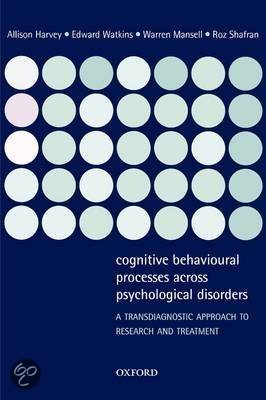
Cognitive behavioural processes across disorders
A transdiagnostic approach
1. Introduction
The role of behavioural processes became recognized through research by Pavlov, Watson and
Raynor, Wolpe, Skinner and others.
This led to behaviour therapy.
Beck and Ellis: cognitive processes, including unhelpful beliefs, illogical thinking, and distorted
perception, were crucial to understanding and treating psychological disorders.
This led to cognitive therapy.
Both combined gives CBT = Cognitive behavioural therapy
CBT has a disorder-focus, which does not look at the comorbidity across disorders.
The dominant schemes for classifying psychological disorders are the DSM (=Diagnostic and
Statistical Manual of Mental Disorders) and the ICD (=International Classification of Diseases).
Benefits classification systems:
Give a common language to clearly communicate with other clinicians/researchers.
Facilitates research on best possible treatment of a disorder.
Being diagnosed can be a relief for clients and their families.
Disadvantages classification:
When assigning a diagnosis, the complexity of the clinical picture can be minimized and
important and relevant personal info about the patient can be lost.
Classification system very complicated because so many disorders.
Being diagnosed can make clients feel stigmatized and they can experience discrimination.
It is a categorical system that specifies a clear cut-off at an often arbitrarily defined point.
Although claiming to be supported by an extensive empirical foundation, there are several
DSM diagnoses that have been criticized for being included without a sufficient rationale or
evidence-base.
The approach to classification adopted by the DSM and ICD is known as the syndromal approach in
that it uses groups of signs (what the clinician sees) and symptoms (what the patient reports) to
identify disease entities (syndromes).
These signs and symptoms are conceived as pointers to a disease with a known aetiology, course and
response to treatment.
Criticised, because knowledge of psychological disorders is not sufficiently well-advanced for
this ideal to be achieved.
Alternative syndromal approach: functional approach = relies on a thorough functional analysis, for
each individual patient, involving:
1. Identification of the clients problematic behaviour and it’s context.
2. Formulation of the info gathered to identify causal relationships.
3. Use of this formulation to collect additional info and finalize formulation.
4. Development of an intervention based on step 3.
5. Implementation of intervention and assessment of change.
If treatment does not reduce the problem behaviour, back to step 2.
A transdiagnostic approach
1. Introduction
The role of behavioural processes became recognized through research by Pavlov, Watson and
Raynor, Wolpe, Skinner and others.
This led to behaviour therapy.
Beck and Ellis: cognitive processes, including unhelpful beliefs, illogical thinking, and distorted
perception, were crucial to understanding and treating psychological disorders.
This led to cognitive therapy.
Both combined gives CBT = Cognitive behavioural therapy
CBT has a disorder-focus, which does not look at the comorbidity across disorders.
The dominant schemes for classifying psychological disorders are the DSM (=Diagnostic and
Statistical Manual of Mental Disorders) and the ICD (=International Classification of Diseases).
Benefits classification systems:
Give a common language to clearly communicate with other clinicians/researchers.
Facilitates research on best possible treatment of a disorder.
Being diagnosed can be a relief for clients and their families.
Disadvantages classification:
When assigning a diagnosis, the complexity of the clinical picture can be minimized and
important and relevant personal info about the patient can be lost.
Classification system very complicated because so many disorders.
Being diagnosed can make clients feel stigmatized and they can experience discrimination.
It is a categorical system that specifies a clear cut-off at an often arbitrarily defined point.
Although claiming to be supported by an extensive empirical foundation, there are several
DSM diagnoses that have been criticized for being included without a sufficient rationale or
evidence-base.
The approach to classification adopted by the DSM and ICD is known as the syndromal approach in
that it uses groups of signs (what the clinician sees) and symptoms (what the patient reports) to
identify disease entities (syndromes).
These signs and symptoms are conceived as pointers to a disease with a known aetiology, course and
response to treatment.
Criticised, because knowledge of psychological disorders is not sufficiently well-advanced for
this ideal to be achieved.
Alternative syndromal approach: functional approach = relies on a thorough functional analysis, for
each individual patient, involving:
1. Identification of the clients problematic behaviour and it’s context.
2. Formulation of the info gathered to identify causal relationships.
3. Use of this formulation to collect additional info and finalize formulation.
4. Development of an intervention based on step 3.
5. Implementation of intervention and assessment of change.
If treatment does not reduce the problem behaviour, back to step 2.