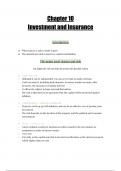
Chapter 10
Investment and Insurance
Introduction
● When money is safe to make it grow
● The amount invested is known as capital contribution
The major asset classes and risk
e bigger the risk you take the greater the possible return
● Cash - low risk
- Although it can be safeguarded, you can never hope to make a fortune
- Cash investment, including bank deposits, in money market accounts, o er
investors, the insurance of regular interest
- It will not be subject to huge external fluctuation
- The risk is that there is no guarantee that the capital will be protected against
inflation
● Fixed property - moderate to high risk
- Property can keep up with inflation, and can be an e ective way of gearing your
investment
- The risk depends on the location of the property and the political and economic
environment
● Bonds - moderate risk
- Can be defined as interest, bearing securities issued by the government or
companies in order to borrow money
- I owe you
- It is risky as the capital sum that is invested can fluctuate as the interest payment
will be higher than on cash
, ● equities - high-risk
- An investment in equities meaning shares of stocks means that the investors have
obtained a partial ownership of a company
- They can be freely traded on the JSE
- They are high risk, but they have the best chance of beating inflation over the long
term
Diversification should include a combination of the four major acid classes, meeting, spreading
the investment risk between the various classes
Risk profiling
Trying to find the best option for each individual, the risk profile will help to create an
understanding of the investors tolerance for risk, and thus whether the expected return is
acceptable
, ● Criteria used to choose an investment option
a) determining the investment timeframe; there’s no time to recover from losses or
price fluctuation in the market, the general rule is the longer the investment time
horizon. The more the customer can a ord to have the investment mix of high and
low risks
b) Acknowledging the financial position; the size of the potential investment relative to
the total wealth of the investor portfolio. It’s also important to look towards the
future investment risks. The greater the need for income for the investment, the
more balanced, or conservative the choice of the investment should be.
c) Risk and return on investment; looking for a high return, you will need more risk
Investors use risk profiling to decide on the amount of risk they are prepared to except
Investment and Insurance
Introduction
● When money is safe to make it grow
● The amount invested is known as capital contribution
The major asset classes and risk
e bigger the risk you take the greater the possible return
● Cash - low risk
- Although it can be safeguarded, you can never hope to make a fortune
- Cash investment, including bank deposits, in money market accounts, o er
investors, the insurance of regular interest
- It will not be subject to huge external fluctuation
- The risk is that there is no guarantee that the capital will be protected against
inflation
● Fixed property - moderate to high risk
- Property can keep up with inflation, and can be an e ective way of gearing your
investment
- The risk depends on the location of the property and the political and economic
environment
● Bonds - moderate risk
- Can be defined as interest, bearing securities issued by the government or
companies in order to borrow money
- I owe you
- It is risky as the capital sum that is invested can fluctuate as the interest payment
will be higher than on cash
, ● equities - high-risk
- An investment in equities meaning shares of stocks means that the investors have
obtained a partial ownership of a company
- They can be freely traded on the JSE
- They are high risk, but they have the best chance of beating inflation over the long
term
Diversification should include a combination of the four major acid classes, meeting, spreading
the investment risk between the various classes
Risk profiling
Trying to find the best option for each individual, the risk profile will help to create an
understanding of the investors tolerance for risk, and thus whether the expected return is
acceptable
, ● Criteria used to choose an investment option
a) determining the investment timeframe; there’s no time to recover from losses or
price fluctuation in the market, the general rule is the longer the investment time
horizon. The more the customer can a ord to have the investment mix of high and
low risks
b) Acknowledging the financial position; the size of the potential investment relative to
the total wealth of the investor portfolio. It’s also important to look towards the
future investment risks. The greater the need for income for the investment, the
more balanced, or conservative the choice of the investment should be.
c) Risk and return on investment; looking for a high return, you will need more risk
Investors use risk profiling to decide on the amount of risk they are prepared to except