

NSG6006 Predictor Exam-complete
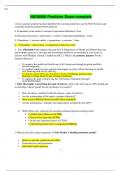
NSG6006 Predictor Exam-complete 1. Once a practice problem has been identified the next step would be to use the PICOT format to ask a question about the problem PICOT stands for O P population I intervention C concepts O operational definitions T time O P precision instrument , I intervention , C control , O Operational definitions , T time O P Population , I internal validity , c comparisons , o outcome , T time O P Population , I Intervention , C Comparison O Outcome T time 2. The Affordable Care Act has directed the US Department of Health and Human Services and multiple agencies to develop and disseminate initiatives on meeting the care needs of patients with Multiple Chronic Conditions (MCC). What is the primary purpose for the national direction? • To improve the health and health care of all Americans through targeted portfolio focused programs • To conduct health services research and engage in policy efforts focusing on health care financing and service delivery. • To protect against high out-of-pocket costs by prohibiting insurers from denying coverage based on pre-existing conditions. • To support the goal of improving the well being of humanity through smart globalization . 3 After thoroughly researching the topic of interest, what is the next step an APN should ask in selecting a theory/model for use in practice or research? • Does the theory /model fit with the purpose / topic of interest ? • Are the relationships of the major concepts delineated ? • Have several different theories/models been examined? • Are the assumptions , rationale and suppositions accepted by the APN? 4. Which three roles represent the accepted advanced practice nursing roles? • Certified Nurse Midwives (CNM) • Clinical Nurse Specialist (CNS) • Critical care registered nurses (CCRNs) • Certified Registered Nurse Anesthetists (CRNAs) 5. What are the three major categories of Nola Pender’s Health promotion model? • Behavior-specific cognitions and affect • Characteristics and experiences • Individual health measures • Behavioral outcomes 6. Which theorist/s identifies caritive factors as a value system, faith-hope and sensitivity to self and others? This describes which of the following theories? • Dorothea Orem • Paterson and Zderad • Jean Watson theory of human caring • Margaret Newman 7. What set of components is essential in a scientific theory ? • Interrelated concepts, definitions, and propositions. • Interrelated statements which assume all the relationship to be true • Statements that are based on the authors opinions and experience only • Propositions and constructs that are not necessarily tied together 8. The term advanced nursing practice (APN)includes nurses who are : • Certified APRNs with a minimum of a master’s degree • Graduates of programs in nursing education or a health-related field • Nurses certified in nursing informatics, nurse administration , policy or public health • Registered nurses with specialized post baccalaureate training 9. To meet Medicare’s coverage requirements , the nurse practitioners’ services must be • Provided subject to states restrictions and supervision requirements • Provided under direct supervision • Provided in rural health clinic or federally qualified health center • Billed through a physician directed clinic , health agency or hospital 10. A 20-year-old female comes to the primary care clinic with clinical findings consistent with acute bronchitis. She is sexually active with a male partner, although she states prior to this relationship she did have two sexual partners. Her menses occurs every 28 days and is regular. An example of a primary prevention activity for this patient is: • Screening for a sexually transmitted disease • Prescribing therapies to decrease a cough • Obtaining a Papanicolaou (PAP) test • Counseling about safer sexual practices 11. Which agency’s initiative establishes national health promotion and prevention efforts and establishes benchmarks for monitoring the progress of health among Americans over a 10-year timeframe? • Agency for health care research and quality • National institutes of Heath • Centers for Disease Control and Prevention (CDC) • Institute of Medicine 12. Development of the first pediatric nurse practitioner program at the University of Colorado in 1965 is credited to which two individuals? • Harry Fox, MD • Henry Silver, MD • Luella Jackson, RN • Loretta Ford , RN • Carla Brown, ARNP 13. Raynaud phenomenon is classified as a type III hypersensitivity reaction and is due to: • Immune complexes that are deposited in capillary beds, blocking circulation • Mast cells that are bound to specific endothelial receptors, causing them to degranulate and creating a localized inflammatory reaction that occludes capillary circulation • Cytotoxic T cells that attack and destroy the capillaries so that they are unable to perfuse local tissue • Antibodies that detect the capillaries as foreign protein and destroy them using lysosomal enzymes and toxic oxygen species. 14. The nurse practitioner is caring for a 21-year-old female who presents with a pruritic, erythematous rash matching pattern of her sandal straps. The nurse practitioner advises the patient to avoid scratching the area due to the risk of developing a secondary infection. The NP understands that the most likely etiology of secondary skins infections is caused by which organism. • Streptococcus pneumoniae • Proteus • Candida albicans • Staphylococcus aureus 15. How can the APN best influence development and passage of a specific health policy agenda? • Develop a health policy proposal and independently present it to the house of representative • Partner with a legislator to sponsor a bill despite unrelated committed assignment • Determine the best fit between legislative agenda, supporting organizations, and health policy issue. • Join a national committee to advocate for issues that impact APRNs 16. Which is the gold standard research design for generating evidence? • Randomized Control Trial • Nonrandomized comparison cohort trial • Case study • Systematic review 17. The APN is examining a client with new onset HTN. The NP recognizes that HTN may result in significant complications associated with which of the following three organs • Kidney • Liver • Eyes • Skin • Brain 18. which organization allows the use of the “BC” credential (e.g., FNP-BC) • commission on Collegiate Nursing Education (CCNE) • National Council of State Boards of Nursing (NCSBN) • American Nurses Credentialing Center (ANCC) • National Association of Pediatric Nurse Practitioners (NAPNAP) 19. which agency houses the United States Protective and Safety Task Force (USPSTF)? • The US Department of Health and Human Services • Centers for Disease Control and Prevention • Agency for Health, Research and Quality • National Clearing House Guidelines 20. : which two organizations administer nurse practitioner certification Programs? • State boards of nursing • American Nurses Association • National Organization of Nurse Practitioner Faculties • American Association of Nurse Practitioners • American Nurses Credentialing Center • 21. A style that is relational driven by common goal and satisfies the leader and the follower • a variable leadership style based on the environment, task, competency of works, or situation • Transformational leadership • A style that allows followers to act on their own decisions 22. A metaparadigm must include which of the following 3 characteristics† • Identification of a domain that is similar to domains of other disciplines. • • • Be global in scope 23. Which statement best reflects King’s theory? • The coping process responses constitute the outputs of the human adaptive system which are reflected in behaviors. • A person is a system of behavior characterized by repetitive, predictable, and goal —directed behaviors that strive toward balance. • Nursing goals are negotiated with the client and taking into account both the clients and the nurses perceptions • If nurses with special knowledge and skills communicate appropriate information to clients, mutual goal-setting and goal attainment will occur 24. which agency will the APN reference when seeking the current evidence- based guidelines directing standards of care? • Patient Centered Outcomes Research Institute (PCORI) • Agency for Health Research and Quality • Centers for Disease Control and Prevention • US Protective and Safety Task Force 25. A 43-year old woman has a 12-hour history of sudden onset of right upper quadrant abdominal pain with radiation to the shoulder, fever, and chills. She has had similar, milder episodes in the past. Examination reveals marked tenderness to right upper quadrant abdominal palpation. Her most likely diagnosis is: • Hepatoma • Acute cholecystitis • Acute hepatitis • Appendicitis 26. what theory is used to describe the cause of endometriosis? • Obstruction within the fallopian tubes prevents the endometrial tissue from • Endometrial tissue passes through the fallopian tubes and into the peritoneal cavity and remains responsive to hormones. • Inflammation of the endometrial tissue develops after recurrent sexually transmitted diseases • Endometrial tissue lies dormant in the uterus until the ovaries produce sufficient hormone to stimulate its growth . 27. Chronic pain, physical disability, social support, age and gender are related to perceived daily stress, which is related to depression. This is an example of which type of theory? • Explanatory • Predictive • Descriptive • Inter-relational 28. The leadership core competency of advanced practice nursing includes which three characteristics? • Mentoring • Innovation • Consultation • Collaboration • Activism 29. What initiative specifically focuses on the aging American, under the Affordable Care Act? • Team STEPPS • Multiple Chronic Conditions • Shared decision making • Literacy tool kit 30. Which of the following philosophies of work view would characterize human beings as holistic; parts are viewed only in the context of the whole? • Reaction • Simultaneous action • Holistic interaction • Reciprocal interaction 31. A difficult aspect of determining occupational exposure to disease is the: • Confidentiality of the information with company records • Inaccuracy of occupational exposure • Long latency period between exposure and disease reporting • Reliance on workers recall 32. A novice nurse practitioner is experiencing feeling of inferiority toward more experienced clinicians in the practice. She has identified that time constraints for visits and expectations to increase productivity limits her ability to address these non-adherent issues during client visits. Which barrier to ethical practice is influencing practice? • Internal to the APN • Inter-professional • Patient provider • Organizational/environmental 33. Utilizing Johnson’s Behavioral systems model (JBSM), the APN discovers that a patient is not sure who he can depend on because his wife is emotionally distant. This data would be characteristic of which subsystem of the JBSM • Restorative subsystem • Aggressive protective subsystem • Dependency subsystem • Affiliative protective subsystem 34 A purposeful, complex, dynamic, collaborative, and holistic interpersonal process aimed at supporting and facilitating patients and families through health-related experiences and transitions to achieve health-related goals (mutually determined when possible)” defines which APN role? • Coach • Collaborator • Direct care provider • Mentor 35.A 60 year old female with a history of emphysema presents to the primary care office with complaints of cough and shortness of breath at rest. During the physical exam, the nurse practitioner recognizes clubbing, barrel chest, and prolonged expiration. The nurse practitioner understands that the patient is exhibiting symptoms resulting from which type of pulmonary disease process? • Restrictive • Obstructive • Pleuritic • Atelectatic 36. Which of the following statements accurately defines Hamric’s conceptual definition of advanced practice nursing? • The patient-focused application of an expanded range of competencies to improve health outcomes for patients and populations within a specialized clinical area of the larger discipline of nursing. • A mid-level position that incorporates advanced clinical knowledge and skills to impact patient care • A nurse who has achieved education and specialized certification beyond that basic nursing education • None of the above 37. When caring for a client who presents with pain and swelling to location of the metacarpophalangeal (MCP) and proximal interphalangeal (PIP) joints. Which diagnostic test is most specific to diagnosis of rheumatoid arthritis? • Elevated rheumatoid factor level • Elevated uric acid level • Positive antinuclear antibody titer • Elevated erythrocyte sedimentation rate • 38. The Consensus Model for Advanced Practice Registered Nurse Regulations addresses which four areas? • Specialty areas • Roles and titles to be used • Population foci • Preparation for emerging APRN roles • Licensure blueprints for testing • 39. Which statement best supports primary prevention of burns for geriatric clients? • Douse flames with a fire extinguisher • Avoid smoking in bed • Install a smoke detector • Use a planned emergency escape route • 40.Which of the following three complications are associated with chronic hepatitis B? • Continued infectivity • Malignant hypertension • Uncompensated cirrhosis • Hepatocellular carcinoma • Renal encephalopathy • 41. The central competency, direct clinical practice, is characterized by which three of the following? • Uniform approach to health management • Expert clinical performance • Formation of a therapeutic partnership with patients • Holistic approach • Direct physician supervision • 42. Which payment system seeks Medicare reimbursement under the MACRA legislation for providing high quality patient-specific care and improved outcomes? • Accountable care organization • Advanced payment models • Merit Incentive Based Payment • Bundle payment programs • 43. What four components of advanced practice nursing (APN) are specified by the National Council for State Boards of Nursing Consensus Model for APRN regulation? • Licensure, • Accreditation • Competence • Education • Certification 44. Which learning theory would be most applicable as a guide for the development of a program to help families of patients in palliative care? • Behaviorist learning theory • Cognitive learning theory • Psychodynamic learning theory • Humanistic Learning Theory
Document information
- Uploaded on
- July 3, 2023
- Number of pages
- 29
- Written in
- 2022/2023
- Type
- Exam (elaborations)
- Contains
- Questions & answers


