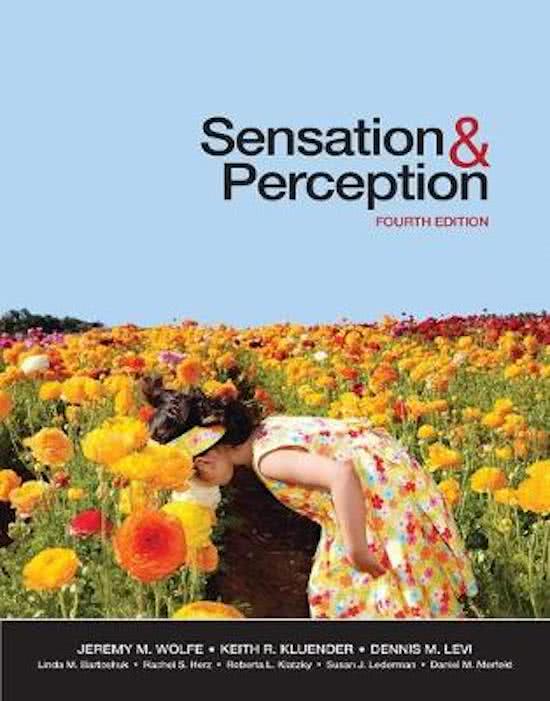
SENSATION & PERCEPTION
Chapter 1. Introduction
Sensation is the ability to detect a stimulus and, perhaps, to turn that detection into a private
experience. Perception is the act of giving meaning to a detected sensation.
There is a variety in the methods used in the study of the senses:
1. Thresholds;
2. Scaling – measuring private experience;
3. Signal detection theory – measuring difficult decisions;
4. Sensory neuroscience;
5. Neuroimaging – an image of the mind.
Thresholds and the Dawn of Psychophysics
There is a debate between dualism and materialism.
Dualism: the mind has an existence separate from the material world of the body.
Materialism: the mind is not separate: the mind is what the brain does.
Panpsychism: the mind exists as a property of all matter, all matter has consciousness.
Psychophysics: the science of defining quantitative relationships between physical and
psychological (subjective) events.
Two-point touch threshold: H13, the minimum distance at which two stimuli are just perceptible
as separate.
This difference is called the difference threshold/just noticeable difference (JND).
The detectable change ratio is almost always a constant ratio between the change and
what was being changed (the standard): Weber fractions.
The general rule that the size of the detectable difference is a constant proportion of
the level of the stimulus is called Weber’s Law.
Fechner extended Weber’s law to Fechner’s Law: a principle describing the relationship
between stimulus and resulting sensation that says that the magnitude (relative size) of
subjective sensation increases proportionally to the logarithm of the stimulus intensity.
o This described the fact that our psychological experience of the intensity of light,
sound, smell, taste or touch increases less quickly than the actual physical
stimulus increases. This demonstrated a relationship between psyche & physics.
Psychophysical methods
An absolute threshold is the minimum amount of stimulation necessary for a person to detect
a stimulus 50% of the time. How can we measure an absolute threshold?
The method of constant stimuli: creating many stimuli with different intensities in order
to find the tiniest intensity that can be detected. Stimuli must be presented multiple
times because subtle perceptual (e.g. threshold) judgements are variable. Because of
the variability in the nervous system, stimuli near threshold will be detected sometimes
and missed at other.
The method of limits: the particular dimension of a stimulus, or the difference between
two stimuli, is varied incrementally until the participant responds differently. Like
increasing and decreasing a sound reporting whether they no longer/start to hear it.
1
, The method of adjustment: this is a method of limits in which the subject controls the
change in the stimulus (like day-to-day life adjusting the volume of a radio).
Scaling Methods
Magnitude estimation is a method in which the participant assigns values according to
perceived magnitudes of the stimuli (how strong a sugar taste is or how bright a light is).
Steven’s Power Law is a principle describing the relationship between a stimulus and resulting
sensation that says that the magnitude of subjective sensation is proportional to the stimulus
magnitude raised to an exponent. Adjusting the light from 1 candle to 11 candles is quite
dramatic, but if we add 10 to 10.000, it will not be that noticeable. The exponent for brightness
is about 0.3. If an exponent is 1, like with length, it seems like that a 12-inch-long stick looks
twice as long as a 6-inch-long stick. Sometimes the exponent can be greater than 1.
Weber’s Law Clear objective measurement. We know how much we varied
the stimulus and the observers can either tell that the stimulus
changed or they cannot.
Fechner’s Law Same sort of objective measures as Weber, but Fechner
assumes that all JNDs are perceptually equivalent (which is not
true: an increase in electric shock can increase pain much more
than the actual electrical increase).
Steven’s Power Law Describes rating data (subject’s ratings) and we can check
whether they are reasonable and consistent, but there is no
way to know whether they are objectively right or wrong.
Cross-modality matching is the ability to match the intensities of sensations that come from
different sensory modalities and thus shows sensory differences. The relationship of visual and
auditory experience appears to be similar across individuals.
Supertasters are individuals who experience the most intense taste sensations.
Signal Detection Theory
The SDT holds that the stimulus you’re trying to detect is always being detected in the presence
of ‘noise’. This can be internal noise, the static in your nervous system, or external noise,
present in a picture or room. This theory exists to help us understand what’s going on when we
make decisions under conditions of uncertainty. A criterion is a value that is somehow
determined by the observer: an internal threshold. A response above the criterion means that
the signal is present. A response below that level will be treated as noise.
No ring Ring
No Correct rejection (~hit) Miss
Yes False alarm Hit
A false alarm is just as likely as a hit. You can measure sensitivity (known as d’=d-prime) by
knowing the relationship of hits to false alarms. If you’re not sensitive and thus the noise curve
and the signal curve overlap, you have no ability to detect the signal. The normal d’ is about 1:
you have hits and misses. If you’re expecting a very important call, you will shift your criterion
2
Chapter 1. Introduction
Sensation is the ability to detect a stimulus and, perhaps, to turn that detection into a private
experience. Perception is the act of giving meaning to a detected sensation.
There is a variety in the methods used in the study of the senses:
1. Thresholds;
2. Scaling – measuring private experience;
3. Signal detection theory – measuring difficult decisions;
4. Sensory neuroscience;
5. Neuroimaging – an image of the mind.
Thresholds and the Dawn of Psychophysics
There is a debate between dualism and materialism.
Dualism: the mind has an existence separate from the material world of the body.
Materialism: the mind is not separate: the mind is what the brain does.
Panpsychism: the mind exists as a property of all matter, all matter has consciousness.
Psychophysics: the science of defining quantitative relationships between physical and
psychological (subjective) events.
Two-point touch threshold: H13, the minimum distance at which two stimuli are just perceptible
as separate.
This difference is called the difference threshold/just noticeable difference (JND).
The detectable change ratio is almost always a constant ratio between the change and
what was being changed (the standard): Weber fractions.
The general rule that the size of the detectable difference is a constant proportion of
the level of the stimulus is called Weber’s Law.
Fechner extended Weber’s law to Fechner’s Law: a principle describing the relationship
between stimulus and resulting sensation that says that the magnitude (relative size) of
subjective sensation increases proportionally to the logarithm of the stimulus intensity.
o This described the fact that our psychological experience of the intensity of light,
sound, smell, taste or touch increases less quickly than the actual physical
stimulus increases. This demonstrated a relationship between psyche & physics.
Psychophysical methods
An absolute threshold is the minimum amount of stimulation necessary for a person to detect
a stimulus 50% of the time. How can we measure an absolute threshold?
The method of constant stimuli: creating many stimuli with different intensities in order
to find the tiniest intensity that can be detected. Stimuli must be presented multiple
times because subtle perceptual (e.g. threshold) judgements are variable. Because of
the variability in the nervous system, stimuli near threshold will be detected sometimes
and missed at other.
The method of limits: the particular dimension of a stimulus, or the difference between
two stimuli, is varied incrementally until the participant responds differently. Like
increasing and decreasing a sound reporting whether they no longer/start to hear it.
1
, The method of adjustment: this is a method of limits in which the subject controls the
change in the stimulus (like day-to-day life adjusting the volume of a radio).
Scaling Methods
Magnitude estimation is a method in which the participant assigns values according to
perceived magnitudes of the stimuli (how strong a sugar taste is or how bright a light is).
Steven’s Power Law is a principle describing the relationship between a stimulus and resulting
sensation that says that the magnitude of subjective sensation is proportional to the stimulus
magnitude raised to an exponent. Adjusting the light from 1 candle to 11 candles is quite
dramatic, but if we add 10 to 10.000, it will not be that noticeable. The exponent for brightness
is about 0.3. If an exponent is 1, like with length, it seems like that a 12-inch-long stick looks
twice as long as a 6-inch-long stick. Sometimes the exponent can be greater than 1.
Weber’s Law Clear objective measurement. We know how much we varied
the stimulus and the observers can either tell that the stimulus
changed or they cannot.
Fechner’s Law Same sort of objective measures as Weber, but Fechner
assumes that all JNDs are perceptually equivalent (which is not
true: an increase in electric shock can increase pain much more
than the actual electrical increase).
Steven’s Power Law Describes rating data (subject’s ratings) and we can check
whether they are reasonable and consistent, but there is no
way to know whether they are objectively right or wrong.
Cross-modality matching is the ability to match the intensities of sensations that come from
different sensory modalities and thus shows sensory differences. The relationship of visual and
auditory experience appears to be similar across individuals.
Supertasters are individuals who experience the most intense taste sensations.
Signal Detection Theory
The SDT holds that the stimulus you’re trying to detect is always being detected in the presence
of ‘noise’. This can be internal noise, the static in your nervous system, or external noise,
present in a picture or room. This theory exists to help us understand what’s going on when we
make decisions under conditions of uncertainty. A criterion is a value that is somehow
determined by the observer: an internal threshold. A response above the criterion means that
the signal is present. A response below that level will be treated as noise.
No ring Ring
No Correct rejection (~hit) Miss
Yes False alarm Hit
A false alarm is just as likely as a hit. You can measure sensitivity (known as d’=d-prime) by
knowing the relationship of hits to false alarms. If you’re not sensitive and thus the noise curve
and the signal curve overlap, you have no ability to detect the signal. The normal d’ is about 1:
you have hits and misses. If you’re expecting a very important call, you will shift your criterion
2