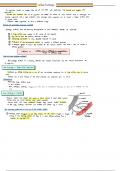
Gas Exchange
An of its cells with like ( for
organism
needs to
supply every one substances
glucose and
oxygen
•
respiration )
The and metabolic of affect amount of material that For
size rate an
organism will the each is
exchanged
-
.
high larger surface
example ,
organisms with a metabolic rate exchange more materials and so
require a area
to volume ratio .
•
Different sized do this in different
organisms
:
ways
Features of specialised exchange surfaces
surfaces have effective of materials
Exchange the following characteristics to allow transfer
'
:
1- A surface
large area relative to the volume of the organism
2
Very thin so that the diffusion distance is short
3 to
Selectively permeable allow selected materials to cross
4 Movement of the medium diffusion
environmental to maintain a
gradient
5 A of medium like blood in to maintain
transport system to ensure the movement the internal order a
diffusion
gradient .
surface area ✗ difference in concentration
diffusion a
length of diffusion path
what surfaces ?
are
gas exchange
Gas surface between the environment of
exchange is
boundary outside environment and the internal
•
a
an
organism .
Gas Exchange in Single-celled Organisms 7¥
"÷: * .÷÷ ←.
Substances diffuse directly surface
into out of the cell surface membrane due to
high to volume
•
can or - area
ratio .
•
Diffusion rate is
quick because of the small distances the substances have to travel .
Adaptations
Relatively large surface
•
area
•
A thin surface
Short diffusion ( take biochemical diffuses the
pathway part in reactions it into
•
can soon as
oxygen as
cell )
Gas Exchange in Insects % spiracle
"" ÷⇐÷÷¥
tracheoles.ier.s.ia.in
. " " " " " "" "" """ "" " " " "" " "" " "" "" " "
" "
trachea
•
Tracheae divide into smaller dead-end tubes called
tracheoles
Gases enter and leave tracheae through called spiracles
tiny
'
pores
:
,
on the
body surface . Spiracles are opened and closed by a valve .
How in and out of the tracheal system
respiratory gases move
1- Tracheoles extend
body of the fluid-filled
throughout tissues insect
Oxygen is
brought
'
all the .
ends of
directly to the
respiring tissues ,
as there is a short diffusion pathway from a trachea / es
tracheae cell
any body
to .
An of its cells with like ( for
organism
needs to
supply every one substances
glucose and
oxygen
•
respiration )
The and metabolic of affect amount of material that For
size rate an
organism will the each is
exchanged
-
.
high larger surface
example ,
organisms with a metabolic rate exchange more materials and so
require a area
to volume ratio .
•
Different sized do this in different
organisms
:
ways
Features of specialised exchange surfaces
surfaces have effective of materials
Exchange the following characteristics to allow transfer
'
:
1- A surface
large area relative to the volume of the organism
2
Very thin so that the diffusion distance is short
3 to
Selectively permeable allow selected materials to cross
4 Movement of the medium diffusion
environmental to maintain a
gradient
5 A of medium like blood in to maintain
transport system to ensure the movement the internal order a
diffusion
gradient .
surface area ✗ difference in concentration
diffusion a
length of diffusion path
what surfaces ?
are
gas exchange
Gas surface between the environment of
exchange is
boundary outside environment and the internal
•
a
an
organism .
Gas Exchange in Single-celled Organisms 7¥
"÷: * .÷÷ ←.
Substances diffuse directly surface
into out of the cell surface membrane due to
high to volume
•
can or - area
ratio .
•
Diffusion rate is
quick because of the small distances the substances have to travel .
Adaptations
Relatively large surface
•
area
•
A thin surface
Short diffusion ( take biochemical diffuses the
pathway part in reactions it into
•
can soon as
oxygen as
cell )
Gas Exchange in Insects % spiracle
"" ÷⇐÷÷¥
tracheoles.ier.s.ia.in
. " " " " " "" "" """ "" " " " "" " "" " "" "" " "
" "
trachea
•
Tracheae divide into smaller dead-end tubes called
tracheoles
Gases enter and leave tracheae through called spiracles
tiny
'
pores
:
,
on the
body surface . Spiracles are opened and closed by a valve .
How in and out of the tracheal system
respiratory gases move
1- Tracheoles extend
body of the fluid-filled
throughout tissues insect
Oxygen is
brought
'
all the .
ends of
directly to the
respiring tissues ,
as there is a short diffusion pathway from a trachea / es
tracheae cell
any body
to .