NSG 252 Perfusion Review Questions and answer already passed 2023
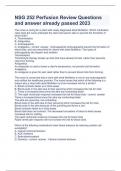
NSG 252 Perfusion Review Questions and answer already passed 2023 The nurse is caring for a client with newly diagnosed atrial fibrillation. Which medication class does the nurse anticipate the client will need to take to prevent the formation of blood clots? A. Thrombolytics B. Antipyretics C. Anticoagulants D. Analgesics - correct answer Anticoagulants Anticoagulants prevent the formation of blood clots, and are prescribed for clients with atrial fibrillation. Two types of anticoagulants are heparin and warfarin. Thrombolytics Thrombolytic therapy breaks up clots that have already formed, rather than prevents clots from forming. Antipyretics An antipyretic is used to lower a client's temperature, not prevent clot formation. Analgesics An analgesic is given for pain relief rather than to prevent blood clots from forming. The nurse is concerned that a client with atrial fibrillation is not on any anticoagulants and notifies the healthcare provider. The nurse knows that which of the following is a reason why a client with atrial fibrillation is at an increased risk for a stroke? A. Blood contracts faster so it clots easier B. Blood pools in the atria due to their quivering which increases the risk for clots C. There is increased blood since the atria are contracting faster D. The rapid ventricular response increases the risk for blood clots - correct answer There is increased blood since the atria are contracting faster The atria are quivering, not contracting. Blood pools in the atria due to their quivering which increases the risk for clots Blood pools in the atria because of the quivering and forms a clot. Blood contracts faster so it clots easier Blood itself does not contract. The decreased circulation of blood is what causes increased risk for clotting. The rapid ventricular response increases the risk for blood clots Rapid ventricular response will not increase the risk for blood clots. Which of the following medications lower blood pressure by reducing cardiac cell excitability? A. Calcium channel blockers B. ACE inhibitors C. Beta-adrenoceptors D. Diuretics - correct answer Calcium channel blockers
Written for
- Institution
- NSG 252 Perfusion
- Course
- NSG 252 Perfusion
Document information
- Uploaded on
- July 1, 2023
- Number of pages
- 12
- Written in
- 2022/2023
- Type
- Exam (elaborations)
- Contains
- Questions & answers
Subjects
-
nsg 252 perfusion review questions and answer alre
-
the nurse is caring for a client with newly diagno
-
the nurse is concerned that a client with atrial f

Also available in package deal