Section 3 : Organic Chemistry
Amino Acids, Proteins and DNA
Amino Acids
General Structure
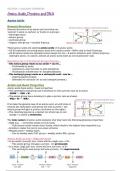
General structure of an amino acid involves one
‘central’ C atom (α-carbon) w/ bonds to 4 groups:
• Hydrogen atom
• Amino group
• Carboxyl group
• Organic side group = variable R-group
These amino acids are called α-amino acids or 2-amino acids.
• All 20 naturally occurring amino acids are α-amino acids + differ only in their R-groups.
• All 20 amino acids are optically active except for one = 2-amino ethanoic acid (where R-group =
hydrogen atom). In nature, almost all amino acids exist as one enantiomer only.
Reactions due to Functional Groups Present…
• The amino group reacts as an amine + can be…
- Protonated by acids.
- Acylated w/ acyl chloride or acid anhydride.
- Nucleophilic substitution w/ halogenoalkanes.
• The carboxyl group reacts as a carboxylic acid + can be…
- Deprotonated by bases.
- Esteri ed w/ alcohols (w/ an acid catalyst present).
Acidic and Basic Properties
Amino acids have acidic + basic properties:
• The carboxylic acid group has a tendency to lose a proton (act as an acid):
-COOH ⇌ -COO- + H+
• The amine group has a tendency to gain a proton (act as a base):
-NH2 + H+ ⇌ -NH3+
If we take the general case of an amino acid, at a pH close to
neutral the carboxylic acid group will lose a proton + the
amine group will gain a proton (as shown on the right).
• The resulting species is a dipolar ion which has no net
charge + is called a zwitterion.
The ionic nature of amino acids explains why they have the following physical properties:
• High m.p. ∴ colourless solids at room temp.
- Solid amino acids contain ionic bonds, which leads to the higher than expected m.p.
• Soluble in water but not in non-polar solvents.
• Weakly acidic + weakly basic.
- Due to weakly basic COO- group + weakly acidic NH3+ group.
Amino Acids at Low + High pH Levels
• In an acidic (low pH) env., there will be a high conc. of H+.
- The amine group will gain a proton - it’s protonated.
• In a basic (high pH) env., there will be a low conc. of H+.
- The carboxylic acid group will lose a proton - it’s deprotonated.
fi
, Section 3 : Organic Chemistry
Proteins
Proteins are sequences of amino acids joined by peptide links.
• 2 amino acids form a dipeptide.
• 3 amino acids form a tripeptide.
• Up to 50 amino acids are polypeptides.
• More than 50 amino acids are proteins.
The reaction between amino acids to form a peptide link is called a condensation reaction since water
is eliminated:
Protein Structure
• Primary structure: the sequence of amino acids in a
polypeptide.
• Secondary structure: the shape the polypeptide chain folds
into = an α-helix or a β-pleated sheet.
- This is governed by H-bonds between atoms of the
peptide links, particularly between the O atoms from the
carbonyl groups + the H atoms from the amide groups.
- The large no. of H-bonds ↑ forces w/in + between proteins
+ forms stable structures.
• Tertiary structure: further folding of the secondary
structure (α-helix or β-pleated sheet) which gives the
protein the characteristic 3D shape that is closely related to
its function.
- This is held together by various bonds between R-groups
of the individual amino acids. 4 types of bonds are
involved (listed in order of ↑ strength):
• Hydrophobic + hydrophilic interactions: polar + non-
polar R-groups localised in certain sections of the
protein molecule depending on its function.
• Hydrogen bonds: weak. Between polar R-groups.
• Ionic bonds: quite strong. Between R-groups w/ +ve or
-ve (opp.) charges,
• Disul de bridges (-S-S-): very strong. Covalent
disul de bonds between 2 sulfur containing amino
acids.
Hydrolysis of Polypeptides and Proteins
The C-N bond in the peptide link is broken + the polypeptide/
protein is broken down into its constituent amino acids in a
hydrolysis reaction (where a molecule of water is removed for
each peptide link broken).
In the presence of water alone this process is very slow, but it can
be catalysed by:
•An acid, or…
•A substrate-speci c enzyme.
fifi fi
Amino Acids, Proteins and DNA
Amino Acids
General Structure
General structure of an amino acid involves one
‘central’ C atom (α-carbon) w/ bonds to 4 groups:
• Hydrogen atom
• Amino group
• Carboxyl group
• Organic side group = variable R-group
These amino acids are called α-amino acids or 2-amino acids.
• All 20 naturally occurring amino acids are α-amino acids + differ only in their R-groups.
• All 20 amino acids are optically active except for one = 2-amino ethanoic acid (where R-group =
hydrogen atom). In nature, almost all amino acids exist as one enantiomer only.
Reactions due to Functional Groups Present…
• The amino group reacts as an amine + can be…
- Protonated by acids.
- Acylated w/ acyl chloride or acid anhydride.
- Nucleophilic substitution w/ halogenoalkanes.
• The carboxyl group reacts as a carboxylic acid + can be…
- Deprotonated by bases.
- Esteri ed w/ alcohols (w/ an acid catalyst present).
Acidic and Basic Properties
Amino acids have acidic + basic properties:
• The carboxylic acid group has a tendency to lose a proton (act as an acid):
-COOH ⇌ -COO- + H+
• The amine group has a tendency to gain a proton (act as a base):
-NH2 + H+ ⇌ -NH3+
If we take the general case of an amino acid, at a pH close to
neutral the carboxylic acid group will lose a proton + the
amine group will gain a proton (as shown on the right).
• The resulting species is a dipolar ion which has no net
charge + is called a zwitterion.
The ionic nature of amino acids explains why they have the following physical properties:
• High m.p. ∴ colourless solids at room temp.
- Solid amino acids contain ionic bonds, which leads to the higher than expected m.p.
• Soluble in water but not in non-polar solvents.
• Weakly acidic + weakly basic.
- Due to weakly basic COO- group + weakly acidic NH3+ group.
Amino Acids at Low + High pH Levels
• In an acidic (low pH) env., there will be a high conc. of H+.
- The amine group will gain a proton - it’s protonated.
• In a basic (high pH) env., there will be a low conc. of H+.
- The carboxylic acid group will lose a proton - it’s deprotonated.
fi
, Section 3 : Organic Chemistry
Proteins
Proteins are sequences of amino acids joined by peptide links.
• 2 amino acids form a dipeptide.
• 3 amino acids form a tripeptide.
• Up to 50 amino acids are polypeptides.
• More than 50 amino acids are proteins.
The reaction between amino acids to form a peptide link is called a condensation reaction since water
is eliminated:
Protein Structure
• Primary structure: the sequence of amino acids in a
polypeptide.
• Secondary structure: the shape the polypeptide chain folds
into = an α-helix or a β-pleated sheet.
- This is governed by H-bonds between atoms of the
peptide links, particularly between the O atoms from the
carbonyl groups + the H atoms from the amide groups.
- The large no. of H-bonds ↑ forces w/in + between proteins
+ forms stable structures.
• Tertiary structure: further folding of the secondary
structure (α-helix or β-pleated sheet) which gives the
protein the characteristic 3D shape that is closely related to
its function.
- This is held together by various bonds between R-groups
of the individual amino acids. 4 types of bonds are
involved (listed in order of ↑ strength):
• Hydrophobic + hydrophilic interactions: polar + non-
polar R-groups localised in certain sections of the
protein molecule depending on its function.
• Hydrogen bonds: weak. Between polar R-groups.
• Ionic bonds: quite strong. Between R-groups w/ +ve or
-ve (opp.) charges,
• Disul de bridges (-S-S-): very strong. Covalent
disul de bonds between 2 sulfur containing amino
acids.
Hydrolysis of Polypeptides and Proteins
The C-N bond in the peptide link is broken + the polypeptide/
protein is broken down into its constituent amino acids in a
hydrolysis reaction (where a molecule of water is removed for
each peptide link broken).
In the presence of water alone this process is very slow, but it can
be catalysed by:
•An acid, or…
•A substrate-speci c enzyme.
fifi fi