Section 3 : Organic Chemistry
Aromatic Chemistry
The Structure and Nomenclature of Benzene
The Kekulé Structure of Benzene
In 1865 Kekulé proposed that the structure of benzene (C6H6) was a
hexagonal ring structure of 6 C atoms, each bonded to a single H atom + w/
alternating double + single bonds between the C atoms. This theoretical
model of benzene was known as cyclohexa-1,3,5-triene.
However, there are problems w/ this theoretical model of benzene
(cyclohexa-1,3,5-triene) that show it to be inaccurate…
Kekulé’s/Theoretical structure of benzene Experimental observations
Bond lengths in the carbon ring should alternate All bond lengths in the carbon ring are the
between those of single (C-C) + double (C=C) same + intermediate in length between single
covalent bonds. + double bonds.
It should readily undergo addition reactions in the Benzene can undergo substitution reactions
way that alkenes + bromine rapidly react to but does not undergo addition reactions easily.
decolourise bromine water.
The enthalpy of hydrogenation (adding H atoms to The actual enthalpy of hydrogenation is
all unsaturated bonds) would be -360kJmol-1. -208kJmol-1.
The Delocalised Structure of Benzene
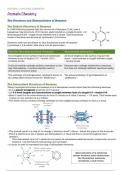
Today’s accepted structure for benzene is of a delocalised model which has the following features:
• It is a planar hexagonal molecule of 6 C atoms.
• All C-C bond lengths are intermediate in length between that of a single C-C + double C=C.
• Each C uses 3 of its outer electrons to form 3 σ bonds to 2 other C atoms, + 1 H atom. This leaves each
C atom w/ one electron in a p orbital.
• The lobes of the p orbitals overlap sideways w/ the neighbouring p orbitals to form a π bond.
• The overall result is a ring of -ve charge (“electron cloud”) above + below the plane of the molecule.
• The 6 p electrons in the π system are delocalised (i.e. they are free to move throughout the π
system).
- This delocalised cloud of π electrons is present in substances called aromatic compounds; as such,
benzene + its derivatives (the arenas) are aromatic.
• A circle is used to represent the ring of delocalised electrons.
Delocalisation of p electrons
makes benzene more stable than
the theoretical molecule
cyclohexa-1,3,5-triene.
Aromatic Chemistry
The Structure and Nomenclature of Benzene
The Kekulé Structure of Benzene
In 1865 Kekulé proposed that the structure of benzene (C6H6) was a
hexagonal ring structure of 6 C atoms, each bonded to a single H atom + w/
alternating double + single bonds between the C atoms. This theoretical
model of benzene was known as cyclohexa-1,3,5-triene.
However, there are problems w/ this theoretical model of benzene
(cyclohexa-1,3,5-triene) that show it to be inaccurate…
Kekulé’s/Theoretical structure of benzene Experimental observations
Bond lengths in the carbon ring should alternate All bond lengths in the carbon ring are the
between those of single (C-C) + double (C=C) same + intermediate in length between single
covalent bonds. + double bonds.
It should readily undergo addition reactions in the Benzene can undergo substitution reactions
way that alkenes + bromine rapidly react to but does not undergo addition reactions easily.
decolourise bromine water.
The enthalpy of hydrogenation (adding H atoms to The actual enthalpy of hydrogenation is
all unsaturated bonds) would be -360kJmol-1. -208kJmol-1.
The Delocalised Structure of Benzene
Today’s accepted structure for benzene is of a delocalised model which has the following features:
• It is a planar hexagonal molecule of 6 C atoms.
• All C-C bond lengths are intermediate in length between that of a single C-C + double C=C.
• Each C uses 3 of its outer electrons to form 3 σ bonds to 2 other C atoms, + 1 H atom. This leaves each
C atom w/ one electron in a p orbital.
• The lobes of the p orbitals overlap sideways w/ the neighbouring p orbitals to form a π bond.
• The overall result is a ring of -ve charge (“electron cloud”) above + below the plane of the molecule.
• The 6 p electrons in the π system are delocalised (i.e. they are free to move throughout the π
system).
- This delocalised cloud of π electrons is present in substances called aromatic compounds; as such,
benzene + its derivatives (the arenas) are aromatic.
• A circle is used to represent the ring of delocalised electrons.
Delocalisation of p electrons
makes benzene more stable than
the theoretical molecule
cyclohexa-1,3,5-triene.