Section 3: Organic Chemistry
Alcohols
Alcohols are a homologous series w/ the general formula CnH2n+1OH and the functional group -OH.
Physical Properties of Alcohols
Alcohols have a higher b.p. than alkanes w/ a similar Mr because…
• When a molecular covalent liquid is vaporised, energy is supplied to break the intermolecular forces
of attraction between the molecules.
• Alkane molecules are held together by van der Waals’ forces.
• Alcohol molecules are held together by both van der Waals’ forces + hydrogen bonding.
• Hydrogen bonding is stronger than the weak van der Waals’ forces ∴ alcohols = higher b.p.
• Alcohols are soluble in water as they can hydrogen bond w/ water molecules. Alkanes are not soluble
in water as they contain no hydroxyl groups + ∴ can’t hydrogen bond w/ water molecules.
• The greater the no. of hydroxyl groups, the greater the no. of H-bonds + ∴ the greater the solubility
of the alcohol.
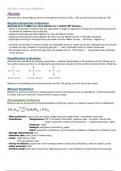
Classi cation of Alcohols
Alcohols are classi ed as primary, secondary + tertiary depending on the position of the -OH group in
the carbon chain and the no. of alkyl groups, R groups, attached to the carbon bonded to the -OH group.
Methanol is classi ed as a primary alcohol as the -OH group is at the end of the chain.
Ethanol Production
Ethanol is used as a solvent to make many common substances such as detergents + pharmaceuticals.
It is also used as a solvent to remove ink or paint stains.
Fermentation of Glucose
Ethanol can be produced by the fermentation of glucose, which is a batch process (this is inef cient).
• Raw materials: crops (such as maize, sugar cane and sugar beet) = renewable resource
• Conditions: Temperature: 35°C (as below this temp. reaction rate = too slow + above this
temp. enzymes in yeast are denatured ∴ compromise temp. used)
Pressure: 1atm
Catalyst: enzymes produced by yeast
Other: anaerobic conditions (to prevent the oxidation of ethanol to ethanoic acid)
• Energy requirements: low
• Reaction rate: slow (due to lower temp.)
• Costs: high labour costs
low equipment costs
• Purity of ethanol: impure as it also contains water (fractional distillation used to make it pure)
• Atom economy: 75%
• Product yield: fairly low (because at high ethanol conc. the enzymes in yeast stops functioning)
fi fifi fi
, Section 3: Organic Chemistry
Biofuels
Ethanol produced industrially by fermentation is separated by fractional distillation to make it pure +
can then be used as a biofuel.
• Biofuel: a fuel produced from plants or material derived from plants (biomass).
Advantages of biofuel use…
• biofuels are renewable energy sources ∴ more sustainable.
• most biofuels are considered carbon-neutral (although this is not quite true - see below).
Disadvantages of biofuel use…
• if countries start using land to grow biofuel crops instead of food, they may be unable to feed
everyone in the country.
• it takes a long time to grow the crops and they are subject to the weather + climate.
• in some places, deforestation may occur to create more land to grow crops for biofuels. Deforestation
destroys habitats + removes trees, which means less carbon dioxide is taken in. Trees that are cut
down are also often burnt, releasing even more carbon dioxide.
• fertilisers added to soils to increase biofuel production can pollute waterways, + some fertilisers also
release nitrous oxide (a greenhouse gas).
• practical problems including the fact that most current car engines would be unable to run on fuels
w/ high ethanol concentrations w/out being modi ed.
Is ethanol a carbon-neutral biofuel?
Carbon-neutral activity: one in which there is no net annual emissions of carbon dioxide into the
atmosphere.
∴ a fuel can be considered carbon neutral when the amount of carbon dioxide released when the fuel is
manufactured + combusted = the amount of carbon dioxide absorbed when the raw material is grown.
So bioethanol is sometimes thought of as a carbon neutral fuel. Here are the chemical equations to
support that argument:
1. During photosynthesis, 6 moles of carbon dioxide are absorbed from the atmosphere to produce 1
mole of glucose:
2. During fermentation, 2 moles of carbon dioxide are released into the atmosphere when 1 mole of
glucose is converted to 2 moles of ethanol:
3. During the combustion of ethanol, 4 moles of carbon dioxide are released into the atmosphere when
2 moles of ethanol are burned completely.
Combining all 3 equations shows that 6 moles of carbon dioxide are absorbed + exactly 6 moles of
carbon dioxide are released back into the atmosphere. This shows that bioethanol can be considered a
carbon neutral fuel.
HOWEVER, energy is required to power the machinery used to make fertilisers for the crops + the
machinery used to harvest the crops. Re ning + transporting bioethanol also uses a lot of energy, and
this energy comes from fossil fuels. Burning fossil fuels produces carbon dioxide, which is released into
the atmosphere. ∴ bioethanol isn’t a completely carbon neutral fuel.
fi fi
Alcohols
Alcohols are a homologous series w/ the general formula CnH2n+1OH and the functional group -OH.
Physical Properties of Alcohols
Alcohols have a higher b.p. than alkanes w/ a similar Mr because…
• When a molecular covalent liquid is vaporised, energy is supplied to break the intermolecular forces
of attraction between the molecules.
• Alkane molecules are held together by van der Waals’ forces.
• Alcohol molecules are held together by both van der Waals’ forces + hydrogen bonding.
• Hydrogen bonding is stronger than the weak van der Waals’ forces ∴ alcohols = higher b.p.
• Alcohols are soluble in water as they can hydrogen bond w/ water molecules. Alkanes are not soluble
in water as they contain no hydroxyl groups + ∴ can’t hydrogen bond w/ water molecules.
• The greater the no. of hydroxyl groups, the greater the no. of H-bonds + ∴ the greater the solubility
of the alcohol.
Classi cation of Alcohols
Alcohols are classi ed as primary, secondary + tertiary depending on the position of the -OH group in
the carbon chain and the no. of alkyl groups, R groups, attached to the carbon bonded to the -OH group.
Methanol is classi ed as a primary alcohol as the -OH group is at the end of the chain.
Ethanol Production
Ethanol is used as a solvent to make many common substances such as detergents + pharmaceuticals.
It is also used as a solvent to remove ink or paint stains.
Fermentation of Glucose
Ethanol can be produced by the fermentation of glucose, which is a batch process (this is inef cient).
• Raw materials: crops (such as maize, sugar cane and sugar beet) = renewable resource
• Conditions: Temperature: 35°C (as below this temp. reaction rate = too slow + above this
temp. enzymes in yeast are denatured ∴ compromise temp. used)
Pressure: 1atm
Catalyst: enzymes produced by yeast
Other: anaerobic conditions (to prevent the oxidation of ethanol to ethanoic acid)
• Energy requirements: low
• Reaction rate: slow (due to lower temp.)
• Costs: high labour costs
low equipment costs
• Purity of ethanol: impure as it also contains water (fractional distillation used to make it pure)
• Atom economy: 75%
• Product yield: fairly low (because at high ethanol conc. the enzymes in yeast stops functioning)
fi fifi fi
, Section 3: Organic Chemistry
Biofuels
Ethanol produced industrially by fermentation is separated by fractional distillation to make it pure +
can then be used as a biofuel.
• Biofuel: a fuel produced from plants or material derived from plants (biomass).
Advantages of biofuel use…
• biofuels are renewable energy sources ∴ more sustainable.
• most biofuels are considered carbon-neutral (although this is not quite true - see below).
Disadvantages of biofuel use…
• if countries start using land to grow biofuel crops instead of food, they may be unable to feed
everyone in the country.
• it takes a long time to grow the crops and they are subject to the weather + climate.
• in some places, deforestation may occur to create more land to grow crops for biofuels. Deforestation
destroys habitats + removes trees, which means less carbon dioxide is taken in. Trees that are cut
down are also often burnt, releasing even more carbon dioxide.
• fertilisers added to soils to increase biofuel production can pollute waterways, + some fertilisers also
release nitrous oxide (a greenhouse gas).
• practical problems including the fact that most current car engines would be unable to run on fuels
w/ high ethanol concentrations w/out being modi ed.
Is ethanol a carbon-neutral biofuel?
Carbon-neutral activity: one in which there is no net annual emissions of carbon dioxide into the
atmosphere.
∴ a fuel can be considered carbon neutral when the amount of carbon dioxide released when the fuel is
manufactured + combusted = the amount of carbon dioxide absorbed when the raw material is grown.
So bioethanol is sometimes thought of as a carbon neutral fuel. Here are the chemical equations to
support that argument:
1. During photosynthesis, 6 moles of carbon dioxide are absorbed from the atmosphere to produce 1
mole of glucose:
2. During fermentation, 2 moles of carbon dioxide are released into the atmosphere when 1 mole of
glucose is converted to 2 moles of ethanol:
3. During the combustion of ethanol, 4 moles of carbon dioxide are released into the atmosphere when
2 moles of ethanol are burned completely.
Combining all 3 equations shows that 6 moles of carbon dioxide are absorbed + exactly 6 moles of
carbon dioxide are released back into the atmosphere. This shows that bioethanol can be considered a
carbon neutral fuel.
HOWEVER, energy is required to power the machinery used to make fertilisers for the crops + the
machinery used to harvest the crops. Re ning + transporting bioethanol also uses a lot of energy, and
this energy comes from fossil fuels. Burning fossil fuels produces carbon dioxide, which is released into
the atmosphere. ∴ bioethanol isn’t a completely carbon neutral fuel.
fi fi