Section 3: Organic Chemistry
Introduction to Organic Chemistry
Nomenclature
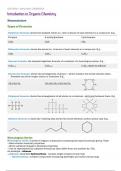
Types of Formulae
Empirical formula: shows the simplest whole no. ratio of atoms of each element in a compound. E.g…
Propane 2-methylpentane Cyclohexane
C3H8 C3H7 CH2
Molecular formula: shows the actual no. of atoms of each element in a compound. E.g…
C3H8 C6H14 C6H12
General formula: the simplest algebraic formula of a member of a homologous series. E.g…
CnH2n+2 CnH2n+2 CnH2n (same as alkene)
Structural formula: shows the arrangement of atoms +, where needed, the bonds between them.
- Brackets can show longer chains or branches. E.g…
CH3CH2CH3 CH3CH(CH3)CH2CH2CH3
Displayed formula: shows the arrangement of all atoms in a molecule + all bonds between them. E.g.
Skeletal formula: a ‘stick-like’ drawing that shows the bonds between carbon atoms only. E.g…
Homologous Series
Homologous series: a series of organic compounds containing the same functional group. They:
• Have similar chemical properties.
• Show a gradual change in physical properties.
• Can be represented by a general formula as they differ from one another by -CH2.
An example = alkanes.
• Alkanes: saturated hydrocarbons - contain single covalent bonds only.
- Hydrocarbons: covalent compounds containing hydrogen and carbon atoms only.
Introduction to Organic Chemistry
Nomenclature
Types of Formulae
Empirical formula: shows the simplest whole no. ratio of atoms of each element in a compound. E.g…
Propane 2-methylpentane Cyclohexane
C3H8 C3H7 CH2
Molecular formula: shows the actual no. of atoms of each element in a compound. E.g…
C3H8 C6H14 C6H12
General formula: the simplest algebraic formula of a member of a homologous series. E.g…
CnH2n+2 CnH2n+2 CnH2n (same as alkene)
Structural formula: shows the arrangement of atoms +, where needed, the bonds between them.
- Brackets can show longer chains or branches. E.g…
CH3CH2CH3 CH3CH(CH3)CH2CH2CH3
Displayed formula: shows the arrangement of all atoms in a molecule + all bonds between them. E.g.
Skeletal formula: a ‘stick-like’ drawing that shows the bonds between carbon atoms only. E.g…
Homologous Series
Homologous series: a series of organic compounds containing the same functional group. They:
• Have similar chemical properties.
• Show a gradual change in physical properties.
• Can be represented by a general formula as they differ from one another by -CH2.
An example = alkanes.
• Alkanes: saturated hydrocarbons - contain single covalent bonds only.
- Hydrocarbons: covalent compounds containing hydrogen and carbon atoms only.