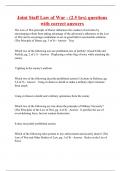
Joint Staff Law of War - (2.5 hrs) questions
with correct answers
The Law of War principle of Honor influences the conduct of activities by encouraging refrain from taking advantage of the adversary's adherence to the Law
of War and to encourage combatants to act in good faith in non-hostile relations. (The Principle of Honor, pg. 3 of 6) - Answer True
Which two of the following acts are prohibited acts of perfidy? (Good Faith and Perfidy, pg. 2 of 11) - Answer Displaying a white flag of truce while attacking the
enemy Fighting in the enemy's uniform
Which two of the following describe prohibited actions? (Actions in Defense, pg. 5,6 of 9) - Answer Using civilians to shield or make a military object immune from attack
Using civilians to shield one's military operations from the enemy
Which two of the following are true about the principle of Military Necessity? (The Principles of the Law of War, pg. 4 of 8) - Answer It justifies the use of overwhelming force, but not wanton destruction
It does not justify prohibited actions
Which of the following rules pertain to law enforcement and security duties? (The Law of War and Other Bodies of Law, pg. 5 of 8) - Answer Rules on the Use of Force The Law of War may overlap, or be included within, other bodies or types of international law. (The Law of War and Other Bodies of Law, pg. 1 of 8) - Answer
True
The principle of Proportionality obligates military commanders to consider the expected incidental harms from planned attacks, but also the consequences of other
military options as well. (The Principles of Proportionality and Distinction, pg. 2 of
9) - Answer True
The Law of War does not permit wanton destruction. What is wanton destruction? (Combatants and Civilians, pg. 5 of 9) - Answer Destruction without purpose
What principle of the Law of War forbids the infliction of unnecessary suffering, injury, and destruction? (The Principles of the Law of War, pg. 5 of 8) - Answer Humanity
In addition to applying to the conduct of hostilities, the Law of War also applies to duties during peacetime and occupation. (The Law of War, pg. 5 of 8) - Answer True
Which two of the following cultural centers are most likely to qualify under the 1954 Hague Cultural Property Convention? (Protection of Cultural Property, pg. 2 of 10) - Answer A center square containing monuments representing ancient cultures
A new contemporary arts center A museum containing artifacts and historical writings
with correct answers
The Law of War principle of Honor influences the conduct of activities by encouraging refrain from taking advantage of the adversary's adherence to the Law
of War and to encourage combatants to act in good faith in non-hostile relations. (The Principle of Honor, pg. 3 of 6) - Answer True
Which two of the following acts are prohibited acts of perfidy? (Good Faith and Perfidy, pg. 2 of 11) - Answer Displaying a white flag of truce while attacking the
enemy Fighting in the enemy's uniform
Which two of the following describe prohibited actions? (Actions in Defense, pg. 5,6 of 9) - Answer Using civilians to shield or make a military object immune from attack
Using civilians to shield one's military operations from the enemy
Which two of the following are true about the principle of Military Necessity? (The Principles of the Law of War, pg. 4 of 8) - Answer It justifies the use of overwhelming force, but not wanton destruction
It does not justify prohibited actions
Which of the following rules pertain to law enforcement and security duties? (The Law of War and Other Bodies of Law, pg. 5 of 8) - Answer Rules on the Use of Force The Law of War may overlap, or be included within, other bodies or types of international law. (The Law of War and Other Bodies of Law, pg. 1 of 8) - Answer
True
The principle of Proportionality obligates military commanders to consider the expected incidental harms from planned attacks, but also the consequences of other
military options as well. (The Principles of Proportionality and Distinction, pg. 2 of
9) - Answer True
The Law of War does not permit wanton destruction. What is wanton destruction? (Combatants and Civilians, pg. 5 of 9) - Answer Destruction without purpose
What principle of the Law of War forbids the infliction of unnecessary suffering, injury, and destruction? (The Principles of the Law of War, pg. 5 of 8) - Answer Humanity
In addition to applying to the conduct of hostilities, the Law of War also applies to duties during peacetime and occupation. (The Law of War, pg. 5 of 8) - Answer True
Which two of the following cultural centers are most likely to qualify under the 1954 Hague Cultural Property Convention? (Protection of Cultural Property, pg. 2 of 10) - Answer A center square containing monuments representing ancient cultures
A new contemporary arts center A museum containing artifacts and historical writings