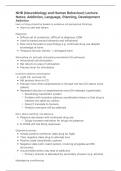
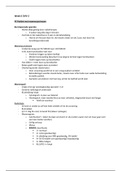
NHB (Neurobiology and Human Behaviour) Lecture
Notes: Addiction, Language, Planning, Development
Addiction
Harm of drug should be based on evidence not perceptual thinkings
● Harm to self and others
Diagnosis
● Diffuse set of symptoms, difficult to diagnose, DSM
● Used to based around tolerance and withdrawal
● Now more focused on psychology e.g. continued drug use despite
knowledge of harm
● Temporal horizon shrinks -> disregard harm
Stimulating LH (actually stimulating mesolimbic DA pathways)
● Intracranial cell stimulation
● Rat returns to area of stimulation
● Presses lever for stimulation
Incentive salience sensitisation
● Light CS, sucrose US
● Rat presses lever on CS
● Presses more when amphetamine is infused into NA (CS seems more
salient)
● Repeated injection of amphetamine more DA released, hyperkinetic
○ Sensitising mesolimbic system
○ Problem with incentive salience sensitisation theory is that drug is
injected not taken by volition
○ Doesn’t translate to humans
○ Predicts everyone will be addicted
DA is about wanting, not pleasure
● Pleasure decreases with continued drug use
○ Drugs increase motivation for drugs not pleasure
● 6-OHDA still has liking responses
Opponent process
● Initially positive reinforcer (take drug for high)
● Then negative (take drug to alleviate low)
● Positive state (mesolimbic system)
● Negative state (anti-rward system, involving amygdala and BS
structures)
● Uncontrolled stress may lead to addiction
○ Primary stressor is alleviated by secondary stressor (e.g. alcohol)
Maladaptive conditioning
, ● Voluntarily take drug
● Pavlovian conditioning of stimuli in the environment
● Habit triggered by stimulus
○ Dorsolateral striatum
Impaired top-down control
● Impaired PFC -> impulsive
● Drug abuse can do this
● Transmagnetic stimulation can restore some function
Vulnerability mechanisms
● Genetic (e.g. impulsive rats have less D2 receptors in NA) and
environmental
● Risk factors (e.g. reduced connectivity between PFC and amygdala)
and protective factors
Neurobiology of Language
Semantic is laid down in associative cortex
Episodic memory is stored in distributed bits
Have to talk together with long range fibres, without this episodic memory is
lost
Broca
● Nouns are fine
● Verb and grammar is poor
● But can write down
● Can’t comprehend complex sentences tall boy
○ Possibly due to poor STM from PFC damage
Wernicke
● Can speak fluent nonsense
● Can’t comprehend
Conduction
● Can’t repeat
Split brain patients
● Can’t describe object in left hand, right cortex not connect to left
language centres
● Can say simple things like round for ball
● Left handed had some on right and bilateral
● Right handed had very few on right and none bilateral
TMA
● Cannot speak fluently
● But can repeat very long sentences
Notes: Addiction, Language, Planning, Development
Addiction
Harm of drug should be based on evidence not perceptual thinkings
● Harm to self and others
Diagnosis
● Diffuse set of symptoms, difficult to diagnose, DSM
● Used to based around tolerance and withdrawal
● Now more focused on psychology e.g. continued drug use despite
knowledge of harm
● Temporal horizon shrinks -> disregard harm
Stimulating LH (actually stimulating mesolimbic DA pathways)
● Intracranial cell stimulation
● Rat returns to area of stimulation
● Presses lever for stimulation
Incentive salience sensitisation
● Light CS, sucrose US
● Rat presses lever on CS
● Presses more when amphetamine is infused into NA (CS seems more
salient)
● Repeated injection of amphetamine more DA released, hyperkinetic
○ Sensitising mesolimbic system
○ Problem with incentive salience sensitisation theory is that drug is
injected not taken by volition
○ Doesn’t translate to humans
○ Predicts everyone will be addicted
DA is about wanting, not pleasure
● Pleasure decreases with continued drug use
○ Drugs increase motivation for drugs not pleasure
● 6-OHDA still has liking responses
Opponent process
● Initially positive reinforcer (take drug for high)
● Then negative (take drug to alleviate low)
● Positive state (mesolimbic system)
● Negative state (anti-rward system, involving amygdala and BS
structures)
● Uncontrolled stress may lead to addiction
○ Primary stressor is alleviated by secondary stressor (e.g. alcohol)
Maladaptive conditioning
, ● Voluntarily take drug
● Pavlovian conditioning of stimuli in the environment
● Habit triggered by stimulus
○ Dorsolateral striatum
Impaired top-down control
● Impaired PFC -> impulsive
● Drug abuse can do this
● Transmagnetic stimulation can restore some function
Vulnerability mechanisms
● Genetic (e.g. impulsive rats have less D2 receptors in NA) and
environmental
● Risk factors (e.g. reduced connectivity between PFC and amygdala)
and protective factors
Neurobiology of Language
Semantic is laid down in associative cortex
Episodic memory is stored in distributed bits
Have to talk together with long range fibres, without this episodic memory is
lost
Broca
● Nouns are fine
● Verb and grammar is poor
● But can write down
● Can’t comprehend complex sentences tall boy
○ Possibly due to poor STM from PFC damage
Wernicke
● Can speak fluent nonsense
● Can’t comprehend
Conduction
● Can’t repeat
Split brain patients
● Can’t describe object in left hand, right cortex not connect to left
language centres
● Can say simple things like round for ball
● Left handed had some on right and bilateral
● Right handed had very few on right and none bilateral
TMA
● Cannot speak fluently
● But can repeat very long sentences