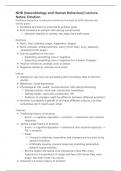
NHB (Neurobiology and Human Behaviour) Lecture
Notes: Emotion
Emotional behaviour is behaviour driven by the need to fulfil (internal and
social) goals
● Emotions are there to motivate to achieve goals
● Find emotions in animals with strong social bonds
○ Maintain stability in society, see angry face walk away
Emotions
● Basic: fear, sadness, anger, happiness, disgust
● More complex: embarrassment, worry (from fear); envy, jealously,
contempt (from anger)
● Can be qualified on two axis
○ Expecting something nice or negative
○ Expecting something nice or negative but it doesn’t happen
● Positive reinforcer, animals work to obtain
● Negative reinforcer, animals work avoid
Indices
● Subjective: say how you are feeling (but not always able to find the
words)
● Behaviour: facial expression
● Physiological: HR, sweat, muscle tension, EEG desynchronising
○ Seeing incision: more skin conduction (sweating)
○ Seeing spider: more skin conduction, HR
○ Patterns of changes might be different between different emotions
● Emotion is probably a gestalt of all these different outputs, but they
sometimes don’t match each other
Theories
● Traditional theory of emotion
○ Event -> cognitive appraisal -> emotion -> behaviour and visceral
response
● James-Lange theory of emotion
○ Event -> cognitive appraisal -> behaviour and visceral response ->
FB -> emotion
○ Flaws
◆ Viscera is relatively insensitive and changes are too slow to be
cause of emotion
◆ Artificially causing visceral response (injecting adrenaline)
doesn’t cause emotion
○ But the higher the spinal cord transection (less FB), more
reductions in experience of anger and fear (still ‘knew they were
angry’ but didn’t feel it as much)
● Schacter’s 2-factor theory of emotion
, ○ Event -> cognitive appraisal ->
◆ Emotion
◆ Behaviour and visceral response
○ Behaviour and visceral response ->
◆ Emotion (more intensity)
◆ Cognitive appraisal (promoted when cause of arousal is
unknown), attribute peripheral stimuli to arousal -> emotion
○ Interplay between physiological changes and cognitive appraisal
(labelling)
◆ Physiological changes impact intensity but direction of
emotion is from periphery
Experiments and examples
● Schacter and Singer study
○ Inject people with adrenaline (some are told what it does, some are
un or misinformed)
○ The people fill out a questionnaire and watch someone (happy or
angry) filling it out too
○ The un or misinformed people start showing the same emotion as
the other person
○ When you can’t explain arousal, you cognitively appraise
peripheral stimuli and and them to arousal
● Hunger
○ Physiological state
○ Doesn’t usually cause emotion by itself but can motivate behaviour
○ But if stranded in desert: hunger -> cognitive appraisal -> emotion
(worry about starving)
○ Need cognitive appraisal for emotion
● Anxiety
○ Somatic: arising from bodily symptoms (e.g. palpitations,
hyperventilation)
○ Psychic: arising from external stressors
○ Diazepam (GABA facilitator, possibly less cognitive appraisal)
◆ Improved reports in both somatic and psychic, but didn’t affect
physiological values
○ Propranolol (beta blocker)
◆ Improved physiological values and somatic reports, but didn’t
affect psychic reports
Anatomy
● Limbic system (Papez’s circuit)
○ Amygdala, hippocampus, HT, cingulate cortex (associated with
smell too)
● Modern definition of circuitry
○ OFC, medial cingulate, VS, HT, amygdala
Notes: Emotion
Emotional behaviour is behaviour driven by the need to fulfil (internal and
social) goals
● Emotions are there to motivate to achieve goals
● Find emotions in animals with strong social bonds
○ Maintain stability in society, see angry face walk away
Emotions
● Basic: fear, sadness, anger, happiness, disgust
● More complex: embarrassment, worry (from fear); envy, jealously,
contempt (from anger)
● Can be qualified on two axis
○ Expecting something nice or negative
○ Expecting something nice or negative but it doesn’t happen
● Positive reinforcer, animals work to obtain
● Negative reinforcer, animals work avoid
Indices
● Subjective: say how you are feeling (but not always able to find the
words)
● Behaviour: facial expression
● Physiological: HR, sweat, muscle tension, EEG desynchronising
○ Seeing incision: more skin conduction (sweating)
○ Seeing spider: more skin conduction, HR
○ Patterns of changes might be different between different emotions
● Emotion is probably a gestalt of all these different outputs, but they
sometimes don’t match each other
Theories
● Traditional theory of emotion
○ Event -> cognitive appraisal -> emotion -> behaviour and visceral
response
● James-Lange theory of emotion
○ Event -> cognitive appraisal -> behaviour and visceral response ->
FB -> emotion
○ Flaws
◆ Viscera is relatively insensitive and changes are too slow to be
cause of emotion
◆ Artificially causing visceral response (injecting adrenaline)
doesn’t cause emotion
○ But the higher the spinal cord transection (less FB), more
reductions in experience of anger and fear (still ‘knew they were
angry’ but didn’t feel it as much)
● Schacter’s 2-factor theory of emotion
, ○ Event -> cognitive appraisal ->
◆ Emotion
◆ Behaviour and visceral response
○ Behaviour and visceral response ->
◆ Emotion (more intensity)
◆ Cognitive appraisal (promoted when cause of arousal is
unknown), attribute peripheral stimuli to arousal -> emotion
○ Interplay between physiological changes and cognitive appraisal
(labelling)
◆ Physiological changes impact intensity but direction of
emotion is from periphery
Experiments and examples
● Schacter and Singer study
○ Inject people with adrenaline (some are told what it does, some are
un or misinformed)
○ The people fill out a questionnaire and watch someone (happy or
angry) filling it out too
○ The un or misinformed people start showing the same emotion as
the other person
○ When you can’t explain arousal, you cognitively appraise
peripheral stimuli and and them to arousal
● Hunger
○ Physiological state
○ Doesn’t usually cause emotion by itself but can motivate behaviour
○ But if stranded in desert: hunger -> cognitive appraisal -> emotion
(worry about starving)
○ Need cognitive appraisal for emotion
● Anxiety
○ Somatic: arising from bodily symptoms (e.g. palpitations,
hyperventilation)
○ Psychic: arising from external stressors
○ Diazepam (GABA facilitator, possibly less cognitive appraisal)
◆ Improved reports in both somatic and psychic, but didn’t affect
physiological values
○ Propranolol (beta blocker)
◆ Improved physiological values and somatic reports, but didn’t
affect psychic reports
Anatomy
● Limbic system (Papez’s circuit)
○ Amygdala, hippocampus, HT, cingulate cortex (associated with
smell too)
● Modern definition of circuitry
○ OFC, medial cingulate, VS, HT, amygdala