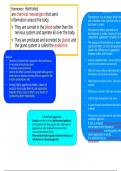
Hormones= Hormones Testosterone
are chemical messengers that send • Testosterone is an androgen which dev
information around the body. and maintains male characteristics so
dominant in males.
v They are carried in the blood rather than the • Testosterone affects prenatal brain
nervous system and operate all over the body. development in males, leading to incre
competitive aggression compared to fe
v They are produced and excreted by glands and • The exposure to testosterone in utero
the gland system is called the endocrine significant effect on brain developmen
system. explain the differences in aggression
between males and females.
Oxytocin
• Oxytocin is a hormone that is produced in the hypothalamus. • Linked to navigational skills – men use distances
• It is secreted by the pituitary gland. direction whereas women use landmarks.
• It increases prosocial behaviour.
• However, this effect is reversed among people with aggressive • Affects the corpus callosum which allows the tw
tendencies or in situations involving defensive aggression, like hemispheres of the brain to communicate.
a mother protecting her child. • Affects levels of empathy in males – high levels
• Among highly aggressive people, a boost of empathy.
oxytocin may cause them to use aggression
towards others close to them, as a means of • Testosterone is present in both men and women
maintaining their relationship.
• It affects brain development in the womb.
• It causes the physical development that leads u
or female.
• Testosterone can increase levels of social domin
Cortisol and aggression
• Cortisol is referred to in the ‘dual-hormone hypothesis’. competitive aggression.
• Cortisol protects the body against stress. High levels of • It also is released immediately after bi
aggression are often displayed only when cortisol which leads to the increase in cell grow
is low and testosterone is high. the hypothalamus and amygdala, whic
• When cortisol is high it appears to block the influence of cause aggression in adults.
testosterone on increased aggression. • It is believed that an over-production o
testosterone could cause aggression.
, Evidence for oxytocin Evidence for testosterone
• Dewall et al. (2014) found that
Supporting evidence fo
high levels of oxytocin in males • Dabbs (1987) analysed
who already had high levels saliva samples from 89
of aggression were more likely male prisoners and found • Carre and Mehta (2011)
to display aggressive that those with higher levels high levels of testosteron
behaviours towards their of testosterone committed levels of aggression whe
partners. SUPPORTING violent crimes. Total of 10 was high. Testosterone a
out of 11 violent criminals interact to predict
• Lane et al. (2014) found more had high levels competitive, aggressive,
oxytocin did lead to an increase of testosterone. SUPPORTI dominant behaviours. SU
in trustworthiness, they did NG
not study whether lack of the • Shaol et al (2003) found
hormone caused aggression, so • Eisenegger et al. (2011) increased aggressive be
it may not be a factor found when giving females adolescents with low cor
in aggressive from the general population more strongly associated
behaviour. CRITICISING a dose of testosterone, they of self-control than with a
behaved more generously specifically “aggressive
and more personality.” CRITICISIN
sociably. SUPPORTING
are chemical messengers that send • Testosterone is an androgen which dev
information around the body. and maintains male characteristics so
dominant in males.
v They are carried in the blood rather than the • Testosterone affects prenatal brain
nervous system and operate all over the body. development in males, leading to incre
competitive aggression compared to fe
v They are produced and excreted by glands and • The exposure to testosterone in utero
the gland system is called the endocrine significant effect on brain developmen
system. explain the differences in aggression
between males and females.
Oxytocin
• Oxytocin is a hormone that is produced in the hypothalamus. • Linked to navigational skills – men use distances
• It is secreted by the pituitary gland. direction whereas women use landmarks.
• It increases prosocial behaviour.
• However, this effect is reversed among people with aggressive • Affects the corpus callosum which allows the tw
tendencies or in situations involving defensive aggression, like hemispheres of the brain to communicate.
a mother protecting her child. • Affects levels of empathy in males – high levels
• Among highly aggressive people, a boost of empathy.
oxytocin may cause them to use aggression
towards others close to them, as a means of • Testosterone is present in both men and women
maintaining their relationship.
• It affects brain development in the womb.
• It causes the physical development that leads u
or female.
• Testosterone can increase levels of social domin
Cortisol and aggression
• Cortisol is referred to in the ‘dual-hormone hypothesis’. competitive aggression.
• Cortisol protects the body against stress. High levels of • It also is released immediately after bi
aggression are often displayed only when cortisol which leads to the increase in cell grow
is low and testosterone is high. the hypothalamus and amygdala, whic
• When cortisol is high it appears to block the influence of cause aggression in adults.
testosterone on increased aggression. • It is believed that an over-production o
testosterone could cause aggression.
, Evidence for oxytocin Evidence for testosterone
• Dewall et al. (2014) found that
Supporting evidence fo
high levels of oxytocin in males • Dabbs (1987) analysed
who already had high levels saliva samples from 89
of aggression were more likely male prisoners and found • Carre and Mehta (2011)
to display aggressive that those with higher levels high levels of testosteron
behaviours towards their of testosterone committed levels of aggression whe
partners. SUPPORTING violent crimes. Total of 10 was high. Testosterone a
out of 11 violent criminals interact to predict
• Lane et al. (2014) found more had high levels competitive, aggressive,
oxytocin did lead to an increase of testosterone. SUPPORTI dominant behaviours. SU
in trustworthiness, they did NG
not study whether lack of the • Shaol et al (2003) found
hormone caused aggression, so • Eisenegger et al. (2011) increased aggressive be
it may not be a factor found when giving females adolescents with low cor
in aggressive from the general population more strongly associated
behaviour. CRITICISING a dose of testosterone, they of self-control than with a
behaved more generously specifically “aggressive
and more personality.” CRITICISIN
sociably. SUPPORTING