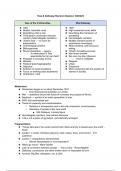
Tess & Dalloway Revision Session: 04/04/23
Tess of the d’Urbervilles Mrs Dalloway
★ 1891 ★ 1925
★ Realist, naturalist novel ★ High modernist novel; elitist
★ Describing what is real ★ Describing the impression of
★ Third person omniscient intrusive something
narrator (heterodiegetic narration) ★ Homodiegetic narration
★ ‘Author-God’ → no room for ★ Multiple narrative points of
interpretation view/interior monologue
★ Chronological timeline ★ Meta-narrative, self conscious
★ Bildungsroman writing
★ Round characters → agency ★ ‘Woolf’s tunnelling process’
○ To what extent is Tess ★ Non-linear timeline
responsible for her own fate? ★ Set over one day (Ulysses)
★ Prolepsis in everyday events ○ Time is malleable
★ Mimesis ★ Diegesis
★ Pastoral (psychogeography) ★ Urban
★ Objective ★ Subjective
★ Criticism of social conditions ★ More concerned with the position of
★ Focus on working-class experience women in society
★ Characters > plot
Modernism:
★ ‘Modernism began on or about December 1910’
○ First Impressionist exhibition in London
★ War → questions around the future of humanity, the purpose of life etc.
★ Septimus → symbol of an entire generation of men
★ WWI: first mechanised war
★ Threat of modernity and industrialisation
○ Reaction is introspection and a dive into characters’ consciousness
○ Alienation of people in this new world
■ Mrs Dalloway: a lonely figure
★ Homodiegetic narration, free indirect discourse
★ ‘Life is not a series of gig lamps, symmetrically arranged’
Fragmentation:
★ ‘Things falls apart, the centre cannot hold / Mere anarchy is loosed upon the world’ -
Yeats
★ London: ‘a vortex of broken passions, lusts, hopes, fears, and horrors’ - D H
Lawrence
★ London = contradictory, dichotomised
○ Whose interpretation is most important?
★ ‘Merry go round’ - Mark Gentler
★ Lack of connection between people → ‘The Lovers’ - Rene Magritte
★ Dalloway: connections are either broken down or impossible to form
★ Anchors: Big Ben, aeroplane, car, a child.
Tess of the d’Urbervilles Mrs Dalloway
★ 1891 ★ 1925
★ Realist, naturalist novel ★ High modernist novel; elitist
★ Describing what is real ★ Describing the impression of
★ Third person omniscient intrusive something
narrator (heterodiegetic narration) ★ Homodiegetic narration
★ ‘Author-God’ → no room for ★ Multiple narrative points of
interpretation view/interior monologue
★ Chronological timeline ★ Meta-narrative, self conscious
★ Bildungsroman writing
★ Round characters → agency ★ ‘Woolf’s tunnelling process’
○ To what extent is Tess ★ Non-linear timeline
responsible for her own fate? ★ Set over one day (Ulysses)
★ Prolepsis in everyday events ○ Time is malleable
★ Mimesis ★ Diegesis
★ Pastoral (psychogeography) ★ Urban
★ Objective ★ Subjective
★ Criticism of social conditions ★ More concerned with the position of
★ Focus on working-class experience women in society
★ Characters > plot
Modernism:
★ ‘Modernism began on or about December 1910’
○ First Impressionist exhibition in London
★ War → questions around the future of humanity, the purpose of life etc.
★ Septimus → symbol of an entire generation of men
★ WWI: first mechanised war
★ Threat of modernity and industrialisation
○ Reaction is introspection and a dive into characters’ consciousness
○ Alienation of people in this new world
■ Mrs Dalloway: a lonely figure
★ Homodiegetic narration, free indirect discourse
★ ‘Life is not a series of gig lamps, symmetrically arranged’
Fragmentation:
★ ‘Things falls apart, the centre cannot hold / Mere anarchy is loosed upon the world’ -
Yeats
★ London: ‘a vortex of broken passions, lusts, hopes, fears, and horrors’ - D H
Lawrence
★ London = contradictory, dichotomised
○ Whose interpretation is most important?
★ ‘Merry go round’ - Mark Gentler
★ Lack of connection between people → ‘The Lovers’ - Rene Magritte
★ Dalloway: connections are either broken down or impossible to form
★ Anchors: Big Ben, aeroplane, car, a child.