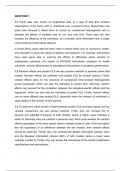
Briefly describe the different mechanisms (simple diffusion, facilitated diffusion, active
transport) by which solutes can cross the membrane. Provide examples of specific substances
that cross the membrane by each of the methods. Define osmosis and how this process affects
cells that are placed in hypertonic, isotonic and 1. 2. ypotonic solutions.
Solution
1. Simple diffusion is the process which the solutes are moved along a concentration gradient in
a solution or a senipermeable membrane.simple diffusion is carried out by the action of hydrogen
bonds forming between water molecules and solutes. Examples of molecules that can use simple
diffusion to travel in and out of the cell membrane are water,oxygen, carbon dioxide ,ethanol and
urea.
Commen examples are you can smell the perfume because it diffuses into the air and one can
smell.
Facilitated diffusion is a form of facilitated transport involving the passive movement of
molecules along their concentration gradient guided by the other molecule.examples of
facilitated diffusion to move in and out of the cell membrane are glucose ,sodium ions and
potassium ions they pass along using carrier proteins through the cell membrane without energy
along the concentration gradient . examples of these are aquaporins ion channels ect.
Active Transpo: it requires energy it is accomplished by having a transport protein which
changes the shape while binding with the cells fuel a molecule called Secondary active transport
involves the use of an electrochemical gradient.examples are the active transport includes the
uptake of glucose in the intestines in humans and the uptake of mineral ions into root hair cells of
plant.
Osmosis: osmosis is the movement of water molecules from the region of higher concentration to
a region of lower concentration across the senipermeable membrane.
Whena plant cell is kept in a hypotonic solution then the plant cell become fully turgid due to
endosmosis.water enters into the cell.
When a plant cell is kept in a hypertonic solution the plant cell becomes flaccid due to exomosis
the plant cell is called as plasmolysed and the phenomenon is called plasmolysis.
When a plant cell is placed in an isotonic solution there is no change in the structure of your cell
as there is no movement of water into or out of the cell.
transport) by which solutes can cross the membrane. Provide examples of specific substances
that cross the membrane by each of the methods. Define osmosis and how this process affects
cells that are placed in hypertonic, isotonic and 1. 2. ypotonic solutions.
Solution
1. Simple diffusion is the process which the solutes are moved along a concentration gradient in
a solution or a senipermeable membrane.simple diffusion is carried out by the action of hydrogen
bonds forming between water molecules and solutes. Examples of molecules that can use simple
diffusion to travel in and out of the cell membrane are water,oxygen, carbon dioxide ,ethanol and
urea.
Commen examples are you can smell the perfume because it diffuses into the air and one can
smell.
Facilitated diffusion is a form of facilitated transport involving the passive movement of
molecules along their concentration gradient guided by the other molecule.examples of
facilitated diffusion to move in and out of the cell membrane are glucose ,sodium ions and
potassium ions they pass along using carrier proteins through the cell membrane without energy
along the concentration gradient . examples of these are aquaporins ion channels ect.
Active Transpo: it requires energy it is accomplished by having a transport protein which
changes the shape while binding with the cells fuel a molecule called Secondary active transport
involves the use of an electrochemical gradient.examples are the active transport includes the
uptake of glucose in the intestines in humans and the uptake of mineral ions into root hair cells of
plant.
Osmosis: osmosis is the movement of water molecules from the region of higher concentration to
a region of lower concentration across the senipermeable membrane.
Whena plant cell is kept in a hypotonic solution then the plant cell become fully turgid due to
endosmosis.water enters into the cell.
When a plant cell is kept in a hypertonic solution the plant cell becomes flaccid due to exomosis
the plant cell is called as plasmolysed and the phenomenon is called plasmolysis.
When a plant cell is placed in an isotonic solution there is no change in the structure of your cell
as there is no movement of water into or out of the cell.