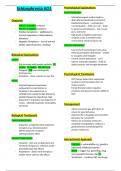
Psychological Explanations
Schizophrenia AO1
Family Dysfunction
- Schizophrenogenic mother leads to
Diagnosis distrustful and paranoid environment
- Double-bind theory – contradictory
- DSM-5 = 1 positive symptom communication – child can’t win – leads
- ICD-10 = 2 negative symptoms to paranoia and delusions – not a cause
- Positive Symptoms – additional to just a risk factor
normal experience: hallucinations, - High levels of negative expressed
delusions emotion create a stressful family
- Negative Symptoms – loss of normal environment which increases risk
ability: speech poverty, avolition Cognitive Explanations
- Low levels of functioning in brain areas
- Metarepresentation dysfunction – unable
Biological Explanations to recognise own thoughts
Genetic - Central control dysfunction – can’t
supress automatic thoughts – leads to
- Risk increases with genetic similarity: 2% speech poverty and thought derailment
cousins, 9% siblings, 48% MZ twins
- Polygenic (108) and aetiologically
heterogenous
Psychological Treatments
- Mutations – more common in over 50s
- CBT therapy helps client understand
Neural
symptoms and normalises them to
- Original Dopamine Hypothesis: reduce anxiety
antipsychotics result similar to - Family therapy reduces negative
Parkinson’s (low dopamine) so emotions and improves family’s ability to
schizophrenia caused by high dopamine help
- Updated Dopamine Hypothesis: high
dopamine in subcortex, low dopamine in
cortex – affected by genetic vulnerability
Management
and stress
- Token economies give gift tokens in
return for good behaviour
Biological Treatments - Improves life in hospitals and normalises
behaviour for outside life
Typical Antipsychotics - Tokens are secondary reinforcers
- Dopamine antagonists block dopamine rewarded immediately to reinforce a
receptors (e.g. chlorpromazine) good behaviour and exchanged for
- Affects histamine receptors – primary reinforcers
calming/sedative effect
Atypical Antipsychotics Interactionist Approach
- Clozapine - Also acts on glutamate and
- Diathesis = vulnerability e.g. genetics,
serotonin receptors so enhances mood –
potentially fatal side effects
repressed childhood trauma
- Risperidone – binds more strongly so - Stress = trigger e.g. parenting, drug
smaller doses and less side effects use (cannabis increase risk 7x)
- Treatment – combine CBT and drugs
Schizophrenia AO1
Family Dysfunction
- Schizophrenogenic mother leads to
Diagnosis distrustful and paranoid environment
- Double-bind theory – contradictory
- DSM-5 = 1 positive symptom communication – child can’t win – leads
- ICD-10 = 2 negative symptoms to paranoia and delusions – not a cause
- Positive Symptoms – additional to just a risk factor
normal experience: hallucinations, - High levels of negative expressed
delusions emotion create a stressful family
- Negative Symptoms – loss of normal environment which increases risk
ability: speech poverty, avolition Cognitive Explanations
- Low levels of functioning in brain areas
- Metarepresentation dysfunction – unable
Biological Explanations to recognise own thoughts
Genetic - Central control dysfunction – can’t
supress automatic thoughts – leads to
- Risk increases with genetic similarity: 2% speech poverty and thought derailment
cousins, 9% siblings, 48% MZ twins
- Polygenic (108) and aetiologically
heterogenous
Psychological Treatments
- Mutations – more common in over 50s
- CBT therapy helps client understand
Neural
symptoms and normalises them to
- Original Dopamine Hypothesis: reduce anxiety
antipsychotics result similar to - Family therapy reduces negative
Parkinson’s (low dopamine) so emotions and improves family’s ability to
schizophrenia caused by high dopamine help
- Updated Dopamine Hypothesis: high
dopamine in subcortex, low dopamine in
cortex – affected by genetic vulnerability
Management
and stress
- Token economies give gift tokens in
return for good behaviour
Biological Treatments - Improves life in hospitals and normalises
behaviour for outside life
Typical Antipsychotics - Tokens are secondary reinforcers
- Dopamine antagonists block dopamine rewarded immediately to reinforce a
receptors (e.g. chlorpromazine) good behaviour and exchanged for
- Affects histamine receptors – primary reinforcers
calming/sedative effect
Atypical Antipsychotics Interactionist Approach
- Clozapine - Also acts on glutamate and
- Diathesis = vulnerability e.g. genetics,
serotonin receptors so enhances mood –
potentially fatal side effects
repressed childhood trauma
- Risperidone – binds more strongly so - Stress = trigger e.g. parenting, drug
smaller doses and less side effects use (cannabis increase risk 7x)
- Treatment – combine CBT and drugs