Introduction: Amines and Amides
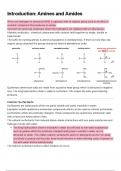
When one hydrogen in ammonia (NH3) is replaced with an organic group such as an alkyl or
aromatic compound this produces an amine.
Derived from ammonia molecules where the hydrogens are replaced with an alkyl group.
Aliphatic molecules - chemical compounds with carbons held together by single, double or
triple bonds.
The suffix for naming amines is amine (propylamine or diethylamine). If there is more than one
organic group attached the groups should be listed in alphabetical order.
Quaternary ammonium salts are made from a positive head group which is attracted to negative
ions. The long hydrocarbon chain is called a surfactant. This makes the salts good cleaning
products.
Cationic Surfactants
Surfactants are compounds which are partly soluble and partly insoluble in water.
Examples include quaternary ammonium compounds which can be used as cationic surfactants
(surfactants which are positively charged). These compounds are quaternary ammonium salts
with at least one hydrocarbon chain.
The cationic surfactants form induced dipole-dipole interactions with non polar substances and
hydrogen bonds with water.
The long hydrocarbon chain is insoluble in water but will bind to non-polar substances
such as grease whilst the positively charged head group is soluble in water as it is
attracted to water. This makes cationic surfactants useful in detergents as the non-polar
end binds to grease and the polar head would dissolve in water allowing spots of grease to
mix with water and be washed away.
The cationic surfactant works to allow emulsion to occur.
When one hydrogen in ammonia (NH3) is replaced with an organic group such as an alkyl or
aromatic compound this produces an amine.
Derived from ammonia molecules where the hydrogens are replaced with an alkyl group.
Aliphatic molecules - chemical compounds with carbons held together by single, double or
triple bonds.
The suffix for naming amines is amine (propylamine or diethylamine). If there is more than one
organic group attached the groups should be listed in alphabetical order.
Quaternary ammonium salts are made from a positive head group which is attracted to negative
ions. The long hydrocarbon chain is called a surfactant. This makes the salts good cleaning
products.
Cationic Surfactants
Surfactants are compounds which are partly soluble and partly insoluble in water.
Examples include quaternary ammonium compounds which can be used as cationic surfactants
(surfactants which are positively charged). These compounds are quaternary ammonium salts
with at least one hydrocarbon chain.
The cationic surfactants form induced dipole-dipole interactions with non polar substances and
hydrogen bonds with water.
The long hydrocarbon chain is insoluble in water but will bind to non-polar substances
such as grease whilst the positively charged head group is soluble in water as it is
attracted to water. This makes cationic surfactants useful in detergents as the non-polar
end binds to grease and the polar head would dissolve in water allowing spots of grease to
mix with water and be washed away.
The cationic surfactant works to allow emulsion to occur.