Reactions of Amines
Formation from Halogenoalkanes
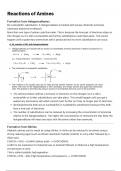
By nucleophilic substitution. A halogenoalkane is heated with excess ethanolic ammonia
(ammonia dissolved in ethanol).
More than one type of amine could be made. This is because the lone pair of electrons stays on
the nitrogen so it is still a nucleophile and further substitutions could take place. This would
happen until a quaternary ammonium salt is produced and no more substitutions can occur.
The amine produce still has a lone pair of electrons on the nitrogen so it is still a
nucleophile so further substitutions can take place. This would happen until you get a
quaternary ammonium salt which cannot react further as it has no longer pair of electrons.
Amines/ammonia both act as nucleophiles in nucleophilic substitution because they both
have a lone pair of electrons.
The number of substitutions can be reduced by increasing the concentration of ammonia
relative to the halogenoalkane. The higher the concentration of ammonia the less likely the
halogenoalkane will meet and react with the amine rather than ammonia.
Formation from Nitriles
Aliphatic amines can be made by using nitriles. A nitrile can be reduced to an amine using a
strong reducing agent such as lithium aluminium hydride (LiAlH4) in a dry ether followed by a
dilute acid.
CH3CN + 4[H] --(LiAlH4) (dilute acid)--> CH3CH2NH2
LiAlH4 is too expensive for industrial use so instead Platinum or Nickel at a high temperature
and pressure is used.
This is called catalytic hydrogenation.
CH3CN + 2H2 --(Ni) (High temperature and pressure)--> CH3CH2NH2
Formation from Halogenoalkanes
By nucleophilic substitution. A halogenoalkane is heated with excess ethanolic ammonia
(ammonia dissolved in ethanol).
More than one type of amine could be made. This is because the lone pair of electrons stays on
the nitrogen so it is still a nucleophile and further substitutions could take place. This would
happen until a quaternary ammonium salt is produced and no more substitutions can occur.
The amine produce still has a lone pair of electrons on the nitrogen so it is still a
nucleophile so further substitutions can take place. This would happen until you get a
quaternary ammonium salt which cannot react further as it has no longer pair of electrons.
Amines/ammonia both act as nucleophiles in nucleophilic substitution because they both
have a lone pair of electrons.
The number of substitutions can be reduced by increasing the concentration of ammonia
relative to the halogenoalkane. The higher the concentration of ammonia the less likely the
halogenoalkane will meet and react with the amine rather than ammonia.
Formation from Nitriles
Aliphatic amines can be made by using nitriles. A nitrile can be reduced to an amine using a
strong reducing agent such as lithium aluminium hydride (LiAlH4) in a dry ether followed by a
dilute acid.
CH3CN + 4[H] --(LiAlH4) (dilute acid)--> CH3CH2NH2
LiAlH4 is too expensive for industrial use so instead Platinum or Nickel at a high temperature
and pressure is used.
This is called catalytic hydrogenation.
CH3CN + 2H2 --(Ni) (High temperature and pressure)--> CH3CH2NH2