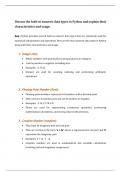
Describe the concept of data types in Python and explain why
they are important in programming.
Ans: Data types in Python refer to the classification of data objects that determine the
type of values they can hold and the operations that can be performed on them. Python
has several built-in data types, such as integers, floats, strings, lists, tuples, dictionaries,
sets, and more.
Data types are crucial in programming because they provide structure and meaning to
the data being manipulated. Following explains the reason why data types are important:
1. Data Integrity: By enforcing specific data types, Python ensures that the data is
stored and processed correctly. For example, using an integer data type ensures
that only whole numbers can be assigned to the variable, preventing accidental
assignments of non-integer values.
2. Memory Allocation: Different data types require varying amounts of memory for
storage. Understanding the data types allows programmers to efficiently allocate
memory resources, optimizing performance and reducing memory usage.
3. Operations and Functions: Each data type supports specific operations and
functions that can be applied to manipulate and process the data. For instance,
mathematical operations are supported by numeric data types, while string
operations are available for manipulating text-based data.
4. Error Prevention: Data types help catch potential errors by providing type
checking. If an operation or function is applied to incompatible data types, Python
will raise a type error, allowing programmers to identify and fix issues early on.
5. Code Readability and Maintainability: Specifying data types in code improves
readability and makes the code more self-explanatory. It helps other developers
they are important in programming.
Ans: Data types in Python refer to the classification of data objects that determine the
type of values they can hold and the operations that can be performed on them. Python
has several built-in data types, such as integers, floats, strings, lists, tuples, dictionaries,
sets, and more.
Data types are crucial in programming because they provide structure and meaning to
the data being manipulated. Following explains the reason why data types are important:
1. Data Integrity: By enforcing specific data types, Python ensures that the data is
stored and processed correctly. For example, using an integer data type ensures
that only whole numbers can be assigned to the variable, preventing accidental
assignments of non-integer values.
2. Memory Allocation: Different data types require varying amounts of memory for
storage. Understanding the data types allows programmers to efficiently allocate
memory resources, optimizing performance and reducing memory usage.
3. Operations and Functions: Each data type supports specific operations and
functions that can be applied to manipulate and process the data. For instance,
mathematical operations are supported by numeric data types, while string
operations are available for manipulating text-based data.
4. Error Prevention: Data types help catch potential errors by providing type
checking. If an operation or function is applied to incompatible data types, Python
will raise a type error, allowing programmers to identify and fix issues early on.
5. Code Readability and Maintainability: Specifying data types in code improves
readability and makes the code more self-explanatory. It helps other developers