

Edexcel A Level Maths - Pure|2023 LATEST UPDATE|GUARANTEED SUCCESS
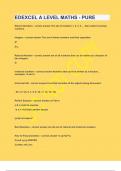
Natural Numbers The set of numbers 1, 2, 3, 4, ... Also called counting numbers. Integers The set of whole numbers and their opposites Z⁺ Z⁺₀ Rational Number set of all numbers that can be written as a fraction of two integers Q irrational numbers Numbers that can't be written as a fraction... examples √2 and π Universal Set A set that includes all the objects being discussed. - Ex: U = {5, 6, 7, 8, 9, 10, 11, 12, 13, 14} Perfect Squares ax²+bx+c a & c must be squares √a x√c =b/2 then perfect square (a+b)²=a²+2ab+b² Real Numbers are the set of rational and irrational numbers How to find parameters 1) a(x+p)²+q 2) sub (-p,q) VERTEX 3) when x=0, y=c 4) rearrange to get a 5) Expand 2(x+p)² to equate to b Quadratics in disguise When one power of x is double the other E.G. x⁶+7x³-8 u=x³ u²+7u-8 solve inflection point Between TP Minimum number: Turning point - 1 (degree - 2) stationary point a point on the function where the slope (derivative) is zero degree - 1 (max) turning point A turning point on a graph is the point on the graph at which the function changes from increasing to decreasing or vice-versa. vertex degree - 1 (max) stationary inflection point degree-2 / 2 Even and odd degree even: opens on same side odd: opens on opposite side Hyperbola Exponential graph Conjecture Mathematical statement yet to be proven true Proof by deduction E.G. Prove sum of odd number are even x=2a+1 y=2b+1 x+y = 2a+2b+2 2(a+b+1) divisible by 2, therefore even proving identities Make LHS look like RHS Proof by exhaustion E.G. Prove no square number ends in 7 Look at all possible values within range that conjecture is true for 1) known theorem: all numbers ending in same digits have square numbers that end in same digit: 4²=16, 14²=196 (end in 6) 2) list: 0²=0, 1²=1, 2²=4, ... 9²=81 3) none end in 7 therefore no square number does Proof by counter example Disprove given statement cannot possibly be correct by showing an instance that contradicts a universal statement Proof by contradiction E.G Prove by contradiction that there is no largest even number 1) Assume it is not true ∴ 2n=L (largest even number) 2) Add 2 L+2 = 2n+2 =2(n+1) 3) This is even and larger than L This is a contradiction to the original assumption, since there is an even number greater than the "largest even number". Hence, the statement is true. Graphs: Axis of symmetry Vertex x= -b/2a (-b/2a, y) y=a(x+p)²+q Graph Transformations f(x)±a f(x+a) f(x-a) Up or down Move left Move right -f(x) E.G. f(x) = 1, -1, 11 Horizontal reflection E.G -f(x)= -1, 1, -11 f(-x) E.G Vertical Reflection E.G. x=-3, -x=3 therefore f(-x)= 3 subbed in 1/a f(x) squashed towards horizontal a f(x) Stretch away from horizontal f(x/a) Stretch away from vertical f(ax) Squash towards vertical 1) Multiply x term first 2) Sub into f(x) Straight lines ax+by+c E.G. y=-5/2x +4/3 y-y₁=m(∞) 1) Multiply by 2 2y=-5x+8/3 2) Multiply by 3 6y=-15x+8 3) Rearrange 6y+15x-8=0 Straight lines y-y₁/y₂-y₁ = x-x₁/x₂-x₁ E.G. (-3, 1) (3, -2) 1) Sub in y-1/-2-1 = x+3/3+3 2) Simplify and rearrange
Document information
- Uploaded on
- June 24, 2023
- Number of pages
- 36
- Written in
- 2022/2023
- Type
- Exam (elaborations)
- Contains
- Questions & answers


