FiCEP- F1900 Financial Counseling Certification Program Exam 100% Solved
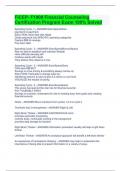
Spending Cycle- 1 - ANSWER-Earn/Spend/Earn paycheck to paycheck SOLUTION: Must deal with habits Divide paycheck into SPECIFIC spending categories Capture $$$ for savings Pay down debt Spending Cycle - 2 - ANSWER-Earn/Spend/Borrow/Spend Rely on debt to establish and maintain lifestyle Have difficulty denying self Confuse wants with needs They believe they deserve it now Spending Cycle - 3 - ANSWER-Earn/Spend/Save CAN save $$$ BUT Savings is a low priority & something always comes up SOLUTION: Persuade to change ways by: Identifying reasons to save & give it a name (i.e car fund) VISUALIZE the results of saving Spending Cycle - 4 - ANSWER-Earn/Save/Spend This group has learned the vital rule for financial security: PAY YOURSELF FIRST Savings is a priority- understand its role in meeting long- term goals and creating financial security GOAL - ANSWER-Move members from cycles 1,2,3 to cycle 4 The Brain has 2 hemispheres - ANSWER-Right & Left Right Brain Thinker - ANSWER-UNCONSCIOUS mind provides automatic processing controls body- continually working in the background provides data storage for reaction Right Brain Thinker - ANSWER-Information presented visually will help a right brain thinker Left Brain Thinker - ANSWER-An analytical approach will benefit a left-brain thinker An awareness of hemispheric thinking: - ANSWER-may help to understand the importance of being able to present information in a variety of ways. Left Brain Thinker - ANSWER-CONSCIOUS mind orderly & systematic center for: processing information provided by the senses -Interprets information -Evaluates situtation -Makes decisions Typically directed w/ focused activity Hard and Soft approaches: - ANSWER-Can be connected to the dominant side of the brain Hard Approach - ANSWER-LEFT Brain Analytical side Communicates in ways that are ORDERLY, SPECIFIC, & STRAIGHT FORWARD Often ASSERTIVE & may sometimes be perceived as AGGRESSIVE REASON & LOGIC tend to dominate the hard approach to communication Soft Approach - ANSWER-RIGHT brain Creative Side Offers POSSIBILITIES & SUGGESTIONS Avoiding absolutes and directives May overcome resistance by using humor, metaphors, or personal stories Offers OPTIONS & OPPORTUNITIES Reminds members that they are in control & the counselor is there to support Relationship w/ self and others - ANSWER-The Johari window helps people understand relationships between themselves and others. Blind zone - ANSWER-Counselors often do their most important work in a member's blind zone 4 Zones of Johari Window - ANSWER-Open Blind Hidden Unknown Johari Window: Open Zone - ANSWER-info that is known to counselor and member Johari Window: Blind Zone - ANSWER-info counselor knows and a member does not (the member is blind to the info) Gradually reduce a member's blind zone by learning more about the member- starting with info about financial habits Counselors help members realize what is in their blind zone Johari Window: Hidden Zone - ANSWER-info the member knows and chooses not to share (the member is hiding the info) As a counselor gains a member's trust, the member usually chooses to reveal private info Johari Window: Unknown - ANSWER-info unknown to self and others Exploring this area is usually the work of psychotherapists, who operate at a level far above financial counseling The Johari Window: - ANSWER-Changes in size as counseling sessions progress/as the counselor and member get to know one another Hiding or revealing information impacts the size of overlapping zones Counseling Types: - ANSWER-Remedial Preventative Productive Remedial Counseling - ANSWER-Helps members cope with debt they cannot afford or poor money management generally when an emergency or shut-off is faced Preventative Counseling - ANSWER-Helps members with good financial habits manage financial challenges due to life changes Can also be used to help prepare for a large purchase- pre-purchase counseling: helps members learn how much they can afford now and to maintain the large purchase Productive Counseling - ANSWER-Helps identify the best way to use resources to improve financial status often need when someone acquires assets counselors often have to refer to other professionals for part of the process: such as for tax or investment advice Counseling Elements - ANSWER-In all 3 types of counseling, the following elements are discussed: Budget Credit Debt Financial Planning Budget - ANSWER-Used to determine how earnings will be allocated -makes it possible to restrain spending so $$$ is available for --living expenses --debt repayment --other short term/long term goals AKA Personal Spending Plan Credit - ANSWER-Manage spending in a way to REBUILD credit &make achieving financial goals possible Debt - ANSWER-Structure properly to improve credit while paying expenses & staying in budget Financial Planning - ANSWER-Make the most of income to accomplish LONG-TERM goals Vital Counselor Skills - ANSWER--Ask perceptive questions -Observe non-verbal clues -Help members assess behaviors & attitudes -Express empathy for members -Assist members to identify needs & wants -Explore money management skills -Assemble a complete financial picture -Develop a workable budget -Gain agreement on a budget & money issues -Suggest workable approaches and potential solutions -Motivate members to implement spending plan -Combine Optimism, enthusiasm, and realism -Assess progress -Offer Confidentiality -Adjust plan as needed -Make referrals when needed -Offer Hope
Written for
- Institution
- FiCEP- F1900
- Course
- FiCEP- F1900
Document information
- Uploaded on
- June 23, 2023
- Number of pages
- 18
- Written in
- 2022/2023
- Type
- Exam (elaborations)
- Contains
- Questions & answers
Subjects
- ficep f1900
- spending cycle 1
- spending cycle 2
- spending cycle 3
-
ficep f1900 financial counseling certification

Also available in package deal