

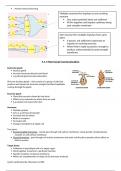
Permits memory/learning
Multiple neurones fire impulses to one receiving
neurone
One action potential alone not sufficient
All fire together and impulse continues along
post synaptic membrane
One neurone fires multiple impulses from same
place
If pauses, not sufficient to generate an
impulse on receiving neurone
When fired in rapid succession, enough to
produce action potential on post-synaptic
membrane
5.1.4 Hormonal Communication
Endocrine gland:
Ductless gland
Secretes hormones directly into blood
e.g adrenal gland secretes adrenaline
They are ductless glands – they consist of a group of cells that
produce and release the hormone straight into blood capillaries
running through the gland.
Exocrine gland:
Gland that secretes chemicals into ducts
Which carry molecules to where they are used
E.g amylase into pancreatic duct
Hormone:
Globular protein
Acts as a chemical messenger
Secreted into the blood
Binds to receptors
On target cells
Changes metabolism of target cell
Two types:
Protein/peptide hormones - cannot pass through cell surface membrane; needs specific complementary
receptor on cell surface membrane
Steroid hormones - pass through cell surface membrane and enter cell directly to produce direct effect on
DNA in nucleus
Target tissue:
Collection of specialized cells of a target organ
Work together to perform a particular function
Specific receptors on plasma membrane
Which are complimentary in shape to the hormone molecule
Insulin synthesized by ribosomes on RER.
, The histology of the pancreas, and outline its role as an endocrine and exocrine gland;
ENDOCRINE function
Islets of Langerhan
Contain two types of cell;
A cells: secrete glucagon
B cells: secrete insulin
Majority of cells in pancreas perform an
EXOCRINE function
Acinar cells (pancreatic cells):
Secrete pancreatic juice into tubules
which join up to make the pancreatic duct
(carries juice to small intestine)
Contains:- digestive enzymes (lipase,
Pancreas as an endocrine gland: amylase, trypsin) and NaHCO3 ions (helps
Hormone released directly into the blood neutralise stomach acid)
B cells secrete insulin
A cells secrete glucagon
Islet of langerhans (a + B cells) monitor blood glucose concentration
Pancreas as an exocrine gland:
Pancreatic juice released into duct
Triggered by nervous/hormonal stimulation
Pancreatic secretions into small intestine
o Contains enzymes lipase, amylase & trypsin
Multiple neurones fire impulses to one receiving
neurone
One action potential alone not sufficient
All fire together and impulse continues along
post synaptic membrane
One neurone fires multiple impulses from same
place
If pauses, not sufficient to generate an
impulse on receiving neurone
When fired in rapid succession, enough to
produce action potential on post-synaptic
membrane
5.1.4 Hormonal Communication
Endocrine gland:
Ductless gland
Secretes hormones directly into blood
e.g adrenal gland secretes adrenaline
They are ductless glands – they consist of a group of cells that
produce and release the hormone straight into blood capillaries
running through the gland.
Exocrine gland:
Gland that secretes chemicals into ducts
Which carry molecules to where they are used
E.g amylase into pancreatic duct
Hormone:
Globular protein
Acts as a chemical messenger
Secreted into the blood
Binds to receptors
On target cells
Changes metabolism of target cell
Two types:
Protein/peptide hormones - cannot pass through cell surface membrane; needs specific complementary
receptor on cell surface membrane
Steroid hormones - pass through cell surface membrane and enter cell directly to produce direct effect on
DNA in nucleus
Target tissue:
Collection of specialized cells of a target organ
Work together to perform a particular function
Specific receptors on plasma membrane
Which are complimentary in shape to the hormone molecule
Insulin synthesized by ribosomes on RER.
, The histology of the pancreas, and outline its role as an endocrine and exocrine gland;
ENDOCRINE function
Islets of Langerhan
Contain two types of cell;
A cells: secrete glucagon
B cells: secrete insulin
Majority of cells in pancreas perform an
EXOCRINE function
Acinar cells (pancreatic cells):
Secrete pancreatic juice into tubules
which join up to make the pancreatic duct
(carries juice to small intestine)
Contains:- digestive enzymes (lipase,
Pancreas as an endocrine gland: amylase, trypsin) and NaHCO3 ions (helps
Hormone released directly into the blood neutralise stomach acid)
B cells secrete insulin
A cells secrete glucagon
Islet of langerhans (a + B cells) monitor blood glucose concentration
Pancreas as an exocrine gland:
Pancreatic juice released into duct
Triggered by nervous/hormonal stimulation
Pancreatic secretions into small intestine
o Contains enzymes lipase, amylase & trypsin


