1.5 Perfect competition,
imperfectly competitive markets
and monopoly
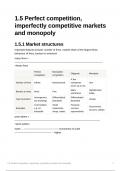
1.5.1 Market structures
Important features include: number of firms, market share of the largest firms,
behaviour of firms, barriers to entry/exit
many firms <
————————————————————————————————————
>fewer firms
Perfect Monopolist
Oligopoly Monopoly
competition competition
A few
Number of firms Infinite Many/several companies One
(norm up to 15)
Many High/blocked
Barriers to entry None Few
restrictions totally
Homogenous Differentiated Differentiated
Type of product Unique
(no branding) (branded) (branded)
Commodities Small Financial
Government,
Examples e.g. oil, restaurants, services,
services, utilities
foodstuffs shops, trades supermarkets
price takers <
———————————————————————————————————
>price setters
lower ←————————————-—— economies of scale
———————————————→ higher
1.5 Perfect competition, imperfectly competitive markets and monopoly 1
,1.5 Perfect competition, imperfectly competitive markets and monopoly 2
, 1.5.2 The objectives of firms
Profit maximisation is assumed to be the main objective for most firms. This allows:
finance for capital investment and research
market entry signals sent to other suppliers
demand for flow of factor resources
signals about the health of the economy.
Different business objectives
Profit maximisation
Sales revenue maximisation
Business growth/ market power (increasing their market share)
Business survival e.g. in a recession
Not for profit social enterprises e.g. charities
State-owned businesses
How firms achieve objectives
Profit maximisation marginal cost = marginal revenue (MC=MR)
Revenue maximisation marginal revenue = 0
Sales maximisation average cost = average revenue (AC=AR)
Satisficing involves the owners of a business (shareholders)
Satisficing behaviour setting minimum acceptable levels of achievement in terms of
revenue and profitability
Business with profits reinvested for social aims - profit, people
Social enterprising
and planet
1.5 Perfect competition, imperfectly competitive markets and monopoly 3
, Profit-maximisation
Between 0 and Q1, MR > MC so
additional revenue from producing
one more unit is greater than the
additional cost, profits could be
increased by raising output - profits
are rising
After Q1, profits are falling as
marginal cost of producing an extra
unit is greater than additional
revenue generated. It would be
better to decrease output. So profit
max is where MC=MR.
Benefits of profit-maximisation
Shareholders benefit from higher dividends, share price increase over time -
making it easier to raise finance in the future
Research and development - may lead to improved quality of service for
consumers
Used to increase barriers to entry to maintain higher profits in the future -
predatory and limit pricing
Employees may receive pay rises
Increased capital investment spending that may benefit other industries such as
construction and engineering (derived demand)
Provides a safety net for businesses in tough times or recession
If a business keeps down it’s costs to raise profits (profit = TR-TC), may be
passed down to consumers resulting in lower prices for consumers
Evaluations
Businesses may not have knowledge of their MC and MR
Greater scrutiny by regulators/competitions authorities if profits are high, leads to
investigations which may result in outcomes that increases costs/lower profits
1.5 Perfect competition, imperfectly competitive markets and monopoly 4
imperfectly competitive markets
and monopoly
1.5.1 Market structures
Important features include: number of firms, market share of the largest firms,
behaviour of firms, barriers to entry/exit
many firms <
————————————————————————————————————
>fewer firms
Perfect Monopolist
Oligopoly Monopoly
competition competition
A few
Number of firms Infinite Many/several companies One
(norm up to 15)
Many High/blocked
Barriers to entry None Few
restrictions totally
Homogenous Differentiated Differentiated
Type of product Unique
(no branding) (branded) (branded)
Commodities Small Financial
Government,
Examples e.g. oil, restaurants, services,
services, utilities
foodstuffs shops, trades supermarkets
price takers <
———————————————————————————————————
>price setters
lower ←————————————-—— economies of scale
———————————————→ higher
1.5 Perfect competition, imperfectly competitive markets and monopoly 1
,1.5 Perfect competition, imperfectly competitive markets and monopoly 2
, 1.5.2 The objectives of firms
Profit maximisation is assumed to be the main objective for most firms. This allows:
finance for capital investment and research
market entry signals sent to other suppliers
demand for flow of factor resources
signals about the health of the economy.
Different business objectives
Profit maximisation
Sales revenue maximisation
Business growth/ market power (increasing their market share)
Business survival e.g. in a recession
Not for profit social enterprises e.g. charities
State-owned businesses
How firms achieve objectives
Profit maximisation marginal cost = marginal revenue (MC=MR)
Revenue maximisation marginal revenue = 0
Sales maximisation average cost = average revenue (AC=AR)
Satisficing involves the owners of a business (shareholders)
Satisficing behaviour setting minimum acceptable levels of achievement in terms of
revenue and profitability
Business with profits reinvested for social aims - profit, people
Social enterprising
and planet
1.5 Perfect competition, imperfectly competitive markets and monopoly 3
, Profit-maximisation
Between 0 and Q1, MR > MC so
additional revenue from producing
one more unit is greater than the
additional cost, profits could be
increased by raising output - profits
are rising
After Q1, profits are falling as
marginal cost of producing an extra
unit is greater than additional
revenue generated. It would be
better to decrease output. So profit
max is where MC=MR.
Benefits of profit-maximisation
Shareholders benefit from higher dividends, share price increase over time -
making it easier to raise finance in the future
Research and development - may lead to improved quality of service for
consumers
Used to increase barriers to entry to maintain higher profits in the future -
predatory and limit pricing
Employees may receive pay rises
Increased capital investment spending that may benefit other industries such as
construction and engineering (derived demand)
Provides a safety net for businesses in tough times or recession
If a business keeps down it’s costs to raise profits (profit = TR-TC), may be
passed down to consumers resulting in lower prices for consumers
Evaluations
Businesses may not have knowledge of their MC and MR
Greater scrutiny by regulators/competitions authorities if profits are high, leads to
investigations which may result in outcomes that increases costs/lower profits
1.5 Perfect competition, imperfectly competitive markets and monopoly 4