MCAT Practice Test #
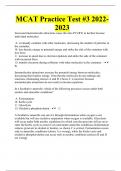
Increased intermolecular attractions cause the ratio PV/(RT) to decline because individual molecules: A. eventually combine with other molecules, decreasing the number of particles in the container. B. lose kinetic energy to potential energy and strike the side of the container with less force. C. increase in speed due to electron repulsion and strike the side of the container with increased force. D. transfer electrons during collisions with other molecules in the container. - B. Intermolecular attractions increase the potential energy between molecules, decreasing their kinetic energy. Note that the molecules do not undergo any reactions, eliminating choices A and D. Choice C is incorrect because intermolecular attractions do not result in electron repulsion. In a facultative anaerobe, which of the following processes occurs under both aerobic and anaerobic conditions? A. Fermentation B. Krebs cycle C. Glycolysis D. Oxidative phosphorylation - C. A facultative anaerobe can survive through fermentation when oxygen is not available but will use oxidative respiration when oxygen is available. Glycolysis will occur under both aerobic conditions (in which case the pyruvate will go on to enter the Krebs cycle as acetyl-CoA) and under anaerobic conditions (fermentation reduces pyruvate to alcohol or lactate), so choice C is correct. Fermentation occurs only in anaerobic conditions (choice A is wrong), while the Krebs cycle and oxidative phosphorylation can occur only in aerobic conditions (choices B and D are wrong). 1-Methylcyclohexanol reacts with HBr to form 1-bromo-1-methylcyclohexane. The mechanism for this reaction is likely to be an: A. SN1 reaction. B. SN2 reaction. C. Nucleophilic addition. D. Addition-elimination. - A. Since no double bonds are formed or broken, this must be a substitution reaction (eliminate choices C and D). Since the hydroxyl in the starting material is on a tertiary carbon atom, the mechanism cannot occur by a bimolecular pathway (eliminate choice B.) The protonated OH group (under acidic conditions) will leave as water to yield a tertiary carbocation, which will be attacked by the bromide ion to give the product. The standard potential for the reaction K+ + e- --> K(s) = -2.93 V, as referenced against 2H+ + 2e- --> arrow H2(set to 0.0 V by definition). If solid potassium is placed into an aqueous solution of HCl, then: A. H2(g) and KCl(aq) are produced. B. Cl2(g) and KCl(aq) are produced. C. Cl2(g), H2(g), and KCl(aq) are produced. D. no reaction occurs. - A. Since the reduction of K+ as given in the question has a potential more negative than the reduction of H+, the oxidation of K(s) to K+ with transfer of electrons to H+ will have a positive potential and be spontaneous. This eliminates choice D. Hydrochloric acid (HCl, a strong acid) will dissociate nearly completely in water into H+ and Cl-. In the presence of a reducing agent (K), H+ ions can accept electrons and be reduced to H2, and K+ and Cl- will remain in solution. Since there is no oxidant which can accept the extra electron from Cl-, Cl2 will not be formed, eliminating choices B and C. An object is floating in a fluid of 1.5 specific gravity. If the volume of the fluid displaced by the floating object is 5 × 10⁻³ m3, what is the object's mass? A. 2.5 kg B. 5.0 kg C. 7.5 kg D. Cannot be determined from the information given - C. Because the object is floating, the object's weight is balanced by the buoyant force; that is, mg = ρfluidVsubg, or, after canceling the g's, m = ρfluidVsub. With ρfluid = 1.5ρH2O = 1500 kg/m3 and Vsub = 5 × 10⁻³ m3, we find that m = ρfluidVsub = (1500 kg/m3)(5 × 10-3 m3) = 7.5 kg Can glucogenic amino acids be converted into glucose? A. Yes: pyruvate and oxaloacetate can be converted directly into glyceraldehyde-3-P, which is a major intermediate in both gluconeogenesis and glycolysis. B. Yes: pyruvate and Krebs cycle intermediates can be converted into oxaloacetate, then phosphoenolpyruvate, which can enter gluconeogenesis. C. No: pyruvate and Krebs cycle intermediates are formed as part of glucose breakdown and this process is important to generate ATP for the cell. D. No: glucose is obtained from the diet and stored in the liver; it cannot be made as a new molecule because cellular respiration has several steps with a -ΔG. - B.
Written for
- Institution
- MCAT
- Course
- MCAT
Document information
- Uploaded on
- June 20, 2023
- Number of pages
- 35
- Written in
- 2022/2023
- Type
- Exam (elaborations)
- Contains
- Questions & answers
Subjects
-
mcat practice test 3 2022 2023

Also available in package deal