THEORY AND METHODS REVISION
Examined in EDUCATION (one 10 marker) and CRIME AND DEVIANCE (one 10
marker, and one 20 marker).
TWO TYPES OF QUESTIONS:
o Outline and explain two... (10 marks)…..
o Applying material from Item C and your own knowledge, evaluate...( 20 marks)
Consensus, conflict, structural and social action theories.
Complete the activities below to prepare for your 20 mark question. You must also review
your 10 mark information from Paper 1 as there is one on this paper too!
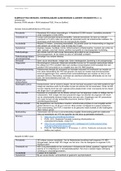
1) Review this table – it shows you what content can be assessed in the 20 mark
question:
For 2-6 complete the following:
a) Read the summary notes and watched the videos as you.
b) Use the information to create a revision resource which includes the following for
each perspective:
- A summary of the perspective
- A summary of the beliefs of the key researchers/thinkers
- A summary of the strengths of the perspective
- A summary of the weaknesses of the perspective
- A summary of examples from contemporary society which demonstrate the
relevance of the theory (you can use examples from education, crime, media
and/or health)
, - A summary of examples from contemporary society which demonstrate the
lack of relevance of the theory (you can use examples from education, crime,
media and/or health)
- A summary of how the perspective differs to others
2) STRUCTURAL CONSENSUS THEORY 1: FUNCTIONALISM
I n a nut shell : Functionalism is a structural perspective that views social order as
based on value consensus. Parsons believes society is a system of independent parts,
in which the function of each part is to help meet the needs of the system.
Individuals are integrated into the system through socialisation and social control.
Or ganic analo gy : Parsons identifies the similarities between society and a
biological organism: SYSTEM - Organisms and societies are both self-regulating
system of interrelated parts that fit together in fixed ways. In the body, these are
cells whereas in society these are institutions (education system, government etc).
SYSTEM NEEDS - Organisms have needs (e.g. nutrition), if these needs are not met,
the organism will die. Functionalists see the social system as having basic needs (E.g.
adequate socialisation) to maintain social order and survive. FUNCTIONS - The
function for any system is based on the contribution it makes to meeting the system
needs, which ensures its survival.
V A L UE CONS E NS US & SOC IAL OR D ER : Social order is achieved through a
shared culture in a ‘central value system’. A culture is a set of norms, values, beliefs
and goals shared by members of society, that provides the framework for
cooperation between individuals, and allows them to define general goals, norms
and values for society. Social order is only possible if we conform to such norms and
values. Parsons calls this value consensus.
I NTE GR A TION OF IND IVID UA LS : The system has two basic mechanisms for
ensuring individuals conform to shared norms and meet systems needs:
SOCIALISATION - The social system can ensure its needs are met by teaching
individuals to internalise the norms and values through socialisation. Agents of
socialisation include family, education system, media and religion. SOCIAL CONTROL
- Positive sanctions reward conformity, negative ones punish deviance. (E.g. the
value system stresses individual achievement through educational success, those
who conform are rewarded with degrees).
S YS TE M NE ED S : ADAPTATION - The social system meets its members’ material
needs through the economic sub-system. GOAL ATTAINMENT - Society needs to set
goals and allocate resources to achieve them. This is the function of the political sub-
system, through institutions such as parliament. INTERGRATION - The different parts
of the system must be integrated together to pursue shared goals. This is the role of
the sub-system of religion, education and media. LATENCY - Refers to the processes
that maintain society over time. The kinship sub-system provides pattern
maintenance (socialising individuals to perform societies roles) and tension
management (a place to relieve stresses after work).
S OC IA L CH A NGE : Parsons identifies the two types of society (traditional and
modern): TRADITIONAL SOCIETY - Ascribed status - status based on fixed traits by
virtue of existence (e.g. royal family). Collective orientation - putting the group need
before the individual need. Diffuseness - relationships are broad with a wide range of
functions. Particularism - norms emphasise treating people differently through
Examined in EDUCATION (one 10 marker) and CRIME AND DEVIANCE (one 10
marker, and one 20 marker).
TWO TYPES OF QUESTIONS:
o Outline and explain two... (10 marks)…..
o Applying material from Item C and your own knowledge, evaluate...( 20 marks)
Consensus, conflict, structural and social action theories.
Complete the activities below to prepare for your 20 mark question. You must also review
your 10 mark information from Paper 1 as there is one on this paper too!
1) Review this table – it shows you what content can be assessed in the 20 mark
question:
For 2-6 complete the following:
a) Read the summary notes and watched the videos as you.
b) Use the information to create a revision resource which includes the following for
each perspective:
- A summary of the perspective
- A summary of the beliefs of the key researchers/thinkers
- A summary of the strengths of the perspective
- A summary of the weaknesses of the perspective
- A summary of examples from contemporary society which demonstrate the
relevance of the theory (you can use examples from education, crime, media
and/or health)
, - A summary of examples from contemporary society which demonstrate the
lack of relevance of the theory (you can use examples from education, crime,
media and/or health)
- A summary of how the perspective differs to others
2) STRUCTURAL CONSENSUS THEORY 1: FUNCTIONALISM
I n a nut shell : Functionalism is a structural perspective that views social order as
based on value consensus. Parsons believes society is a system of independent parts,
in which the function of each part is to help meet the needs of the system.
Individuals are integrated into the system through socialisation and social control.
Or ganic analo gy : Parsons identifies the similarities between society and a
biological organism: SYSTEM - Organisms and societies are both self-regulating
system of interrelated parts that fit together in fixed ways. In the body, these are
cells whereas in society these are institutions (education system, government etc).
SYSTEM NEEDS - Organisms have needs (e.g. nutrition), if these needs are not met,
the organism will die. Functionalists see the social system as having basic needs (E.g.
adequate socialisation) to maintain social order and survive. FUNCTIONS - The
function for any system is based on the contribution it makes to meeting the system
needs, which ensures its survival.
V A L UE CONS E NS US & SOC IAL OR D ER : Social order is achieved through a
shared culture in a ‘central value system’. A culture is a set of norms, values, beliefs
and goals shared by members of society, that provides the framework for
cooperation between individuals, and allows them to define general goals, norms
and values for society. Social order is only possible if we conform to such norms and
values. Parsons calls this value consensus.
I NTE GR A TION OF IND IVID UA LS : The system has two basic mechanisms for
ensuring individuals conform to shared norms and meet systems needs:
SOCIALISATION - The social system can ensure its needs are met by teaching
individuals to internalise the norms and values through socialisation. Agents of
socialisation include family, education system, media and religion. SOCIAL CONTROL
- Positive sanctions reward conformity, negative ones punish deviance. (E.g. the
value system stresses individual achievement through educational success, those
who conform are rewarded with degrees).
S YS TE M NE ED S : ADAPTATION - The social system meets its members’ material
needs through the economic sub-system. GOAL ATTAINMENT - Society needs to set
goals and allocate resources to achieve them. This is the function of the political sub-
system, through institutions such as parliament. INTERGRATION - The different parts
of the system must be integrated together to pursue shared goals. This is the role of
the sub-system of religion, education and media. LATENCY - Refers to the processes
that maintain society over time. The kinship sub-system provides pattern
maintenance (socialising individuals to perform societies roles) and tension
management (a place to relieve stresses after work).
S OC IA L CH A NGE : Parsons identifies the two types of society (traditional and
modern): TRADITIONAL SOCIETY - Ascribed status - status based on fixed traits by
virtue of existence (e.g. royal family). Collective orientation - putting the group need
before the individual need. Diffuseness - relationships are broad with a wide range of
functions. Particularism - norms emphasise treating people differently through