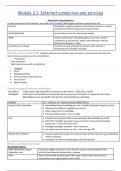
Module 2.1: Internet connection and services
Internet connections:
In order to connect to the internet, you need an ISP as well as what type of internet connection to use.
Internet Worldwide computer network, consisting of computers, devices
and networks linked using communication media
World Wide Web service that runs on the internet eg. Google
WAN network spread over wide geographical area (city, country,
continent) e.g. businesses + shops, bank networks, internet
(Global Area Network - GAN)
IoT (Internet of Things) Trend for all sorts of things to connect to the internet
monitored and controlled remotely
Internet service provider (ISP): Company that has a permanent, fast connection to the internet and that sells
internet access and services for a monthly fee
Permanent
- Fast connection
- Sells internet access for a monthly fee
Services:
• Email
• Webpage hosting
• Wired/ wireless internet access
• Fax-to-email
• Spam filtering
Criteria for types of internet connections:
Broadband - a high speed, high bandwidth connection to the internet - ADSL/Fibre, 3G/4G
Bandwidth - total amount of data that can be transferred from one point to another in a given period of time
(Kbps/Mbps); more bandwidth allocated for downloading than uploading
Mobility Yes – wireless; no – fixed connection (ADSL/ fibre)
Speed of line/connection • Speed determines on package you use + number of people using the service
• Measured in kilobits or megabits per second
• ADSL ranges from 2 to 40 Mbps
• Fibre has fastest speed - max is 1 Gbps
Cap: • Limited amount of data that can be uploaded/ downloaded per month
• Most ISP’s throttle/ slow down your connection if you are downloading
excessively each ISP has an AUP
• Uncapped packages available = more expensive
• Can add to your cap if you run out – cost more per GB
Shaped and unshaped • Shaped: preference is given to certain services on the internet e.g. downloading,
emails, browsing
• Unshaped: all internet services given the same priority
Wired vs wireless connections:
Wired (ADSL/Fibre):
ADSL (Asymmetric Digital Permanent digital connection to the internet using a normal telephone line
Subscriber Line) Split into two channels: phone calls + internet
Fibre Data is transmitted along thin glass fibre tubes. Much faster than electrical
transmission over copper cables used in ADSL.
, Cost:
Monthly ISP cost depending on data package; also pay a fixed monthly cost for line rental
Advantages Disadvantages
• ADSL - cheaper connections than cellular • ADSL affected by electrical interference
connections • ADSL more prone to theft as it has copper
• ADSL and Fibre - more stable connections than • ADSL speed drops as you get further from telephone
cellular connections exchange
• Fibre - faster, cheaper, more stable connection than
ADSL or cellular; can span further distances; not
affected by electrical interference
Wireless connections (cellular technology):
• 4G/3G/LTE
• 3G or 4G dongle on a desktop / laptop to connect to cellular network for internet access
• Smartphone / tablet used as a personal WiFi hotspot to connect other devices to the internet using data bundle
• Wireless connections prone to ‘piggy-backing’ – other ppl using your internet bandwidth or access w/o your
knowledge (use strong passwords)
Advantages Disadvantages
• Mobile access to the internet, using a mobile device • Need to limit amount of data you use
• May have slow access if an area has poor cellular
coverage
• Can never escape communication and results in
information overload
WiFi: way of connecting to an existing ADSL or Fibre connection wirelessly
- Small area of coverage – hotspot
- WiFi at a public hotspot can provide cheaper or free access
- Can use ADSL / Fibre router (built in WiFi adapter) to create own WiFi network – mobile devices can used faster,
cheaper internet access provided by fixed line
- Password needed the first time you connect a device to WiFi
- Device also detects other WiFi networks
*BOYD (bring your own device): allowed to bring your own device to school/work and can connect to school/
company network using WiFi
Internet access using smartphones and tablets:
People prefer data communications that is:
• Always on and everywhere; never without connection: traditional computing devices (wait to boot up/ wake
from sleep, plug in modem) vs mobile devices
• Fast and reliable: don’t have to wait for data
• Hassle free connection
How does it work
Most mobile devices have built in 3G or 4G cellular technology and the hardware to connect to any standard WiFi
network
o Connect to internet using cellular technology whenever cellphone signal is available
o Automatically switch over to a WiFi connection whenever one is available
WiFi vs cellular
o Usually only an issue for tablets - models with WiFi only are less expensive than cellular enabled one
o Makes more sense to get a model with cellular data - so you can access the internet wherever you are
Internet connections:
In order to connect to the internet, you need an ISP as well as what type of internet connection to use.
Internet Worldwide computer network, consisting of computers, devices
and networks linked using communication media
World Wide Web service that runs on the internet eg. Google
WAN network spread over wide geographical area (city, country,
continent) e.g. businesses + shops, bank networks, internet
(Global Area Network - GAN)
IoT (Internet of Things) Trend for all sorts of things to connect to the internet
monitored and controlled remotely
Internet service provider (ISP): Company that has a permanent, fast connection to the internet and that sells
internet access and services for a monthly fee
Permanent
- Fast connection
- Sells internet access for a monthly fee
Services:
• Webpage hosting
• Wired/ wireless internet access
• Fax-to-email
• Spam filtering
Criteria for types of internet connections:
Broadband - a high speed, high bandwidth connection to the internet - ADSL/Fibre, 3G/4G
Bandwidth - total amount of data that can be transferred from one point to another in a given period of time
(Kbps/Mbps); more bandwidth allocated for downloading than uploading
Mobility Yes – wireless; no – fixed connection (ADSL/ fibre)
Speed of line/connection • Speed determines on package you use + number of people using the service
• Measured in kilobits or megabits per second
• ADSL ranges from 2 to 40 Mbps
• Fibre has fastest speed - max is 1 Gbps
Cap: • Limited amount of data that can be uploaded/ downloaded per month
• Most ISP’s throttle/ slow down your connection if you are downloading
excessively each ISP has an AUP
• Uncapped packages available = more expensive
• Can add to your cap if you run out – cost more per GB
Shaped and unshaped • Shaped: preference is given to certain services on the internet e.g. downloading,
emails, browsing
• Unshaped: all internet services given the same priority
Wired vs wireless connections:
Wired (ADSL/Fibre):
ADSL (Asymmetric Digital Permanent digital connection to the internet using a normal telephone line
Subscriber Line) Split into two channels: phone calls + internet
Fibre Data is transmitted along thin glass fibre tubes. Much faster than electrical
transmission over copper cables used in ADSL.
, Cost:
Monthly ISP cost depending on data package; also pay a fixed monthly cost for line rental
Advantages Disadvantages
• ADSL - cheaper connections than cellular • ADSL affected by electrical interference
connections • ADSL more prone to theft as it has copper
• ADSL and Fibre - more stable connections than • ADSL speed drops as you get further from telephone
cellular connections exchange
• Fibre - faster, cheaper, more stable connection than
ADSL or cellular; can span further distances; not
affected by electrical interference
Wireless connections (cellular technology):
• 4G/3G/LTE
• 3G or 4G dongle on a desktop / laptop to connect to cellular network for internet access
• Smartphone / tablet used as a personal WiFi hotspot to connect other devices to the internet using data bundle
• Wireless connections prone to ‘piggy-backing’ – other ppl using your internet bandwidth or access w/o your
knowledge (use strong passwords)
Advantages Disadvantages
• Mobile access to the internet, using a mobile device • Need to limit amount of data you use
• May have slow access if an area has poor cellular
coverage
• Can never escape communication and results in
information overload
WiFi: way of connecting to an existing ADSL or Fibre connection wirelessly
- Small area of coverage – hotspot
- WiFi at a public hotspot can provide cheaper or free access
- Can use ADSL / Fibre router (built in WiFi adapter) to create own WiFi network – mobile devices can used faster,
cheaper internet access provided by fixed line
- Password needed the first time you connect a device to WiFi
- Device also detects other WiFi networks
*BOYD (bring your own device): allowed to bring your own device to school/work and can connect to school/
company network using WiFi
Internet access using smartphones and tablets:
People prefer data communications that is:
• Always on and everywhere; never without connection: traditional computing devices (wait to boot up/ wake
from sleep, plug in modem) vs mobile devices
• Fast and reliable: don’t have to wait for data
• Hassle free connection
How does it work
Most mobile devices have built in 3G or 4G cellular technology and the hardware to connect to any standard WiFi
network
o Connect to internet using cellular technology whenever cellphone signal is available
o Automatically switch over to a WiFi connection whenever one is available
WiFi vs cellular
o Usually only an issue for tablets - models with WiFi only are less expensive than cellular enabled one
o Makes more sense to get a model with cellular data - so you can access the internet wherever you are