Section 2 : Inorganic Chemistry
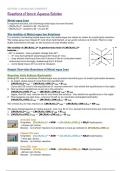
Reactions of Ions in Aqueous Solution
Metal-aqua Ions
In aqueous solution, the following metal-aqua ions are formed:
• [M(H2O)6]2+, limited to M = Fe and Cu
• [M(H2O)6]3+, limited to M = Al and Fe
The Acidity of Metal-aqua Ion Solutions
In a solution containing metal-aqua ions, the metal-aqua ion reacts w/ water in a hydrolysis reaction.
The metal-aqua ions release H+ ions when hydrolysed, so an acidic solution is formed. There is only
slight dissociation though, so the solution is only weakly acidic.
The acidity of [M(H2O)6]3+ is greater than that of [M(H2O)6]2+
because…
• M3+ is smaller + has a greater charge than M2+.
• ∴ 3+ ions have greater polarising power than 2+ ions.
• ∴ they attract electrons from the O atoms of the co-ordinated water
molecules more strongly, weakening the O-H bond.
• ∴ more likely that a H+ ion will be released.
Simple Test-tube Reactions of Metal-aqua Ions
Reaction with Sodium Hydroxide
Adding OH- ions to solutions of metal-aqua ions produces insoluble ppt.s of metal hydroxides because…
1. In water, metal-aqua 3+ ions form the equilibrium:
[M(H2O)6]3+(aq) ⇌ [M(H2O)5(OH)]2+(aq) + H+(aq)
If you add OH- ions to the equilibrium H+ ions are removed - this shifts the equilibrium to the right.
2. Now another equilibrium is set up in the solution:
[M(H2O)5(OH)]2+(aq) ⇌ [M(H2O)4(OH)2]+(aq) + H+(aq)
Again, the OH- ions remove the H+ ions from the solution - this shifts the equilibrium to the right.
3. This happens one last time - now you’re left w/ an insoluble uncharged hydroxide:
[M(H2O)4(OH)2]+(aq) ⇌ [M(H2O)3(OH)3](s) + H+(aq)
The overall eq. for this reaction is: [M(H2O)6]3+(aq) ⇌ [M(H2O)3(OH)3](s) + 3H+(aq)
The same thing happens w/ metal-aqua 2+ ions (e.g. Fe or Cu), except this time there are only 2 steps:
1. [M(H2O)6]2+(aq) ⇌ [M(H2O)5(OH)]+(aq) + H+(aq)
2. [M(H2O)5(OH)]+(aq) ⇌ [M(H2O)4(OH)2](s) + H+(aq)
Iron(II) ions:
Dropwise: [Fe(H2O)6]2+ + 2OH- → [Fe(H2O)4(OH)2] + 2H2O (hydrolysis)
• Green ppt. forms.
Excess: no further reaction but darkens in time as oxidised to [Fe(H2O)3(OH)3]
Copper(II) ions:
Dropwise: [Cu(H2O)6]2+ + 2OH- → [Cu(H2O)4(OH)2] + 2H2O (hydrolysis)
• Blue ppt. forms.
Excess: no further reaction.
Iron(III) ions:
Dropwise: [Fe(H2O)6]3+ + 3OH- →[Fe(H2O)3(OH)3] + 3H2O (hydrolysis)
•Brown ppt. forms.
Excess: no further reaction.
Reactions of Ions in Aqueous Solution
Metal-aqua Ions
In aqueous solution, the following metal-aqua ions are formed:
• [M(H2O)6]2+, limited to M = Fe and Cu
• [M(H2O)6]3+, limited to M = Al and Fe
The Acidity of Metal-aqua Ion Solutions
In a solution containing metal-aqua ions, the metal-aqua ion reacts w/ water in a hydrolysis reaction.
The metal-aqua ions release H+ ions when hydrolysed, so an acidic solution is formed. There is only
slight dissociation though, so the solution is only weakly acidic.
The acidity of [M(H2O)6]3+ is greater than that of [M(H2O)6]2+
because…
• M3+ is smaller + has a greater charge than M2+.
• ∴ 3+ ions have greater polarising power than 2+ ions.
• ∴ they attract electrons from the O atoms of the co-ordinated water
molecules more strongly, weakening the O-H bond.
• ∴ more likely that a H+ ion will be released.
Simple Test-tube Reactions of Metal-aqua Ions
Reaction with Sodium Hydroxide
Adding OH- ions to solutions of metal-aqua ions produces insoluble ppt.s of metal hydroxides because…
1. In water, metal-aqua 3+ ions form the equilibrium:
[M(H2O)6]3+(aq) ⇌ [M(H2O)5(OH)]2+(aq) + H+(aq)
If you add OH- ions to the equilibrium H+ ions are removed - this shifts the equilibrium to the right.
2. Now another equilibrium is set up in the solution:
[M(H2O)5(OH)]2+(aq) ⇌ [M(H2O)4(OH)2]+(aq) + H+(aq)
Again, the OH- ions remove the H+ ions from the solution - this shifts the equilibrium to the right.
3. This happens one last time - now you’re left w/ an insoluble uncharged hydroxide:
[M(H2O)4(OH)2]+(aq) ⇌ [M(H2O)3(OH)3](s) + H+(aq)
The overall eq. for this reaction is: [M(H2O)6]3+(aq) ⇌ [M(H2O)3(OH)3](s) + 3H+(aq)
The same thing happens w/ metal-aqua 2+ ions (e.g. Fe or Cu), except this time there are only 2 steps:
1. [M(H2O)6]2+(aq) ⇌ [M(H2O)5(OH)]+(aq) + H+(aq)
2. [M(H2O)5(OH)]+(aq) ⇌ [M(H2O)4(OH)2](s) + H+(aq)
Iron(II) ions:
Dropwise: [Fe(H2O)6]2+ + 2OH- → [Fe(H2O)4(OH)2] + 2H2O (hydrolysis)
• Green ppt. forms.
Excess: no further reaction but darkens in time as oxidised to [Fe(H2O)3(OH)3]
Copper(II) ions:
Dropwise: [Cu(H2O)6]2+ + 2OH- → [Cu(H2O)4(OH)2] + 2H2O (hydrolysis)
• Blue ppt. forms.
Excess: no further reaction.
Iron(III) ions:
Dropwise: [Fe(H2O)6]3+ + 3OH- →[Fe(H2O)3(OH)3] + 3H2O (hydrolysis)
•Brown ppt. forms.
Excess: no further reaction.