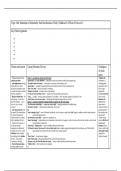
Topic: Ode: Intimations of Immortality from Recollections of Early Childhood by William Wordsworth
Key Points/Arguments
Themes and context Literary/Dramatic Devices Techniques
of whole
poem
- Temporal tension between Stanza 1 – personal loss and sensory deprivation - Pindaric ode
past/present/future ‘Immortality’ and ‘early childhood’ – immediately asserts tension between sublime and common place (celebratory of
- Anti-enlightenment theology ‘The child is father of the man’ – verb produces an inversion of the formative years something public
implies life to be a linear ‘natural piety’ – searching for natural harmonies and continuity between his former and present self and grand) in form
progression, Romantics invest ‘There was a time’ – personal loss/long for something but is trying to
so much into memory and time ‘freshness of a dream’ – ironically evokes a clear memory grapple with
that they complicate it ‘it is not now as it hath been of yore;’ – separates line into past fullness and recent loss something universal
- Roussean Primitivism – ‘the ‘I may…/…or day’ – rhyming couplet and trimetre of six syllables – shows an abrupt, unequivocal indication of loss (which is more
noble savage’, we are boon ‘which I have seen I can see no more’ – blends sight and insight and negates the loss of youth Horatian ode) –
pure but corrupted… ‘man is Stanza 2 – perspective clouded by feelings and this is projected onto the environment childhood has a
born free, but is chained ‘The Moon doth with delight…/…waters on a starry night’ – sweeping statements with childish rhyme deeper sense of
anywhere’ ‘hast past away glory’ – expresses beauty undercutting, morose lines connection between
- Late Spring festivals evoke S3 past/present/future
the pastoral. He acknowledges ‘came a thought of grief’ – sense of Romantic individuality, revels in sadness, couplet with ‘relief’ suggests a sudden reversal in mental processes than an adult (turns
the world of harmony but (structurally lightens mood) upon the self)
loathes himself for not being ‘give themselves up to jollity’ – openness to surrender to joy - Follows rhyme
able to participate fully in it. ‘shouts, thou happy’ – stained undertone to exclamation, on the surface level suggests a wish to be more socially involved, and also a wish to break scheme (ABAB) and
- W believes in the power of from melancholic introspection fundamentally
recollection through ‘Child of joy’, ‘Shepherd-boy’ – returns to childhood (Roussean Primitivism) dialectical, which
imagination to refashion the ‘Ye blessed creatures, I have heard / Ye to each other make; I see – anaphora suggests participation but from a distance, cut off from blissful forms a conflict with
memories of ones life.. Grand nature despite lexical cluster of the senses (reinforced by medial caesurae) antistrophe/strophe
Pantheistic claim: children S4 (arguably the
have feelings for the Sublime ‘I hear, I hear’ – visceral sensory language rhythm of thought)
at birth – divine natural ‘both of them speak’- anthropomorphising the free and the field (personification)
connection to all things ‘the pansy at my feet/ Doth the dame tale repeat:’ – trimetre couplet, declarative unswearving manner
- Natural Supernaturalism – ‘Whither is fled’ – didn’t fade but actively separated
theology applied to nature S5
Key Points/Arguments
Themes and context Literary/Dramatic Devices Techniques
of whole
poem
- Temporal tension between Stanza 1 – personal loss and sensory deprivation - Pindaric ode
past/present/future ‘Immortality’ and ‘early childhood’ – immediately asserts tension between sublime and common place (celebratory of
- Anti-enlightenment theology ‘The child is father of the man’ – verb produces an inversion of the formative years something public
implies life to be a linear ‘natural piety’ – searching for natural harmonies and continuity between his former and present self and grand) in form
progression, Romantics invest ‘There was a time’ – personal loss/long for something but is trying to
so much into memory and time ‘freshness of a dream’ – ironically evokes a clear memory grapple with
that they complicate it ‘it is not now as it hath been of yore;’ – separates line into past fullness and recent loss something universal
- Roussean Primitivism – ‘the ‘I may…/…or day’ – rhyming couplet and trimetre of six syllables – shows an abrupt, unequivocal indication of loss (which is more
noble savage’, we are boon ‘which I have seen I can see no more’ – blends sight and insight and negates the loss of youth Horatian ode) –
pure but corrupted… ‘man is Stanza 2 – perspective clouded by feelings and this is projected onto the environment childhood has a
born free, but is chained ‘The Moon doth with delight…/…waters on a starry night’ – sweeping statements with childish rhyme deeper sense of
anywhere’ ‘hast past away glory’ – expresses beauty undercutting, morose lines connection between
- Late Spring festivals evoke S3 past/present/future
the pastoral. He acknowledges ‘came a thought of grief’ – sense of Romantic individuality, revels in sadness, couplet with ‘relief’ suggests a sudden reversal in mental processes than an adult (turns
the world of harmony but (structurally lightens mood) upon the self)
loathes himself for not being ‘give themselves up to jollity’ – openness to surrender to joy - Follows rhyme
able to participate fully in it. ‘shouts, thou happy’ – stained undertone to exclamation, on the surface level suggests a wish to be more socially involved, and also a wish to break scheme (ABAB) and
- W believes in the power of from melancholic introspection fundamentally
recollection through ‘Child of joy’, ‘Shepherd-boy’ – returns to childhood (Roussean Primitivism) dialectical, which
imagination to refashion the ‘Ye blessed creatures, I have heard / Ye to each other make; I see – anaphora suggests participation but from a distance, cut off from blissful forms a conflict with
memories of ones life.. Grand nature despite lexical cluster of the senses (reinforced by medial caesurae) antistrophe/strophe
Pantheistic claim: children S4 (arguably the
have feelings for the Sublime ‘I hear, I hear’ – visceral sensory language rhythm of thought)
at birth – divine natural ‘both of them speak’- anthropomorphising the free and the field (personification)
connection to all things ‘the pansy at my feet/ Doth the dame tale repeat:’ – trimetre couplet, declarative unswearving manner
- Natural Supernaturalism – ‘Whither is fled’ – didn’t fade but actively separated
theology applied to nature S5