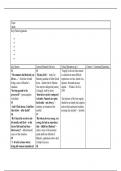
Topic: Lines Written in Early Spring by William Wordsworth
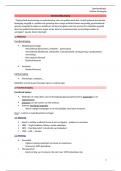
Key Points/Arguments
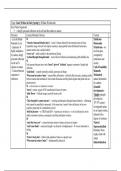
A deeply personal reflection on the self and the relation to nature
Structure Literary/Dramatic Devices Context
- Lyrical Ballad/ S1 Pantheism
Romantic Lyric ‘I heard a thousand blended notes’ – lyrical I situates himself in the moment (spots of time) – Rousseuian
- Quatrains hyperbolic image with soft verb implies seamless, imperceptible fusion (Pantheism harmonises Primitivism – we
highly meditative separate entities into a unified whole) are born pure,
‘sweet/ sad’ – subtle conflict in the antithetical diction
by nature, deeply corrupted by
‘reclined/thoughts/thoughts/mind’ – lexical filed of reflection and alternating (AB) childlike line
personal reflection S2 institutions and
on the self’s Feels present but past tense verbs ‘heard’ ‘grieved’ ‘declined’ suggests a moment of insight and society
relation to nature reflection Cult of Sensibility
- Tension between ‘Link/think’ – enjamb (internally unified), permeates all things Romantic
experience + ‘What man has made of man’ – monosyllabic alliteration – artificial effect (no punc), making conflict Melancholy –
reflection between natural and mechanical. Nod towards Rousseau and being both singular and plural nods to a natural fascination
greater picture. for sadness
S3 – consciousness is ubiquitous in nature Scientific
‘bower,’ comma, organic NOT manufactured closure of nature developments –
‘faith/ flower’ – biblical imagery and soft fricative allit Vitalist principle
S4 developed in
‘Their thoughts I cannot measure:’ – resisting mechanisation through human relations – celebrating
18th/19th century –
what cannot be quantified or measured. At the same time ‘cannot’ shows deficiency in his own
cognitive grasp (part of a mechanised society) investigated nature
‘thrill of pleasure’ – to THEM and HIM – vicarious joy in their joy – so he is deficient due to his as an organic nature,
subtle resentment/ jealousy, meaning he cant fully participate in nature. imbued with a
S5 degree of sentience
‘catch the breezy air’ – contrast between motion of nature and stasis of speaker Natural
‘And I must think’ – conscious thought is an obstacle to Enlightenment – W is more interested in Supernaturalism –
feeling Romantic Poets
S6 replace God with
‘Nature’s holy plan’ – biblical and capitalises Nature as a proper noun nature
‘What man has made of man?’ – fundamentally dialectical Industrialisation
Key Points/Arguments
A deeply personal reflection on the self and the relation to nature
Structure Literary/Dramatic Devices Context
- Lyrical Ballad/ S1 Pantheism
Romantic Lyric ‘I heard a thousand blended notes’ – lyrical I situates himself in the moment (spots of time) – Rousseuian
- Quatrains hyperbolic image with soft verb implies seamless, imperceptible fusion (Pantheism harmonises Primitivism – we
highly meditative separate entities into a unified whole) are born pure,
‘sweet/ sad’ – subtle conflict in the antithetical diction
by nature, deeply corrupted by
‘reclined/thoughts/thoughts/mind’ – lexical filed of reflection and alternating (AB) childlike line
personal reflection S2 institutions and
on the self’s Feels present but past tense verbs ‘heard’ ‘grieved’ ‘declined’ suggests a moment of insight and society
relation to nature reflection Cult of Sensibility
- Tension between ‘Link/think’ – enjamb (internally unified), permeates all things Romantic
experience + ‘What man has made of man’ – monosyllabic alliteration – artificial effect (no punc), making conflict Melancholy –
reflection between natural and mechanical. Nod towards Rousseau and being both singular and plural nods to a natural fascination
greater picture. for sadness
S3 – consciousness is ubiquitous in nature Scientific
‘bower,’ comma, organic NOT manufactured closure of nature developments –
‘faith/ flower’ – biblical imagery and soft fricative allit Vitalist principle
S4 developed in
‘Their thoughts I cannot measure:’ – resisting mechanisation through human relations – celebrating
18th/19th century –
what cannot be quantified or measured. At the same time ‘cannot’ shows deficiency in his own
cognitive grasp (part of a mechanised society) investigated nature
‘thrill of pleasure’ – to THEM and HIM – vicarious joy in their joy – so he is deficient due to his as an organic nature,
subtle resentment/ jealousy, meaning he cant fully participate in nature. imbued with a
S5 degree of sentience
‘catch the breezy air’ – contrast between motion of nature and stasis of speaker Natural
‘And I must think’ – conscious thought is an obstacle to Enlightenment – W is more interested in Supernaturalism –
feeling Romantic Poets
S6 replace God with
‘Nature’s holy plan’ – biblical and capitalises Nature as a proper noun nature
‘What man has made of man?’ – fundamentally dialectical Industrialisation