

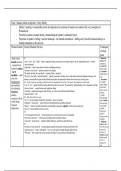
Topic: Stanzas written in dejection – Percy Shelley
- Shelley’s tendency to unnaturally elevate his disposition, his extremes of emotion are central to the very conception of
Romanticism.
- Powerful evocation of natural beauty, demonstrating the speaker’s alienation from it
- Projection of speaker’s feeling’s onto the landscape – the internal externalised – shifting away from the localised setting to a
broader rumination on the universe.
Themes/Context Literary/Dramatic Devices Techniques
of whole
poem
- Shelly lived a S1 - Spenserian
‘warm’, ‘clear’, ‘fast’, ‘bright’ – nature in superficial nature, poet portrays conventional tropes so he can compound them later – conflicts stanzas with
nomadic existence
‘snowy mountains’ interlinking
– rusticated from ABABBCBCC
‘might/ light’ – rhyme creates picture of nature as delighting and open
Oxford for atheism rhyme scheme
‘like many a voice of one’ – pronouns connect to the singular and couplets in
- Age of ‘The winds, the birds, the ocean floods’ – asyndetic listing – simplicity middle and end
Sensibility – a drift ‘The City’s voice itself, is soft like Solitude’s’ – plurally evocations In business, tries to make urban natural and emphasises harmony with lines.
away from sibilance, caesura holds line apart and then blends them together, the personified solitude shows universal joy of being alone - Alexandrine
Enlightenment S2 – no direct reference to speaker in the first stanza, the anaphoristic (I see/I see/ I sit) asserts his relation to external world (12 syllable
preoccupations ‘I see’ x2 ‘I sit’ – speaker forcefully inserting himself into the action of poem contrasted by ‘lighting/flashing’, due to transparency of light iambic adapted
‘showers, thrown:’ – caesura fractures and complicates things from French
with rationality heroic verse) in
Pantheism – ‘ocean/tone/ - enjambement suggests nature flowing, yet a sense of powerful/uncontrolled danger
final line.
seamless ‘measured motion’ – allit - Conflict
S3 – shifts from natural to social between highly
connection with all
‘nor’ x5 – rep and asyndetic listing shows pessimism – focuses on lacking spirited motion
worldly things ‘meditation’, ‘inward glory’ – tension between individual/particular and public/communal and a pervasive
Temporal ‘Others I’ – collective and individual held in uncomfortable juxtaposition, solipsistic (world revolves around you) sense of rest =
displacement ‘they live’- pronoun detaches him from society symbolic
S4 projection of
speaker’s
‘Yet now despair itself is mild ‘ – he has harmonised w/ environment but not how he anticipated
feelings onto the
‘borne and yet must bear’ – rooted in past, anticipating future perpetual weakness landscape
‘warm/cold/’, ‘last monotony’ – simplistic/childish dichotomy, aestheticizes death like Keats - Ambiguous
S5 syntax in these
‘lost heart, too soon grown old’ – unnatural aging, temporal displacement with past/present/future verbs lines offers some
‘stainless glory set’ – links to ‘untrampled’ – loves to evoke negative thoughts through slight positivity hope for the
‘Will linger’ – feels at odds with society and nature but hopes to create a presence through absence recovery of
identity through
public memory
even as it
expresses its
loss.
- Shelley’s tendency to unnaturally elevate his disposition, his extremes of emotion are central to the very conception of
Romanticism.
- Powerful evocation of natural beauty, demonstrating the speaker’s alienation from it
- Projection of speaker’s feeling’s onto the landscape – the internal externalised – shifting away from the localised setting to a
broader rumination on the universe.
Themes/Context Literary/Dramatic Devices Techniques
of whole
poem
- Shelly lived a S1 - Spenserian
‘warm’, ‘clear’, ‘fast’, ‘bright’ – nature in superficial nature, poet portrays conventional tropes so he can compound them later – conflicts stanzas with
nomadic existence
‘snowy mountains’ interlinking
– rusticated from ABABBCBCC
‘might/ light’ – rhyme creates picture of nature as delighting and open
Oxford for atheism rhyme scheme
‘like many a voice of one’ – pronouns connect to the singular and couplets in
- Age of ‘The winds, the birds, the ocean floods’ – asyndetic listing – simplicity middle and end
Sensibility – a drift ‘The City’s voice itself, is soft like Solitude’s’ – plurally evocations In business, tries to make urban natural and emphasises harmony with lines.
away from sibilance, caesura holds line apart and then blends them together, the personified solitude shows universal joy of being alone - Alexandrine
Enlightenment S2 – no direct reference to speaker in the first stanza, the anaphoristic (I see/I see/ I sit) asserts his relation to external world (12 syllable
preoccupations ‘I see’ x2 ‘I sit’ – speaker forcefully inserting himself into the action of poem contrasted by ‘lighting/flashing’, due to transparency of light iambic adapted
‘showers, thrown:’ – caesura fractures and complicates things from French
with rationality heroic verse) in
Pantheism – ‘ocean/tone/ - enjambement suggests nature flowing, yet a sense of powerful/uncontrolled danger
final line.
seamless ‘measured motion’ – allit - Conflict
S3 – shifts from natural to social between highly
connection with all
‘nor’ x5 – rep and asyndetic listing shows pessimism – focuses on lacking spirited motion
worldly things ‘meditation’, ‘inward glory’ – tension between individual/particular and public/communal and a pervasive
Temporal ‘Others I’ – collective and individual held in uncomfortable juxtaposition, solipsistic (world revolves around you) sense of rest =
displacement ‘they live’- pronoun detaches him from society symbolic
S4 projection of
speaker’s
‘Yet now despair itself is mild ‘ – he has harmonised w/ environment but not how he anticipated
feelings onto the
‘borne and yet must bear’ – rooted in past, anticipating future perpetual weakness landscape
‘warm/cold/’, ‘last monotony’ – simplistic/childish dichotomy, aestheticizes death like Keats - Ambiguous
S5 syntax in these
‘lost heart, too soon grown old’ – unnatural aging, temporal displacement with past/present/future verbs lines offers some
‘stainless glory set’ – links to ‘untrampled’ – loves to evoke negative thoughts through slight positivity hope for the
‘Will linger’ – feels at odds with society and nature but hopes to create a presence through absence recovery of
identity through
public memory
even as it
expresses its
loss.


